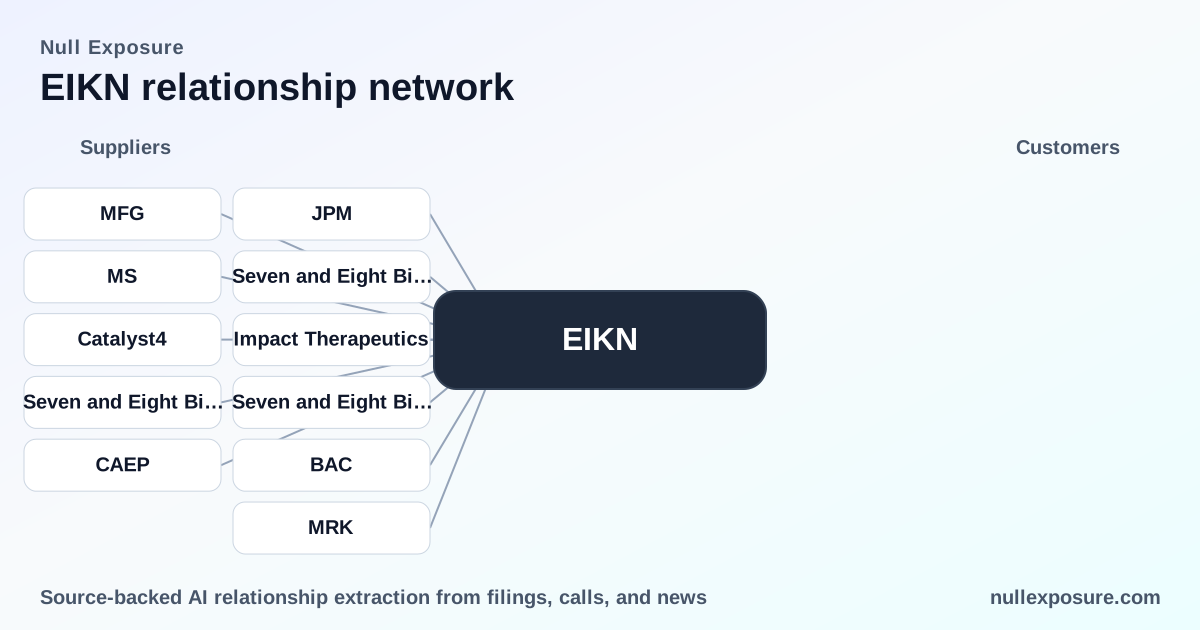
EIKN: Institutional Holders, Commercial Relationships, and What Investors Should Read Into Them
Eikon Therapeutics is a clinical-stage biopharmaceutical company that operates a discovery-to-clinic research engine and monetizes primarily through upstream value creation — equity markets, milestone-bearing partnerships, and future licensing or product revenues rather than current product sales. The company’s public profile shows zero revenue trailing twelve months and a negative EBITDA, making capital access and partner relationships primary drivers of valuation for the foreseeable horizon. For relationship-level tracking and portfolio signals, see https://nullexposure.com/.
What the ETF and institutional listings actually reveal about customer-like relationships
Institutional listings and ETF holdings are not commercial customers in the classical sense, but they are important signals about investor appetite and market distribution of the equity. Two distinct institutional holdings surfaced in public ETF listings that include Eikon Therapeutics.
BlackRock, Inc. (iShares Health Innovation Active ETF)
BlackRock’s iShares Health Innovation Active ETF lists a holding in Eikon Therapeutics on the ETF’s public holding page, indicating that EIKN is included in an actively managed healthcare exposure vehicle as of May 2, 2026. This placement signals that at least some large-scale active managers view Eikon as a tradeable way to access health-innovation exposure rather than a traditional corporate customer relationship. (Source: TradingView ETF listings for NASDAQ:EIKN, May 2, 2026.)
T. Rowe Price Group, Inc. (T. Rowe Price Health Care ETF)
T. Rowe Price’s healthcare ETF also lists Eikon Therapeutics as a position on the same public ETF holdings snapshot, showing additional institutional inclusion in sector portfolios as of May 2, 2026. The presence in T. Rowe’s health-care ETF reinforces the narrative that EIKN trades as an early-stage biotech play inside thematic and active-health funds. (Source: TradingView ETF listings for NASDAQ:EIKN, May 2, 2026.)
Why these institutional holdings matter for investors evaluating relationships
- Distribution and liquidity: Inclusion in large active ETFs increases the float available to institutional managers and can improve tradeability in moments of price stress. That is relevant for investors assessing exit windows and volatility.
- Signaling vs. revenue linkage: These are investor holdings rather than commercial customers; they signal market positioning and sentiment, not direct commercial validation of therapeutic candidates.
- Concentration implications: Multiple active managers holding the shares reduces single-manager concentration risk in liquidity, but does not substitute for diversified commercial revenue streams.
For a deeper look at how institutional holdings intersect with corporate relationship risk, visit https://nullexposure.com/.
Operating model and business-model characteristics investors must internalize
Eikon’s public fundamentals frame a classic early-stage biotech profile and set clear constraints on how relationships function in practice.
- Contracting posture — capital and partner dependent. With RevenueTTM = $0 and negative operating metrics (latest reported EBITDA of approximately –$295.6M and EPS –6.54 TTM), Eikon’s commercial posture is that of a research vendor/partner seeker rather than a revenue-generating supplier. Contract formation with downstream customers (licensors, collaborators) will be driven by scientific milestones and non-dilutive or milestone-based economics rather than product sales today. (Company profile, latest quarter 2025-12-31.)
- Concentration — equity-holder distribution, not customer concentration. Institutional ownership sits at roughly 35.9% with insiders at 15.5% of shares outstanding, which is a meaningful ownership mix for governance and financing outcomes; the ETF holdings above further diversify investor ownership but do not create operating revenue concentration. (Company profile.)
- Criticality — high scientific value, low current revenue dependency. The firm’s value to potential partners is scientific platform upside and candidate pipeline; for end customers (patients, payers) the company currently contributes no commercial product, so criticality is directional and contingent — valuable if clinical readouts succeed, non-critical in day-to-day commercial markets today.
- Maturity — pre-commercial, capital markets reliant. Market capitalization (~$556M) combined with zero revenue and negative profitability metrics marks EIKN as pre-commercial and dependent on financing rounds, equity markets, and licensing deals to fund operations and de-risk pipelines. This maturity profile shapes contracting terms and negotiating leverage with potential partners.
These characteristics should guide how investors evaluate any reported relationship: treat institutional holdings as market signals and any announced collaboration as the primary route to future revenue.
Relationship-by-relationship checklist (practical investor view)
- BlackRock, Inc.: Holding appears in BlackRock’s iShares Health Innovation Active ETF listing (TradingView holdings snapshot, May 2, 2026), signaling active-manager exposure rather than commercial partnership.
- T. Rowe Price Group, Inc.: Listed in the T. Rowe Price Health Care ETF holding page (TradingView holdings snapshot, May 2, 2026), confirming additional active-manager allocation to Eikon shares.
Each of the above entries is a holdings disclosure on ETF pages and should be read as an ownership/distribution signal rather than evidence of a supplier-customer contract or revenue stream. (Source for both: TradingView ETF listings for NASDAQ:EIKN, May 2, 2026.)
Investment implications: risks and opportunity vectors
- Upside is binary and science-driven. The primary upside pathway is successful clinical/proof-of-concept readouts or a value-accretive licensing deal; equity positions held by ETFs make the stock accessible to thematic buyers, which can amplify rallies on positive news.
- Downside is financing and execution risk. Zero revenue and heavy negative cash flow position the company to require further equity or deal-based financing; dilution and financing timing are principal downside drivers.
- Market signals are not commercial validation. Institutional ETF positions increase liquidity and can smooth trading, but they do not substitute for revenue-generating partnerships; investors must prioritize announced collaborations, clinical milestones, and cash runway.
- Governance and influence. With ~36% institutional ownership and roughly 15.5% insider ownership, investor stewardship and future capital decisions will reflect a balance between professional managers and insider alignment.
Practical next steps for analysts and operators
- Monitor announced collaborations and milestone terms closely; those will convert the current investor interest into tangible revenue pathways and materially affect valuation.
- Track cash runway and capital-raising cadence; with current negative EBITDA and zero sales, capital access is the single most material operational constraint.
- Use institutional holdings as a liquidity and sentiment input, not a proxy for commercial validation.
For systematic relationship tracking and alerts that tie institutional holdings to partnership announcements, browse relationship analytics at https://nullexposure.com/.
Conclusion: Eikon is a prototypical pre-revenue biotech where market distribution via ETFs and institutional holders supports liquidity and investor access but does not change the fundamental risk profile — clinical progress and financing events will determine whether these investor relationships convert into commercial value.