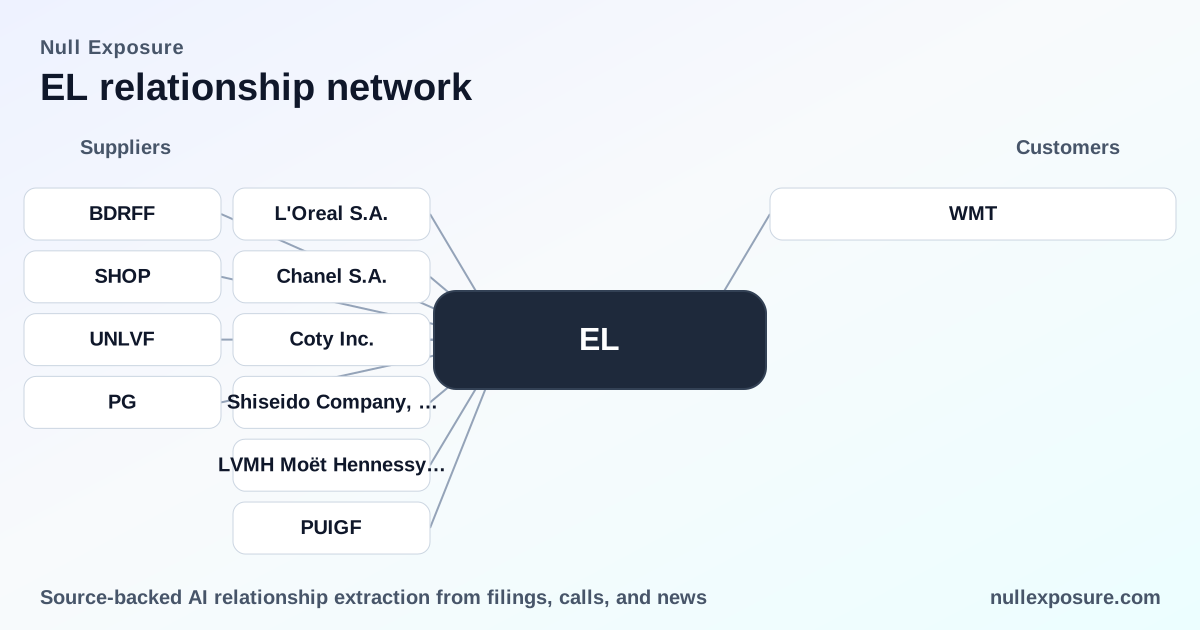
Estee Lauder’s Customer Map: Where revenue actually flows and which partners matter to investors
Estee Lauder Companies (EL) monetizes a portfolio of prestige beauty brands through a mix of direct-to-consumer retail, wholesale distribution to department and specialty retailers, and licensing arrangements that generate royalty streams. The company operates globally with a majority of sales outside the U.S., and its economics reflect a hybrid model: high-margin brand equity plus channel-dependent variability driven by wholesale partners, travel retail, and online platforms. For investors and operators, the key question is concentration and control — which customers are critical revenue conduits, which partnerships are contractual and mature, and where counterparty or channel risk can compress margins.
Learn more on strategy and relationship analytics at https://nullexposure.com/
How EL’s commercial engine works in plain terms
Estee Lauder sells finished products through two primary routes: wholesale to retailers and distributors, and direct channels including freestanding stores and brand.com sites. Wholesale pricing and channel mix vary by brand and geography; the company also licenses the TOM FORD trademark and other IP to third parties for eyewear and fashion, capturing royalty income in addition to product sales. Fiscal context: EL reported roughly $14.83B in trailing revenue and maintains substantial international exposure, with Mainland China and the United States among its largest markets (latest quarter ending March 31, 2026).
The customer relationships that shape revenue (one-by-one review)
Walmart / WMT — large-box distribution and a legal flashpoint
Estée Lauder filed suit against Walmart in FY2026 alleging that counterfeit beauty products were sold on Walmart.com and that the marketplace failed to prevent unauthorized sellers from listing products, an action that underscores the company's insistence on authorized distribution control and brand protection. Sources: WWD reported the complaint on March 9, 2026, and CNBC covered the litigation in early February 2026.
Sephora — specialty retail as a strategic channel for premium brands
Sephora is cited as a core premium retail partner where fast-growing brands like Rhode have achieved leading status in North America and the U.K., illustrating Sephora’s role in scaling new prestige labels for EL. Source: Tikr blog coverage (first seen May 2, 2026) noting Rhode’s performance at Sephora.
Zegna (ZGN) — an explicit licensing counterparty for TOM FORD
Zegna Group is a long-term licensee of Estée Lauder for TOM FORD men’s and women’s fashion and accessories, reflecting EL’s active licensing program that generates royalties with guaranteed minimums. This partnership demonstrates EL’s ability to monetize brand IP beyond core beauty products. Source: CityBiz article on March 10, 2026; company filings describe the royalty-based licensing structure.
Ulta (ULTA) — specialty retail pivot and distribution focus
Ulta is named among the faster-growing specialty channels EL is prioritizing as the company reduces department store exposure; management is reallocating focus to Ulta and other specialty and digital channels in FY2026 restructuring actions. Source: Sahm Capital updates (May 1, 2026) summarizing EL’s staffing reductions and channel strategy.
Amazon (AMZN) — platform expansion and digital scale
Amazon is referenced as a key platform for entering new markets and scaling EL’s online growth, with digital personalization cited as an enabler for marketplace-driven expansion efforts. Source: TradingView commentary (May 2, 2026) highlighting platform and AI-driven market entry.
Tmall (BABA) — Asia marketplace presence and China exposure
Tmall is called out alongside Amazon as a channel for EL to reach new geographies, supporting the company’s significant Asia/Pacific revenue base and its broader global e‑commerce strategy. Source: TradingView commentary (May 2, 2026).
Kohl’s (KSS) — wholesale placement and brand extensions in mass channels
Kohl’s is referenced in relation to Sephora’s shop-in-shops inside Kohl’s stores (e.g., MAC Cosmetics availability in 850 Sephora-at-Kohl’s locations), indicating indirect distribution benefits for EL brands placed at specialty counters within mass-retail footprints. Source: USA Today reporting on Kohl’s store initiatives (March 18, 2026).
Operating model constraints and what they imply for investors
The public record and recent coverage identify several company-level constraints that define EL’s contracting posture, concentration risks, and commercial maturity:
- Licensing is a deliberate revenue stream: EL operates licensing agreements (e.g., TOM FORD eyewear and fashion) that are royalty-based with guaranteed minimums; licensing is a mature, contractually governed line of revenue that diversifies earnings beyond product sales.
- Global footprint with regional concentration: EL is truly global — operating in roughly 150 countries — but a meaningful share of online and in-store sales are concentrated in Mainland China, the U.S., and the U.K., creating geographic sensitivity to travel retail and regional retail trends.
- Hybrid seller and wholesaler posture: The company acts both as a seller (direct-to-consumer through stores and brand websites) and as a wholesaler to department stores, specialty retailers, and online pure-plays; this mix increases distribution complexity and exposes EL to partner-level execution risk.
- Channel concentration and strategic shifts: Management is actively reallocating resources away from department stores toward specialty and digital channels (Ulta, Sephora, Amazon, TikTok Shop), a structural change that reduces reliance on legacy wholesale but increases dependence on a smaller set of specialty partners during the transition.
- Maturity and contract discipline: Licensing and wholesale agreements are long‑standing and documented in filings; EL enforces distribution controls vigorously (as evidenced by litigation against Walmart) to protect pricing and brand integrity.
These constraints translate into a predictable commercial posture: strong contractual control over licensing, moderate concentration in a handful of regions and retail partners, and evolving channel mix that shifts both risk and opportunity.
What investors should watch next
- Brand distribution risk vs. margin protection: Litigation with large marketplaces signals EL’s willingness to defend pricing and authenticity rather than tolerate dilution of brand equity through unauthorized retail channels.
- Channel mix execution: The planned shift from department stores to specialty and digital channels will determine margin recovery and growth cadence; watch Ulta, Sephora, Amazon, and Tmall sales trends for early signals.
- Licensing royalties as a ballast: Licensing arrangements like TOM FORD provide structural, recurring royalties; any renegotiation or termination risk would be financially visible and contractually constrained.
For a deeper read on partner-level exposures and how they affect EL’s commercial risk profile, visit https://nullexposure.com/
Bold takeaway: Estee Lauder’s revenue is diversified across global channels and contractual licensing, but concentrated exposure to a small set of retail platforms and regions makes partner execution and marketplace control the principal operational risks for investors.