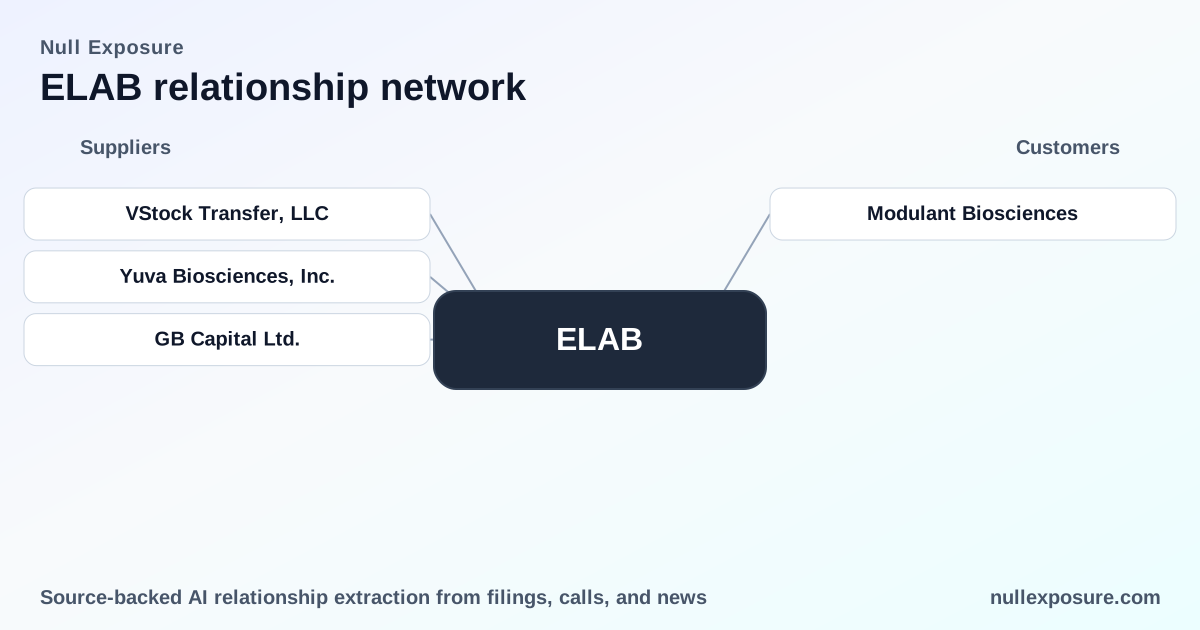
ELAB Customer Map: Who Pays the Bills and What That Means for Investors
Elevai Labs, Inc. (Ticker: ELAB) generates revenue by selling consumer products (skincare) and executing commercial agreements and licensing arrangements that can provide non-recurring cash inflows; the company acts as the principal seller on those contracts and is concentrated geographically in the United States with limited Canadian operations. Investors should treat ELAB as a small-cap, high-volatility operator with early-stage revenue and recurring operational losses, where near-term valuation will be driven by discrete customer contracts, licensing monetization and opportunistic financing. For a systematic tracker of ELAB’s reported commercial relationships and public filings, visit https://nullexposure.com/.
Quick financial context every investor needs
ELAB’s latest public figures show revenue of $590k (TTM), a negative gross profit of $1.03M, and a tiny market capitalization (about $10.4M). These metrics frame all customer relationships: the company depends on a small number of commercially meaningful transactions and occasional licensing or capital raises to sustain operations rather than broad-based recurring revenue.
What the public record lists as ELAB’s customer and partner relationships
Below I cover each relationship item surfaced in public reporting and news articles. Each entry is a concise, plain-English summary with the cited source.
Modulant Biosciences / Modulant Biosciences LLC
Modulant is listed in news coverage as a counterparty to licensing activity tied to ELAB-derived assets: NorthStrive (a third party) executed an exclusive, royalty-bearing license with Modulant for EL-22 and EL-32 assets for animal health applications, which implies ELAB’s IP has been moved down a commercial channel via licensing. Source: GlobeNewswire press release reporting ELAB’s 2025 results and Form 10‑K commentary (Mar 30, 2026) — https://www.globenewswire.com/news-release/2026/03/30/3264501/0/en/PMGC-Holdings-Inc-NASDAQ-ELAB-Reports-2025-Annual-Results-and-Files-Form-10-K-Company-Expands-Asset-Base-to-13-8M-a-43-Increase-from-2024.html.
Related coverage noting the same licensing context also appeared in market news (StockTwits, Mar 9, 2026) discussing patent and licensing flow — https://stocktwits.com/news-articles/markets/equity/why-elab-stock-rising-northstrive-patent-filings/cZRkGTAR4Dc/amp.
Turbo-Jet Products Co. / Turbo-Jet Products Co., Inc.
Turbo‑Jet appears across multiple articles as a customer of subsidiaries in the broader corporate group tied to ELAB/PMGC: reports indicate long-term supply agreements for aerospace and defense components with PMGC subsidiaries (SVM Machining, AGA Precision Systems), documented as one of several commercial contracts in 2026. The references show operational revenue channels in precision manufacturing rather than core skincare, suggesting ELAB’s group has diverse industrial supply relationships. Source: Investing.com coverage of PMGC equity-line and subsidiary contracts (May 2026) — https://uk.investing.com/news/company-news/univest-securities-closes-40m-equity-line-for-pmgc-holdings-93CH-4620828 and https://www.investing.com/news/company-news/univest-securities-closes-40m-equity-line-for-pmgc-holdings-93CH-4627660; additional treatment in INTELLECTIA.ai and SahmCapital reporting (Apr–May 2026) — https://intellectia.ai/news/stock/pmgc-holdings-stock-experiences-extreme-volatility and https://www.sahmcapital.com/news/content/why-pmgc-holdings-stock-is-falling-friday-2026-04-10.
Streeterville Capital
ELAB announced plans to raise approximately $4.6M through a common stock offering to Streeterville Capital, indicating short-term capital sourcing from an institutional buyer rather than revenue. That transaction is material to liquidity and dilution considerations for shareholders. Source: StockstoTrade coverage of ELAB financing (Apr 2026) — https://stockstotrade.com/news/pmgc-holdings-inc-elab-news-2026_04_07/.
AGA Precision Systems / SVM Machining (as referenced)
While the relationship entries are labeled under Turbo‑Jet in the news feed, several reports explicitly name AGA Precision Systems and SVM Machining—PMGC subsidiaries—as the entities that secured long-term supply agreements with Turbo‑Jet, evidencing that the corporate group operates manufacturing supply lines that generate customer revenue outside skin‑care. Source: Industry news summaries and investing coverage noting subsidiary contracts (Apr–May 2026) — see Investing.com and INTELLECTIA.ai pieces cited above.
How to read these relationships into ELAB’s operating model
Treat the above relationships as transaction-driven revenue events rather than evidence of broad recurring demand. Three company-level signals from public filings and descriptions are important:
- Geography (U.S.-centric operations with limited Canadian support): The company conducts most operations in the United States, with a small Canadian research subsidiary providing limited support. This concentrates regulatory, supply-chain and market risk inside North America and highlights exposure to U.S. regulatory and commercial cycles.
- Relationship role (ELAB as principal seller): Public language defines the company as the principal when providing products to customers, meaning ELAB carries fulfillment, inventory and warranty exposure rather than being a pure reseller or agent. That increases operating leverage and operational complexity for each commercial win.
- Segment (core product = skincare): The company reports that revenue is generated through the sale of skincare products, indicating consumer-product economics (unit margin, inventory, distribution) rather than SaaS-style recurring revenue — an important distinction for modeling future margin improvement.
Each of these signals influences contracting posture, concentration and maturity: ELAB’s contracts will be operationally critical (fulfillment required), concentrated (few large transactions and financing events), and reflect an early-stage commercial maturity where one or two deals can materially affect near-term financials.
Investment implications — risks and upside
- Risk: cash runway and dilution. The Streeterville common offering is clear evidence ELAB needs capital; equity financings will drive dilution if the company cannot convert licensing or supply contracts into profitable recurring revenue.
- Risk: negative unit economics today. Negative gross profit on reported TTM figures signals immediate pressure on margins—operational improvements or higher-margin licensing revenues must materialize to move the P&L.
- Opportunity: licensing lever for non-core assets. The EL-22/EL-32 licensing pathway (Modulant / NorthStrive chain) shows ELAB can monetize IP through royalty-bearing arrangements that reduce near-term capex and operational burden while producing non-dilutive long-term revenue.
- Operational complexity: diversified group-level activity. Manufacturing supply contracts through PMGC subsidiaries (SVM Machining, AGA Precision) create revenue diversity but also complicate investor models by mixing consumer skincare economics with aerospace/defense manufacturing cash flows.
For an ongoing tracker of ELAB’s public commercial relationships and filings, check our coverage at https://nullexposure.com/.
Bottom line
ELAB is a small-cap company whose near-term valuation will be largely determined by a handful of commercial contracts, selective licensing outcomes and intermittent financing transactions. Investors should treat reported relationships as discrete cash events that reduce operational risk only if they scale into repeatable revenue streams or generate royalty income without additional capital drain. Monitor licensing receipts and gross-margin trends closely; those two variables will govern whether current agreements convert into sustainable value.