Electra Battery Materials (ELBM): Relationship-led value with concentrated commercial anchors
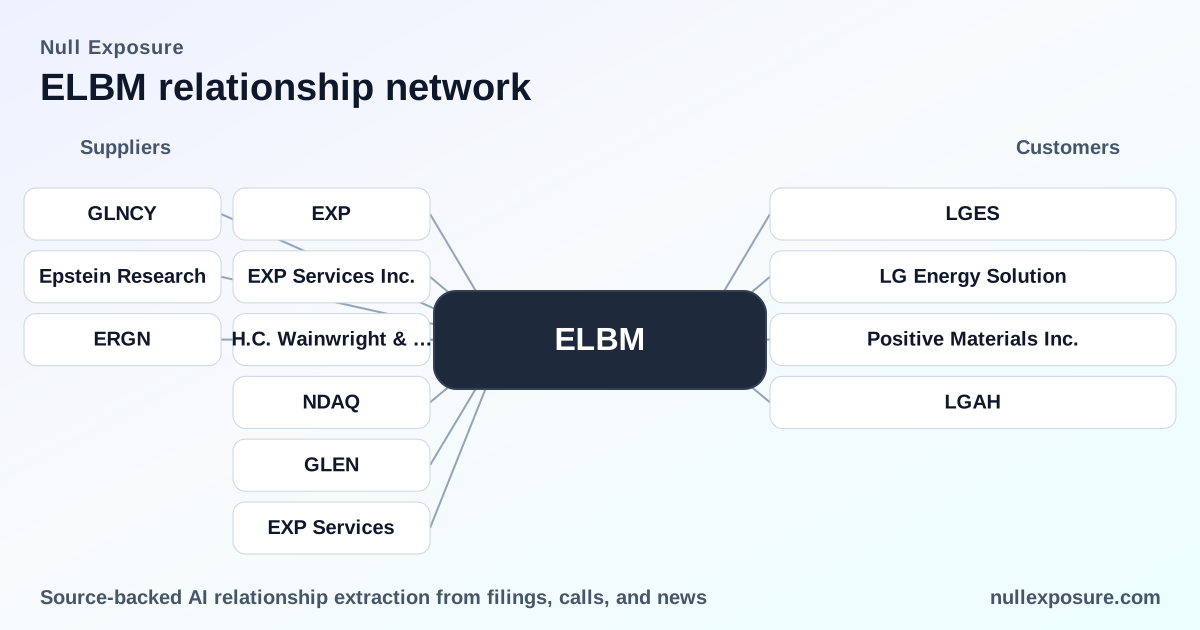
Electra Battery Materials builds and will monetize North American cobalt refining capacity by selling battery-grade cobalt sulfate and through tolling/offtake arrangements with large battery manufacturers and domestic cathode makers. Revenue visibility for the near-term refinery is driven by a long-term commercial framework with LG Energy Solution and emerging supply cooperation with Positive Materials Inc.; Electra is still pre-revenue and capital-dependent while it transitions into production. For a wider map of counterparty exposure and commercial terms, visit https://nullexposure.com/.
Why relationships are the asset, not only the plant
Electra’s business model is not a commodity miner’s free market sale of metal; it is a project-first, relationship-driven refinery play. The company secures construction financing and de-risks output through tolling and offtake frameworks that promise steady offtake for refined cobalt sulfate once commissioning completes. That commercial posture gives Electra structured demand but also creates customer concentration and counterparty dependency—central considerations for investors evaluating upside versus execution and credit risk.
- Contracting posture: Long-term term sheets and tolling arrangements with a major battery maker grant forward demand visibility and tie plant economics to partner volumes and pricing dynamics.
- Concentration: Public disclosures show a major portion of initial output under a framework with one buyer, which concentrates commercial risk.
- Criticality: Battery-grade cobalt sulfate is a strategic, high-value input for cathode manufacturing and EV battery supply chains, which elevates Electra’s strategic importance to buyers and potential pricing power on contracted volumes.
- Maturity: Electra is in the construction-to-commissioning phase; financials show negative EBITDA and no reported revenues, so the company’s execution timeline and funding cadence are the primary short-term drivers.
What the LG relationship actually is — the commercial anchor
LG Energy Solution is Electra’s principal commercial partner. Electra signed a binding term sheet in March 2026 that updates a long-term supply framework for battery-grade cobalt from Electra’s Ontario refinery, and the company describes a separate long-term tolling framework under which LG would account for roughly 60% of initial production during the first five years of operations. According to coverage by Investing News (March 6, 2026) and subsequent press reporting (March 2026), LG’s engagement is structured as both an offtake/tolling anchor and a cornerstone commercial commitment that underpins project economics. (Sources: Investing News, March 2026; Markets Business Insider / Globe and Mail reporting, March 2026.)
Positive Materials — a domestic downstream tie-up
Electra has also executed a supply chain cooperation agreement with Positive Materials Inc., a Canadian precursor cathode active material (pCAM) manufacturer, to evaluate a commercial and technical partnership for Electra’s cobalt sulfate product. This framework targets North American value capture by linking refinery output to domestic cathode production, and was described in Electra’s 2025–2026 press cycle and supporting news coverage. (Sources: Investing News / GlobeNewswire coverage, late 2025–early 2026.)
Complete customer roster and one-line takeaways
Below are every customer relationship mentioned in the available reporting; each entry is summarized in plain English with a concise source reference.
-
LG Energy Solution — Electra has a binding term sheet (dated March 6, 2026) to supply battery-grade cobalt from its Ontario refinery and a long-term tolling framework that is expected to consume approximately 60% of the refinery’s initial output across the first five years. This relationship is the project’s commercial anchor and accounts for the majority of early production under disclosed terms. (Source: Electra press coverage reported by Investing News and corroborating March 2026 business press, including Markets Business Insider and The Globe and Mail.)
-
Positive Materials Inc. — Electra signed a supply chain cooperation agreement to evaluate commercial and technical integration between Electra’s cobalt sulfate and Positive Materials’ pCAM production, targeting a North American supply relationship for downstream cathode feedstock. This is an early-stage domestic partnership intended to broaden the refinery’s customer base beyond global OEMs. (Source: Electra announcements and press distribution reported via Investing News and GlobeNewswire, late 2025–early 2026.)
Financial and execution context that shapes the relationship risk/reward
Electra’s capital structure and operating results frame how valuable those relationships are in practice. The company is pre-revenue on filings aggregated through FY2025/FY2026, with negative EBITDA and negative EPS, and a modest market capitalization (c. $62M as of the latest public snapshot). That financial posture means:
- Counterparty contracts are existential: The LG term sheet and tolling framework provide the primary credible path to cash flow once the refinery is commissioned, making these contracts critical to valuation.
- Concentration amplifies execution risk: With a single partner expected to take the bulk of initial volumes, any renegotiation, delay, or counterparty credit issue would have outsized effects on Electra’s near-term revenue and refinancing options.
- Project execution is the immediate catalyst: Construction budgets and financing rounds reported in the press determine whether the company transitions to the stable, contracted cash flows envisaged in its commercial framework; earlier coverage references capital raises and approved construction budgets that support the next phase. (Source: CruxInvestor and broader March 2026 reporting.)
Investment implications: what to watch next
- Track commissioning milestones and the company’s ability to hit construction schedule and cost targets; these are the bridge from agreements to revenue.
- Monitor incremental commercialization: movement from “term sheet/cooperation agreement” language to binding offtake contracts with price and volume schedules.
- Watch balance sheet actions: refinancing, equity raises, or strategic investors will determine dilution risk and the runway for completion.
- Evaluate LG’s finalized footprint in the offtake/tolling contract over time—public reporting signals an initial ~60% of output but contains signs LG adjusted its share as market prices evolved. (Source: Northern Ontario Business, May 2026.)
Bottom line for investors
Electra’s valuation and near-term cash flow profile are relationship-driven: the LG Energy Solution binding term sheet and tolling framework provide the critical commercial backbone, while Positive Materials represents a tactical domestic downstream opportunity. The investment case is binary in the short run—successful project execution and conversion of commercial frameworks into revenue will re-rate the company; execution shortfalls or counterparty renegotiations will compress value rapidly. For strategic relationship mapping and deeper counterparty analysis, see https://nullexposure.com/.