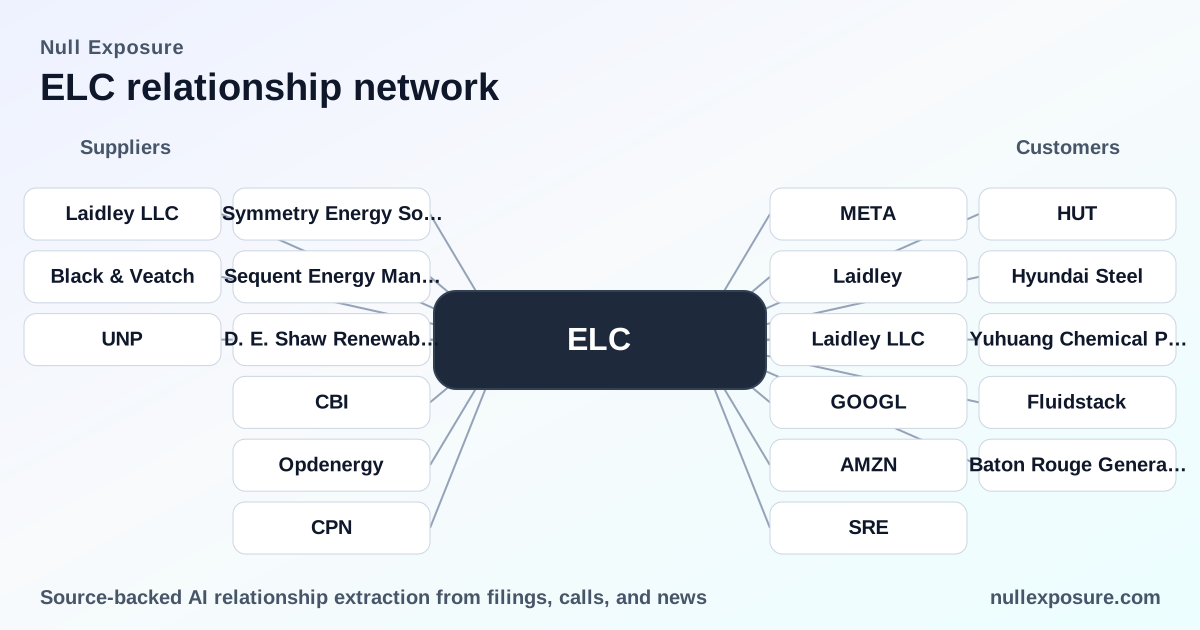
Entergy Louisiana (ELC) — Customer Relationships and Strategic Implications for Investors
Entergy Louisiana (ELC) operates as a regulated utility that generates, transmits and distributes electricity across Louisiana and parts of the region, monetizing through rate-regulated retail sales and long-term contractual arrangements with large commercial and industrial customers. Recent activity demonstrates a deliberate commercial strategy: capture outsized load from hyperscale and industrial customers through bespoke long-term agreements while passing build-costs and some capital recovery through regulatory frameworks. For detailed coverage and monitoring of ELC customer exposures, visit Null Exposure.
Quick investment thesis
ELC’s revenue profile is dominated by regulated retail sales and large-enterprise contracts that fund major generation and transmission additions. The company secures predictable cash flows via regulatory approval of cost recovery riders and long-term customer-funded infrastructure, but that same model concentrates regulatory and reputational risk around a handful of high‑load customers—most notably Meta and Google.
Who ELC is serving today — an itemized run-through
Below I summarize every customer relationship surfaced in the source results, with concise evidence-based citations.
Meta (META)
Entergy Louisiana has executed multiple long-term agreements with Meta to serve a large AI/data center buildout, including a settlement for generation and transmission resources and a deal where Meta will fund the full cost of interconnection and related utility infrastructure. Regulators have approved construction of multiple gas-fired plants to serve the project; Entergy states Meta will match electricity use with 100% renewable energy. (Entergy press release, FY2025; Entergy earnings calls 2025Q3/2025Q4; regional news coverage FY2025–FY2026)
Laidley / Laidley LLC
Laidley LLC is the Meta-affiliated data center developer contracted under a 15‑year electric service agreement (ESA) with Entergy Louisiana; reporting notes this term length explicitly and that Laidley is the contracting counterparty on regulatory filings. (Local reporting and advocacy pieces, FY2025)
Google (GOOGL)
Entergy referenced a special rate contract approved by the Arkansas Public Service Commission for Google and disclosed that Google agreed to cover the full cost of powering its West Memphis data center to protect affordability for legacy customers. (Entergy earnings calls, 2025Q3 & 2025Q4)
Amazon (AMZN)
Amazon is identified as a large industrial customer whose investments allowed Entergy to add grid improvements in Mississippi “at no additional cost to Entergy Mississippi customers,” indicating customer-funded upgrades and positive rate‑recovery implications across the utility group. (Entergy earnings call, 2025Q3)
Hut 8 (HUT) and Fluidstack
Hut 8 selected Entergy Southeast Louisiana to provide an initial 330 MW of utility capacity to support 245 MW of critical IT load for Fluidstack, an AI cloud platform; this is an example of ELC serving AI-focused hosted compute customers through staged capacity commitments. (Entergy press release, FY2025)
Sempra / Sempra Infrastructure (SRE)
Entergy has a collaborative agreement with Sempra Infrastructure to explore deployment of renewables to power Sempra facilities in Louisiana, reflecting enterprise-level partnerships on alternate generation sources. Separately, Sempra reached an FID for an LNG-related project noted in Entergy customer-growth commentary. (Entergy news, FY2022; Entergy earnings call excerpts, 2025Q3)
Hyundai Steel
Hyundai Steel’s planned $5.8 billion investment in Ascension Parish is explicitly referenced in Entergy’s commentary on regional economic development and potential load growth, pointing to large industrial development as a pipeline source of future demand. (Entergy earnings call, 2025Q4)
Yuhuang Chemical Plant
Entergy Louisiana has historically provided power to the Yuhuang Chemical Plant; the relationship is documented in earlier Entergy press materials referencing reliability projects and plant interconnections. (Entergy news, FY2018)
Baton Rouge General (BRG)
Baton Rouge General partnered with Entergy Louisiana’s Power Through program and Enchanted Rock to activate whole‑facility backup generation at hospital campuses, illustrating Entergy’s role in critical infrastructure resiliency services. (Entergy press release, FY2025)
Fluidstack (separately referenced)
Fluidstack is cited as the AI cloud platform that will run on capacity provided via Hut 8 and Entergy’s initial capacity allocation — a downstream tenant in the Hut 8 relationship. (Entergy press release, FY2025)
Operating model constraints and what they mean for investors
The source material provides several company-level signals that clarify how ELC approaches contracting, capital recovery and concentration risk:
- Contracting posture: customer-funded, long-term commitments. Multiple excerpts document long-term agreements and customer-funded infrastructure (e.g., Meta funding full interconnection costs; 15‑year ESA with Laidley). This is a deliberate commercial posture that shifts upfront capex risk to counterparties while preserving regulated revenues.
- Concentration: high exposure to a small set of large enterprise customers. The evidence repeatedly references a strategy to attract large data centers and industrial loads; Entergy recognizes load growth driven by “a small number of large customers.” That increases idiosyncratic counterparty risk even as it creates scale economics.
- Criticality: infrastructure built is system‑critical and regulatorally sensitive. The projects—new combined‑cycle gas plants, long transmission corridors, resilience riders—require explicit regulatory approvals and raise stakeholder scrutiny; delays or adverse rulings can be material. (Regulatory filings and LPSC approvals, FY2024–FY2026)
- Maturity: mix of legacy regulated utility cash flows and nascent, bespoke large-customer projects. Entergy’s core regulated utility business is mature and recurring, while the hyperscale data center relationships are newer, large scale and still in a construction/regulatory phase.
Bottom line: ELC’s model preserves regulated returns while leveraging customer capital to support big-load wins; that improves near-term rate base economics but concentrates regulatory and political risk.
Risks and upside for investors
- Upside: material, contracted load growth from hyperscale and industrial customers can expand long-term rate base and lift regulated earnings if recovery mechanisms remain intact.
- Risk: regulatory, political and reputational exposure from large fossil‑fuel plant builds and contested LPSC processes; cost-recovery uncertainty or public opposition could delay projects and impair timing of returns.
- Operational: dependence on a small number of large customers increases counterparty concentration risk and makes utilities vulnerable to ownership or contractual changes (e.g., transfers of data center ownership that trigger regulatory review).
For a concise dashboard and ongoing tracking of these customer relationships, see Null Exposure.
Final read for investors
Entergy Louisiana’s customer strategy is explicit: win large, long-term enterprise and industrial loads and structure contracts and regulatory recoveries so that the company secures stable, rate-regulated returns while customers fund the capacity necessary to serve them. That configuration creates a compelling growth vector for ELC’s regulated base but concentrates the company’s exposure in regulatory processes and a handful of counterparties. Investors should weigh the potential for durable incremental rate base growth against execution and regulatory risk tied to these high-profile projects.