Eledon Pharmaceuticals (ELDN): Xenotransplant Collaboration Signals Early Commercial Pathways
Eledon Pharmaceuticals is a clinical-stage biotech that advances tegoprubart for use in transplant-related autoimmune and ALS indications; the company currently monetizes through collaborative research agreements and supply arrangements for its lead antibody, while long-term value will depend on clinical advancement and eventual product commercialization. For investors evaluating customer dynamics, the company’s disclosed partner activity provides the clearest near-term read on commercialization cadence and revenue optionality. Learn more at https://nullexposure.com/.
Why a single collaboration matters more than it looks
Eledon has no recurring product revenue reported in its public filings and is funding operations through development-stage activities. A non-exclusive research and supply agreement with a xenotransplantation developer shows Eledon executing a commercial playbook that converts R&D assets into near-term partner receipts and manufacturing offsets, rather than immediate drug sales at scale. That contract structure signals a staged monetization approach: supply and study fees first, larger milestone or licensing economics later.
The relationships documented in public sources
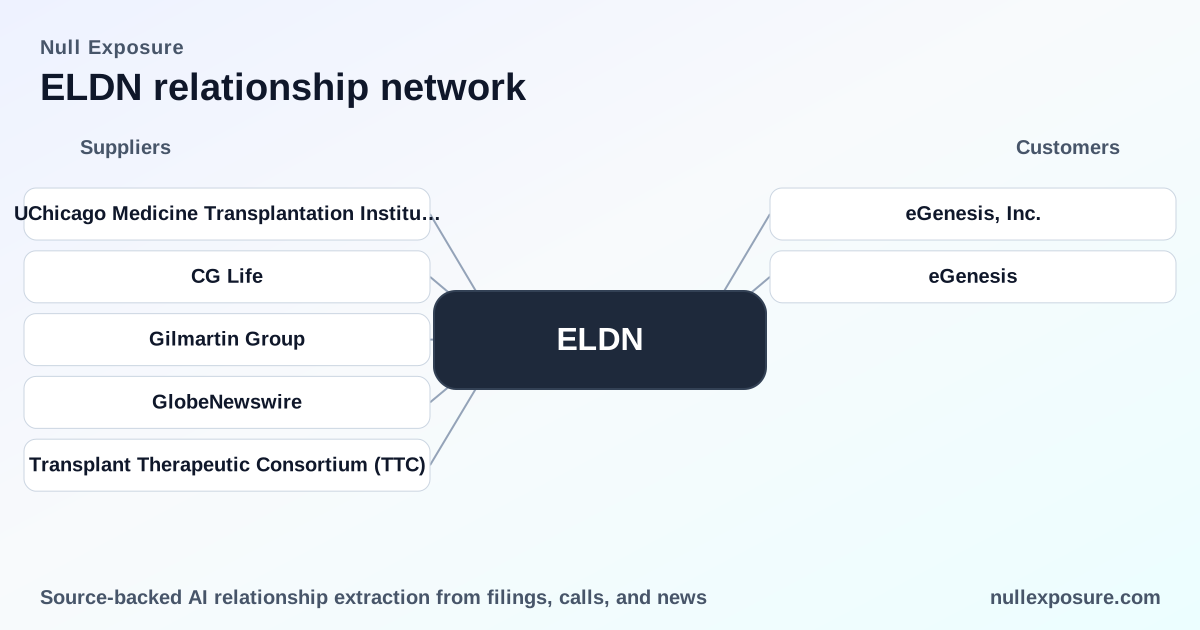
Eledon’s customer relationship results in public records are concentrated and specific; the following entries capture every relationship found in the reviewed materials.
-
Eledon — eGenesis, Inc. (FY2024 10‑K): Eledon executed a non‑exclusive collaborative research agreement granting eGenesis access to tegoprubart for preclinical xenotransplant studies, enabling eGenesis to use the antibody in development of human‑compatible organs and cells. According to Eledon’s FY2024 10‑K filing, the contract provides access to the therapeutic for eGenesis’ ongoing preclinical research and development. (Eledon FY2024 10‑K)
-
Eledon — eGenesis, Inc. (BioSpace, March 2026): Company leadership confirmed externally that Eledon provided tegoprubart to support eGenesis’ xenotransplantation program, including studies in non‑human primates and first‑in‑human procedures as reported by BioSpace. A March 2026 BioSpace article quoted Eledon’s management describing active supply and collaboration with eGenesis across xenotransplant efforts. (BioSpace, March 2026)
Contracting posture and what it implies for commercial risk
The eGenesis arrangement is non‑exclusive and preclinical, which defines several operating constraints for Eledon as a supplier and partner:
- The non‑exclusive nature of the agreement means limited lock‑in: eGenesis can engage alternative suppliers or partners for complementary or substitute reagents, which constrains long‑term pricing leverage for Eledon.
- The relationship is transactional and supply‑oriented in the near term — Eledon supplies tegoprubart for studies and receives payments tied to study days, a buyer–seller dynamic explicitly described in company disclosures (the agreement states eGenesis will pay Eledon for supplies based on study days).
- The partnership is time‑bounded: Eledon discloses the eGenesis agreement continues until September 2025 unless terminated earlier, which establishes a finite window for measurable commercial receipts under this contract.
These features position Eledon’s current commercial exposure as short‑horizon and partner‑dependent rather than embedded recurring revenue.
Financial scale: modest near-term cash flows, larger optionality later
Eledon’s FY2024 disclosure shows the company offset $0.1 million of manufacturing expenses as of December 31, 2024. That line item is the clearest company‑level signal of commercial scale to date and places near‑term partner receipts in the low six‑figure band. This level of offset is consistent with early supplier receipts tied to preclinical study supply rather than product sales at scale; revenue generation is incremental and experimental‑phase, not yet a commercial engine.
Investors should read that $0.1 million offset as a confirmation of monetization mechanics — supply for fees — rather than as evidence of sustainable commercial revenue. Eledon’s reported trailing revenue is zero, while forward valuation and analyst targets reflect optionality tied to clinical outcomes.
Concentration, criticality, and maturity — operational risk lens
- Concentration: Publicly disclosed customer relationships enumerate eGenesis as the primary named collaborator in the reviewed materials, indicating customer concentration at this stage. That concentration amplifies dependency on a small number of partner outcomes and contract extensions for meaningful revenue growth.
- Criticality: Tegoprubart appears functionally important to eGenesis’ xenotransplant studies; Eledon’s antibody is being used in pivotal preclinical work and reported transplant events, which makes the product technically critical to that partner’s immediate program milestones.
- Maturity: The relationship is grounded in preclinical and early translational activity and is time‑limited through 2025, so the maturity profile is early and event‑driven.
Taken together, these operational characteristics position Eledon as a supplier with high programic importance to a single partner but low revenue diversification, a dynamic that investors should weigh against clinical and regulatory risk.
What investors should watch next
- Contract renewals or expansions with eGenesis beyond September 2025 will be a high‑leverage event for Eledon’s near‑term revenue trajectory. A renewal or conversion to longer‑term supply or licensing would materially de‑risk the supplier profile.
- Any additional partner disclosures or new collaborative agreements would reduce customer concentration and validate the company’s ability to replicate the tegoprubart supply model.
- Clinical and regulatory milestones for tegoprubart in transplant‑relevant programs remain the fundamental drivers of longer‑term valuation; partner‑reported use in human xenotransplantation increases the probability of downstream commercial conversations and potential milestone income.
Explore broader relationship analytics and supplier concentration considerations at https://nullexposure.com/.
Bottom line: measured commercial traction, concentrated exposure
Eledon has converted its scientific asset into near‑term commercial receipts via a non‑exclusive, time‑limited supply and research agreement with eGenesis, with publicly reported offsets to manufacturing expenses in FY2024 totaling $0.1 million. This demonstrates the company’s ability to monetize R&D reagents, but also highlights customer concentration and event‑driven revenue risk. For investors, the next material readouts will be contract extensions, additional partner wins, or clinical milestones that shift Eledon from partner‑funded offsets toward sustainable commercial revenues.