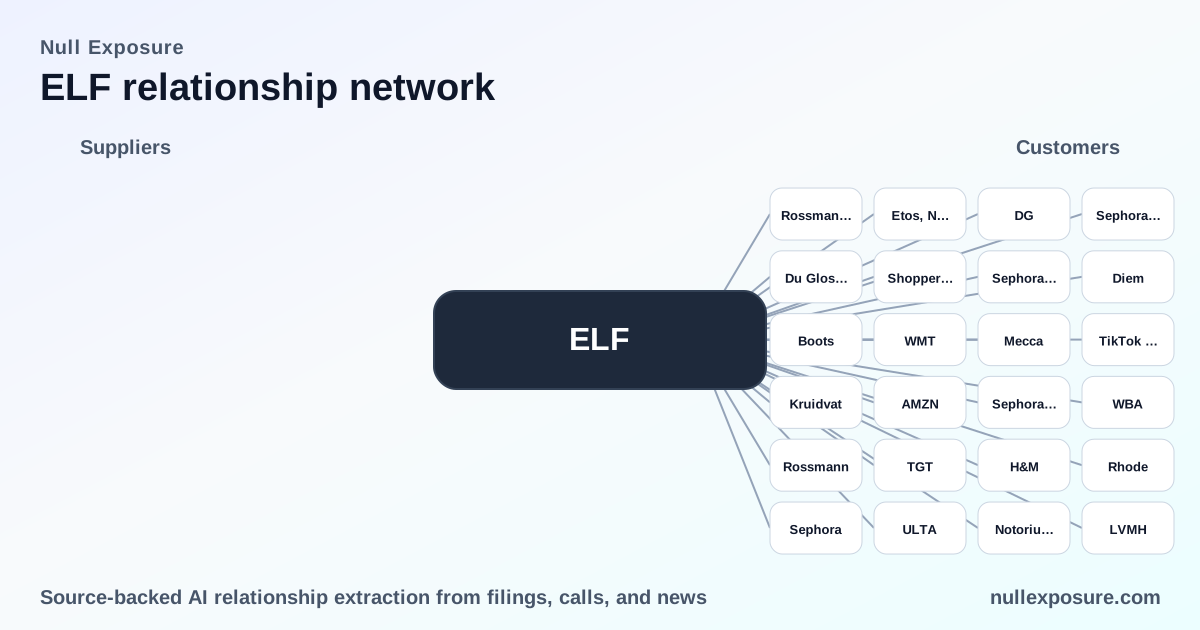
e.l.f. Beauty: Distribution-driven growth with retail muscle
e.l.f. Beauty monetizes by selling accessible cosmetics and skin care through a two-pronged model: a direct-to-consumer e-commerce channel and broad wholesale distribution into national and international retailers. Revenue comes from product sales across mass, prestige and drugstore channels, amplified recently by brand acquisitions (Rhode) and deliberate retail expansions into large chains and specialty stores. For investors, the thesis is simple: scale retail distribution and high-margin DTC lift unit economics and valuation multiple, while concentration among a handful of large retailers creates both leverage and counterparty risk.
If you want a concise refresh on how we source and present customer intelligence, visit our homepage: https://nullexposure.com/
What drives e.l.f.'s retail relationships — a quick read
e.l.f. runs a wholesale-first commercial posture: the company sells primarily to national and international retailers (83% of net sales in FY2025) and supplements that with DTC (17%). Contracts are effectively spot—retailers are not obligated to keep buying—and the relationship set is dominated by a small number of material partners. Target, Walmart, Ulta Beauty and Amazon together accounted for 63% of FY2025 net sales, a concentration that supports distribution scale but concentrates risk. These are company-level signals drawn from FY2025 filings and recent calls.
Key company-level constraints worth noting:
- Contracting posture: spot relationships are the norm; no binding long-term purchase commitments.
- Customer mix: majority wholesale (large retailers) with a sizeable DTC channel.
- Geography: highly concentrated in North America (81% of net sales).
- Materiality: several retailers are individually material to revenue.
- Relationship stage: these major retail partners are active and expanding.
U.S. retail anchors: where the bulk of sales live
-
Target / TGT — Top channel, dominant share. e.l.f. is the number-one beauty brand at Target and holds over 20% share of Target’s cosmetics category; management highlighted a 50% space expansion and a 21% category share in recent remarks. Source: e.l.f. Q3 2025 and Q4 2025 earnings remarks (2025Q3/2025Q4) and related FY2026 coverage in Sherwood News and MarketBeat.
-
Walmart / WMT — Large-scale reach and improving rank. Management reported moving from the number-four to the number-two beauty brand at Walmart, and Naturium and other brands are expanding into Walmart assortments in Spring 2026. Source: e.l.f. earnings calls (2025Q3/2025Q4) and WWD reporting (FY2026).
-
Ulta Beauty / ULTA — Prestige channel access and product launches. e.l.f. has expanded Naturium and other brands to Ulta, with Naturium achieving category leadership in body wash; Ulta is cited repeatedly as a key expansion lane. Source: e.l.f. Q3 and Q4 2025 earnings calls and FY2026 news transcripts (InsiderMonkey, FY2026).
-
Amazon / AMZN — Digital distribution and discovery. Amazon is a strong online channel; management cited momentum on Amazon supported by loyalty and app investments, and product launches (e.g., Slipstick) have performed well on Amazon and TikTok Shop. Source: e.l.f. Q3 2025 earnings call and news coverage (InsiderMonkey, MarketBeat).
-
Dollar General / DG — Value channel expansion. e.l.f. launched into a subset of Dollar General doors and later scaled to thousands of stores, an important play for value-oriented reach. Source: e.l.f. Q3 2025 earnings call and related FY2026 press coverage (InsiderMonkey, FY2026).
-
Walgreens / WBA — Drug channel assortment. Management referenced spring resets that include expanded space in Walgreens as part of seasonal merchandising. Source: e.l.f. Q3 2025 earnings call (2025Q3).
International and specialty rollouts: multiplying distribution
-
Rossmann (Germany) — e.l.f. cited Rossmann Germany as part of a large international rollout and specifically called out that partnership in its 2025 calls. Source: e.l.f. Q3 2025 earnings call (2025Q3).
-
Rossmann (Poland) — e.l.f. plans to launch in 1,000 Rossmann stores in Poland, building on the German partnership. Source: e.l.f. Q4 2025 earnings call (2025Q4).
-
Etos (Netherlands) — Listed as a recent launch market during the international expansion commentary. Source: e.l.f. Q3 2025 earnings call.
-
Kruidvat — Significant footprint in Netherlands/Belgium. e.l.f. launched in over 1,200 Kruidvat stores as part of European expansion. Source: e.l.f. Q4 2025 earnings call (2025Q4).
-
DM Germany — e.l.f. has a planned or announced expansion into DM Germany for e.l.f. Cosmetics (Spring 2026 mention in market reports). Source: TIKR/market coverage (FY2026).
-
Boots (UK) — Boots is part of Naturium and Notorium rollouts in the UK market. Source: e.l.f. FY2026 news summaries (InsiderMonkey, FY2026).
-
Shoppers Drug Mart (Canada) — Naturium and other brands have been introduced into Shoppers Drug Mart as part of Canada expansion. Source: e.l.f. Q4 2025 earnings call (2025Q4) and subsequent news.
-
Mecca (Australia) — Rhode is scheduled to enter Mecca in Australia as part of the international rollout. Source: InsiderMonkey and WWD reporting (FY2026).
-
Sephora (multiple regions) — Strategic prestige distribution for Rhode and other premium launches. e.l.f. reported Rhodes’ U.S./Canada and UK Sephora launches and record-breaking early sell-throughs; management credited Sephora with a major contribution to recent growth and international penetration. Source: e.l.f. Q4 2025 earnings call and multiple news items (Bitget, WWD, FinViz; FY2026).
- Sephora North America / Sephora UK / Sephora Mexico / Sephora Australia & New Zealand — each regional rollout is cited in earnings and press as part of Rhode and Notorium integrations and contributed materially to quarter-over-quarter growth. Sources: FY2026 earnings commentary and news coverage (FY2026).
-
LVMH — referenced as the parent operator for Sephora in certain regions that e.l.f. is targeting for Rhode distribution. Source: e.l.f. Q3 2025 earnings call (2025Q3).
Product and brand-level relationships
-
Rhode — Acquisition that materially altered revenue profile. Rhode contributed a substantial portion of Q3 net sales (reported ~$128M in one quarter and projected to add ~$260–265M to FY2026 by company guidance), and its launch into Sephora materially drove growth. Source: FY2026 earnings and Finviz/TIKR coverage.
-
Notorium (launched with Ulta, Shoppers Drug Mart, Boots, Sephora) — e.l.f. launched Notorium across a mix of mass and prestige retailers, illustrating the group's multi-tier go-to-market capability. Source: InsiderMonkey FY2026 reporting.
-
H&M — Collaboration into fragrance assortments marks a non-traditional retail partnership and co-branded product placement. Source: WWD (FY2026).
-
Diem — Announced as an Ulta Germany launch partner for spring 2026 expansion. Source: InsiderMonkey FY2026.
-
TikTok Shop — Social commerce channel where product launches (e.g., Slipstick) achieved top-new-product rankings alongside Amazon; strengthens discovery-to-sale funnel. Source: InsiderMonkey FY2026.
Legal and investor-context relationships to monitor
- Ulta / Ulta Beauty is referenced in recent securities litigation as an “untracked channel” in plaintiff filings; investor scrutiny around untracked channel inventory and demand visibility is ongoing and relevant to earnings quality discussions. Source: The Fashion Law and NewsfileCorp coverage (FY2026).
Bottom line: concentration and optionality coexist
e.l.f.’s business model blends scale distribution through a small set of large retailers with DTC and brand M&A to create growth optionality. That creates a clear set of investment trade-offs: concentration risk (Target, Walmart, Ulta, Amazon are material) versus high-leverage upside from successful premium rollouts (Rhode, Notorium) and rapid international expansion. Contracting posture is largely spot; geographic revenue is North America‑heavy; and the relationship set is active and expanding across both mass and prestige channels.
If you want to track these customer movements continuously, check our research hub: https://nullexposure.com/
Bold takeaways for investors:
- Distribution scale is e.l.f.’s primary competitive asset.
- A handful of retail partners account for the majority of revenue—monitor assortment and shelf-space dynamics closely.
- Recent acquisitions (Rhode) and retailer rollouts materially change near-term growth composition and valuation assumptions.