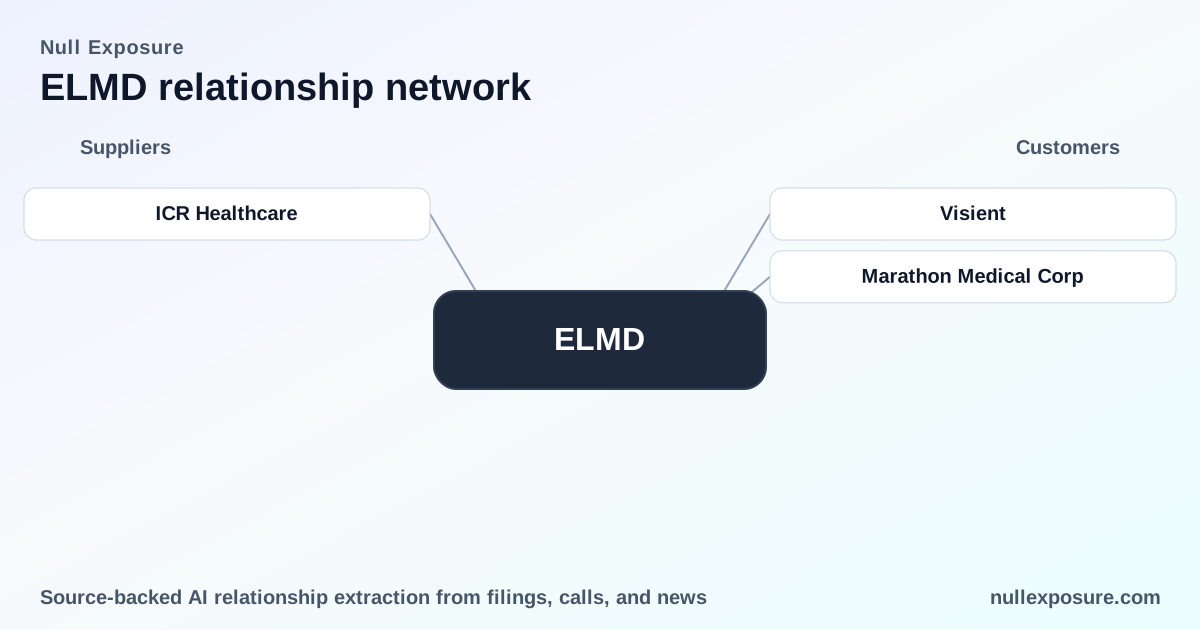
Electromed (ELMD): how SmartVest customers and distribution partners drive revenue and risk
Electromed develops, manufactures and sells the SmartVest high‑frequency chest wall oscillation system and monetizes through a mixed model of direct‑to‑patient sales, clinical referrals with insurance reimbursement, and targeted distributor agreements that place the SmartVest into health systems, VA and federal channels. With roughly $68.9M in trailing revenue and a lean operating profile (operating margin ~19%), the business is a single‑product medical device company where go‑to‑market relationships — payers, large contracting buyers and a handful of distributors — determine both growth pacing and downside exposure.
Explore structured customer intelligence for ELMD at https://nullexposure.com/
How Electromed actually gets paid
Electromed's commercial engine is straightforward: it sells the SmartVest and supports therapy delivery by securing clinician referrals, managing insurance claims for patients, and contracting distribution channels for institutional buyers. The company discloses a hybrid selling posture: direct seller to patients and providers in the U.S., plus independent distributors for international markets. That structure produces predictable revenue per patient but concentrates economic exposure around reimbursement pathways, contracting partners and a single product line.
- Direct-to-patient/provider sales: Electromed handles referrals, insurance billing and home delivery, which gives control over unit economics and service margins.
- Distributor relationships: Outside the U.S., Electromed relies on independent distributors to reach hospitals and clinics, accelerating reach while delegating local sales, inventory and service.
- Single-product concentration: The company explicitly operates one active product, which simplifies focus but raises product‑specific execution risk.
Why relationships matter — revenue concentration and operating leverage
Electromed's economics reflect the leverage of a single product with durable margins: operating margin around 19% and net profit margin near 13% on roughly $68.9M in trailing revenue. That profitability profile works if referral flows and reimbursement rates remain intact; it deteriorates quickly if major contracting partners change posture.
Key commercial levers for investors:
- Contracting concentration: a small number of large contracts and distributor agreements drive a disproportionate share of institutional penetration.
- Reimbursement dependence: patient insurance billing is integral to sales velocity; payers and provider gatekeepers control adoption cadence.
- Geographic distribution: international reach is achieved through third‑party distributors, which reduces fixed selling cost but introduces partner execution risk.
Named customer and distribution relationships: what they mean for investors
Electromed lists customer and distribution relationships that are material to access and volume. Below are the named partners identified in public reporting and press.
Visient
Electromed disclosed a contract with Visient that provides access to roughly half of U.S. health systems, positioning the company to scale institutional placements through Visient’s group purchasing and contracting relationships. According to an earnings call transcript published March 2026, management emphasized the Visient contract as a channel to large health systems (InsiderMonkey, March 2026: https://www.insidermonkey.com/blog/electromed-inc-amexelmd-q1-2026-earnings-call-transcript-1645437/).
Marathon Medical Corp
Electromed entered a distribution agreement with Marathon Medical Corp to extend SmartVest access into federal channels, including VA hospitals, Indian Health Service facilities and other federal buyers; Marathon is noted as a service‑disabled veteran‑owned small business focused on federal medical supply distribution. The company announced this distribution partnership in a trade press release covering expanded access to veterans and federal employees (Respiratory‑Therapy.com, FY2024 coverage: https://respiratory-therapy.com/products-treatment/industry-regulatory-news/business-news/electromed-expands-smartvest-access-to-veterans-federal-employees-and-native-american-communities/).
Other commercial signals and operating constraints investors should track
Electromed’s disclosures and public statements reveal consistent go‑to‑market characteristics that influence execution risk and optionality:
- Geographic footprint: principal distributors are located across the Middle East, Southeast Asia and Central America, which signals a targeted international expansion strategy but also reliance on regional partners for local execution. This is a company‑level signal from Electromed’s distribution disclosures.
- U.S. distribution concentration: Electromed maintains agreements with a limited number of HME (home medical equipment) distributors for the U.S. homecare market, creating concentration risk in domestic channel coverage.
- Role clarity: the company both sells directly (handling referrals and claims) and relies on distributors abroad; this mixed posture reduces sales fixed cost but increases coordination complexity.
- Single product, single business activity: Electromed operates one active product line — the SmartVest — which increases the criticality of product lifecycle management and the impact of any regulatory, reimbursement or competitive shifts.
These constraints translate into observable investor implications: contracting concentration increases counterparty risk; distributor dependence reduces direct control outside the U.S.; and single‑product focus amplifies the importance of market access wins like the Visient relationship.
Risk and upside framed for investors
Electromed is a small‑cap medical device firm with both clear upside and concentrated risk. On the upside, institutional contracting (e.g., Visient) and federal distribution channels can materially accelerate placements without parallel rises in fixed sales costs, leveraging current margins. The company posts attractive returns on equity (~20%) and steady profitability, which supports reinvestment and incremental growth.
On the risk side, reliance on reimbursement, a single active product and a handful of distributors creates volatility if a major payer change, distributor failure, or competitor claim reduces adoption. Ownership structure (insiders ~21% and institutions ~61%) indicates investor alignment but also means material ownership shifts could affect stock liquidity or strategic direction.
Core investor takeaway: Electromed’s value is primarily a function of market access — contracts that broaden institutional reach or open federal channels materially expand revenue without proportionate fixed costs, while loss or underperformance of a major channel would compress growth rapidly.
For structured research on how these customer relationships map to commercial exposure, visit our platform for calibrated signals and relationship scoring: https://nullexposure.com/
Bottom line
Electromed is a focused, profitable medical‑device operator whose growth trajectory depends on a small set of high‑value contractual relationships and distribution partnerships. Visient and Marathon Medical Corp are two named relationships that materially influence institutional and federal channel access, and company‑level constraints — geography, distributor reliance and single‑product concentration — define the primary risk/return tradeoffs for investors evaluating ELMD.