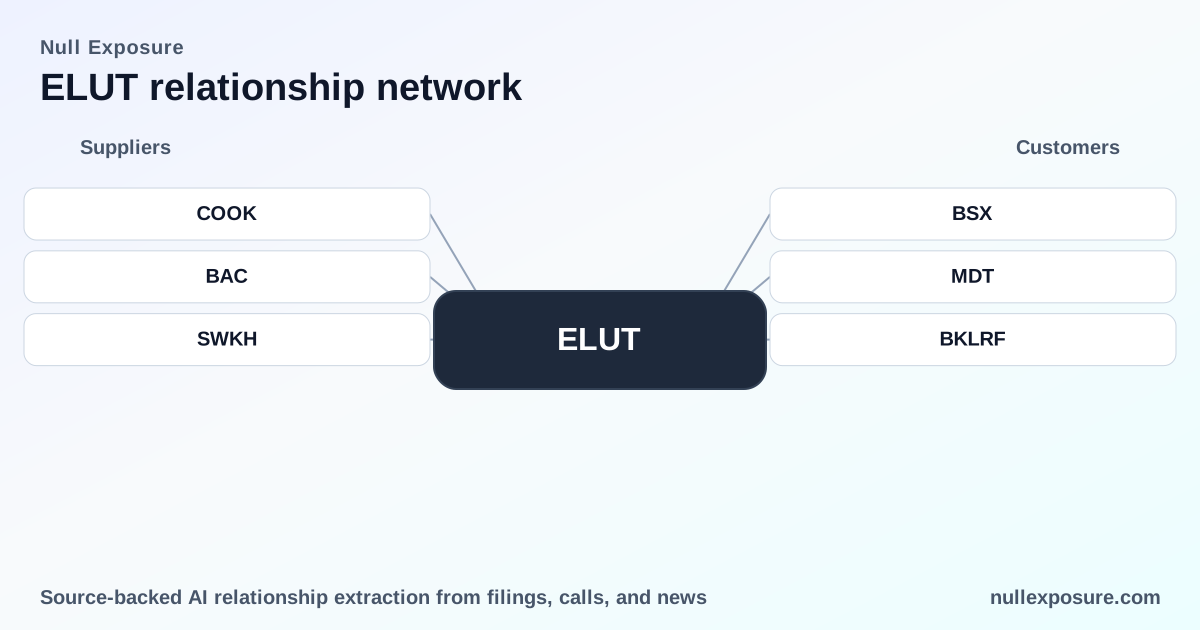
Elutia Inc. (ELUT): Customer Relationships, Commercial Risks and the Strategic Implications of the $88M BioEnvelope Sale
Thesis: Elutia is a commercial-stage medical-device company that monetizes proprietary drug‑eluting biomatrix technology through direct product sales and selective divestitures; the company sells implantable adjuncts and related devices to hospitals, integrated delivery networks (IDNs) and commercial partners, and it is using a recent strategic sale of its BioEnvelope franchise to re-center capital toward NXT‑41x development while materially improving its cash runway.
If you want a consolidated view of Elutia’s customer footprint and partner posture, visit https://nullexposure.com/ for broader coverage and analytics.
What happened with Boston Scientific and why it matters
Elutia executed a decisive commercial transaction in late‑2025: it sold the EluPro™ and CanGaroo® bioenvelopes to Boston Scientific (BSX) for $88 million in cash. The deal transfers the device‑protection product line—used alongside implantable cardiac and other devices—to a large public medtech acquirer, turning a recurring product revenue stream into immediate liquidity that Elutia has earmarked to fund development of breast reconstruction candidate NXT‑41x. According to the company announcement syndicated on Yahoo Finance (March 9, 2026), the transaction price was $88 million in cash; independent reporting in BioWorld and MedTechDive corroborated the same terms and closing details in early 2026.
Key takeaway: the sale de‑risks near‑term funding needs and simplifies the commercial footprint, but it also removes a revenue line that had generated recurring sales—investors must weigh improved balance‑sheet flexibility against the lost top‑line and any longer‑term license or milestone economics that could have arisen from retaining the franchise. (Sources: company press release via Yahoo Finance, March 9, 2026; BioWorld and MedTechDive coverage, March–May 2026.)
Medtronic relationship: a supply contract with litigation context
Elutia had an active contractual relationship to supply FiberCel, a bone matrix product, for distribution by Medtronic Sofamor Danek USA, Inc. The relationship surfaced in recent legal reporting: a Delaware court ruling examined indemnity and insurance obligations in litigation related to the FiberCel arrangement, and the reporting notes the supply relationship between Elutia and Medtronic. This indicates Elutia’s commercial model includes third‑party distribution agreements with large medtech distributors. (Source: Insurance Business America coverage of the Elutia v. Medtronic Delaware court decision, March 2026.)
Key takeaway: Elutia is not purely transactional with hospitals; it also engages in distribution partnerships with major OEMs—arrangements that can yield scale but introduce contractual complexity and potential indemnity exposure when product issues arise.
Berkeley / commercial partners referenced in the 10‑K
In its 2024 Form 10‑K, Elutia described historical cash outflows tied to litigation defense and investments in commercial infrastructure through its direct sales force and its commercial partners to expand presence and promote product adoption. The document mapping included a match labeled “Berkeley” (BKLRF) tied to that disclosure—indicating that Elutia’s commercial strategy explicitly leverages partner channels alongside direct selling. (Source: Elutia Form 10‑K, fiscal year ended December 31, 2024.)
Key takeaway: Elutia’s go‑to‑market is a hybrid of direct sales and channel partners; this hybrid model drives faster adoption but also creates multi‑party contractual exposure and sales concentration dynamics that investors should monitor.
What the constraints tell investors about Elutia’s operating model
Beyond individual counterparties, company‑level contract and sales signals in filings and news produce a clear operating profile:
- Contracting posture — short‑term and flexible. Elutia’s disclosures note that GPO and IDN contracts are typically terminable without cause on 60–90 days’ notice, indicating high buyer leverage and limited long‑duration protection of revenue streams. This is a company‑level signal, not tied to any single counterparty.
- Counterparty profile — large enterprises dominate purchasing decisions. The filing commentary on healthcare cost reform and purchasing consolidation points to IDNs, hospitals and large purchaser groups as the primary decision makers, increasing pricing pressure and procurement discipline.
- Geographic concentration — U.S. centric. Sales in the United States represented greater than 96% of net sales in 2024, and Elutia reported no material international product sales or long‑lived assets outside the U.S., concentrating regulatory and reimbursement risks domestically.
- Seller/buyer roles — Elutia is a seller to hospitals and distributors. The company recognizes revenue on product sales and reports that most customers buy products directly then bill third‑party payors, confirming Elutia’s primary role as a product vendor to healthcare providers and commercial distributors.
- Revenue concentration — material single‑customer exposure. The 10‑K shows one customer accounted for 14% of net sales in 2024 (10% in 2023), placing Elutia in a spend band consistent with mid‑single to low‑double million exposure per large counterparty; this is a structural commercial risk for investors.
Investor implication: Elutia operates in a high‑leverage vendor environment—short contract terms, concentrated U.S. revenue, and reliance on large purchasers—so revenue volatility is an explicit business risk even as the Boston Scientific sale improves liquidity.
Visit https://nullexposure.com/ for comparative coverage of similar medtech customer relationships and counterparty risk scoring.
How these relationships shape valuation and monitoring priorities
The Boston Scientific transaction materially changes the risk/return profile. Immediate cash inflow reduces near‑term dilution risk and funds development, while the Medtronic supply contract and the use of commercial partners highlight continuing operational complexity and exposure to contractual disputes. For investors and operators evaluating Elutia customer relationships, the monitoring checklist is straightforward:
- Track integration and any contingent payments from the Boston Scientific deal that would affect future cash flows.
- Monitor litigation and indemnity outcomes related to the FiberCel agreement with Medtronic; legal rulings can create insurance recoveries or unexpected liabilities.
- Watch customer concentration trends and IDN contracting behavior in quarterly sales disclosures; short‑notice contract terminations are a real revenue tail‑risk.
- Confirm commercialization progress for NXT‑41x and whether new partnerships, licensing, or OEM deals replace the divested BioEnvelope revenue.
Bottom line
Elutia has traded a recurring medical‑device revenue stream for cash and strategic focus on its next‑generation product program. The company’s commercial model remains U.S.‑centric, partner‑dependent, and exposed to short contract tenors and customer concentration—characteristics that increase near‑term revenue uncertainty but also concentrate upside if NXT‑41x achieves clinical and commercial traction. Investors should value the company with explicit assumptions about replacement revenue sources, legal exposures tied to distribution agreements, and the timeline for product‑development milestones funded by the $88 million sale.