Elevance Health (ELV): An investor guide to customers, partners and operating posture
Elevance Health operates as one of the largest U.S. health benefits companies, monetizing through risk-based premiums, administrative fees for self-funded employers, and a growing portfolio of services under the Carelon businesses (pharmacy, care management, analytics). With roughly $200 billion in trailing revenue and a diversified mix of Medicare, Medicaid, employer, individual and federal programs, Elevance combines scale in underwriting with recurring services revenue to generate predictable cash flows and cross-sell opportunities. For further signals on customer structure and partner exposure, see Null Exposure’s platform: https://nullexposure.com/.
Quick summary thesis for investors
Elevance’s business model blends high-contract stickiness from long-term government and employer relationships with incremental margin expansion from fee-based Carelon services and pharmacy operations. The company’s scale in membership (45.2 million medical members as of Dec 31, 2025) creates a platform effect: claims and clinical data feed services that increase retention and open external revenue channels. At the same time, concentration in federal programs and active experimentation with Big Tech for AI-driven clinical workflows are material strategic levers and risk vectors.
Who Elevance is working with: the relationship map
GS-P-A (Goldman Sachs press coverage)
Goldman Sachs issued a Hold rating on Elevance with a $343 price target in early March 2026, reflecting a cautious view on near‑term performance despite the company’s scale. This analyst action was reported in a Globe and Mail press release on March 9, 2026.
AWS (Amazon Web Services)
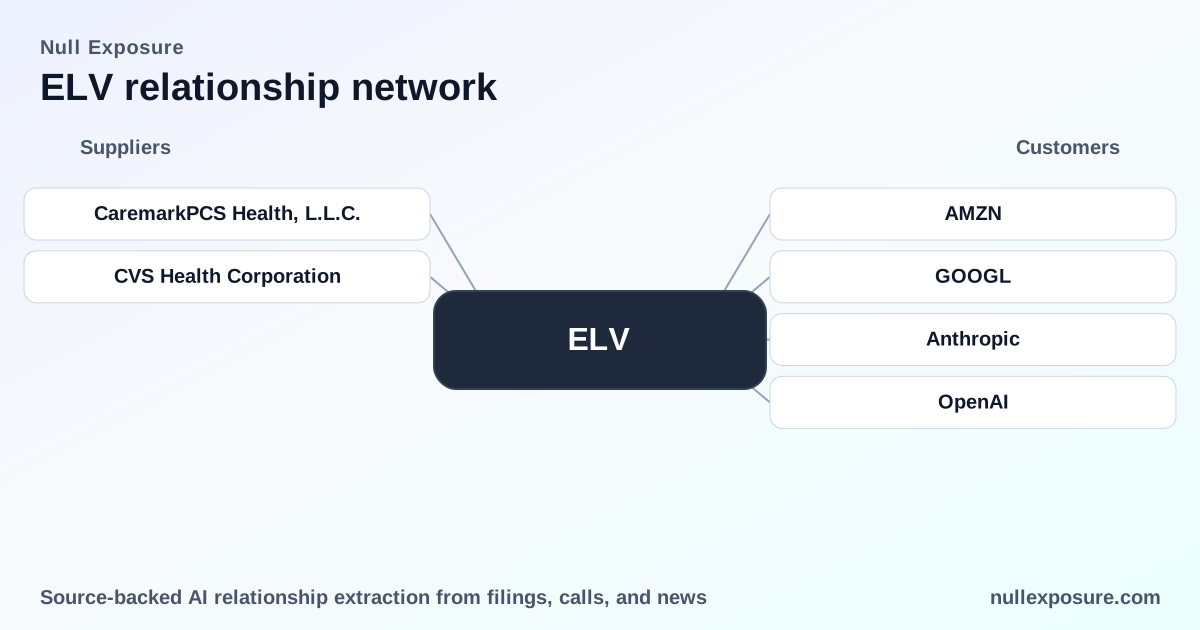
Elevance is partnering with AWS as part of a broader engagement with Big Tech to industrialize AI use cases and “think through the complexity of healthcare,” positioning cloud and infrastructure partners as enablers of clinical and operational automation. This collaboration was noted in MedCity News coverage of Elevance’s AI strategy in February 2026.
GOOGL (Alphabet / Google Cloud reference)
Elevance is engaged with Google (Alphabet) in workstreams to explore AI applications and platform-level integrations that can support population health management and analytics. MedCity News reported in February 2026 that Elevance counts Google among the Big Tech firms it is working with on healthcare AI.
Google (separate mention in reporting)
A repeat mention in the same February 2026 MedCity News article highlights Google specifically among the Big Tech partners Elevance consults with on AI — reinforcing that Elevance is pursuing multiple tech relationships rather than a single-vendor strategy.
Anthropic
Anthropic is listed among the AI companies Elevance is working with to address healthcare complexity, indicating Elevance is evaluating large-language-model vendors beyond incumbent cloud providers. MedCity News (Feb 2026) records this engagement as part of a multi-partner AI approach.
OpenAI
OpenAI is identified alongside Anthropic, Google and AWS as a partner Elevance has engaged in discussions and pilot activities around AI for healthcare workflows, according to MedCity News’ February 2026 reporting.
Operating model characteristics and constraints — what drives performance
Elevance’s public disclosures and the relationship signals produce several company-level operating characteristics investors must weigh:
- Contracting posture: mixed short- and long-duration contracts. Elevance groups contracts into short and long duration for premium deficiency evaluation, indicating a hybrid revenue book that includes both sticky, long-term government/employer contracts and shorter-duration individual or exchange-based policies.
- Concentration: material government exposure. The company generated approximately 32% of consolidated revenue from U.S. government agencies in 2025, a high-concentration revenue source that provides scale but increases dependence on federal reimbursement policy and procurement cycles.
- Counterparty mix: broad — individuals, very large enterprises, and government. Elevance serves individuals, multi-state employer groups (leveraging its BCBS license network), Medicaid/Medicare members and federal programs, which creates diversification across payor types while also concentrating risk in large counterparty segments.
- Role complexity: seller, service provider and buyer. Beyond underwriting and premium income, Elevance operates as a service provider through Carelon (pharmacy, claims processing, analytics) and also assumes buyer-like behaviors where it underwrites risk and purchases care services.
- Criticality and maturity: high-criticality, active relationships at scale. The company’s footprint (licensed in all 50 states and Puerto Rico) and membership scale (45.2 million medical members as of Dec 31, 2025) make Elevance a critical counterparty for providers and vendors and indicate a mature, incumbent position in the market.
- Segment bias toward services. Carelon’s external-facing services (CarelonRx, Carelon Health, Carelon Insights) are explicitly marketed to external customers, signaling a deliberate pivot to fee-based, higher-margin revenue streams.
These constraints collectively show a business that is operationally diversified but strategically exposed to federal policy, large-account retention, and successful commercialization of service offerings.
Investment implications: where the upside and risks live
-
Upside drivers
- Cross-sell leverage from Carelon can expand margins as services scale beyond internal plan customers into external markets.
- AI and Big Tech partnerships have the potential to lower administrative costs and accelerate clinical decision support, improving medical loss ratios if implemented effectively.
- Scale advantages in provider contracting and data-driven care management sustain competitive moat.
-
Key risks
- Policy and reimbursement concentration with ~32% government revenue creates exposure to program changes and procurement cycles.
- Vendor and integration risk from multi-vendor AI pilots (AWS, Google, Anthropic, OpenAI) introduces implementation complexity and execution risk; success requires disciplined governance and data stewardship.
- Mixed contract tenors mean revenue volatility from short-duration individual books can counterbalance longer-term employer and government contracts.
For a deeper operational signal set and to monitor how these relationships evolve over time, visit Null Exposure: https://nullexposure.com/.
Bottom line
Elevance’s proposition is clear: scale in risk-bearing insurance combined with a push into services and AI-enabled operations creates both durable cash flow and material execution risk. Investors should treat government revenue concentration and multi-vendor AI initiatives as primary monitoring points, while valuing the optionality inherent in Carelon’s external growth. The company’s customer and partner map—ranging from federal agencies and very large employers to AWS, Google, Anthropic and OpenAI—reflects a deliberate strategy to pair underwriting scale with technology-enabled services.