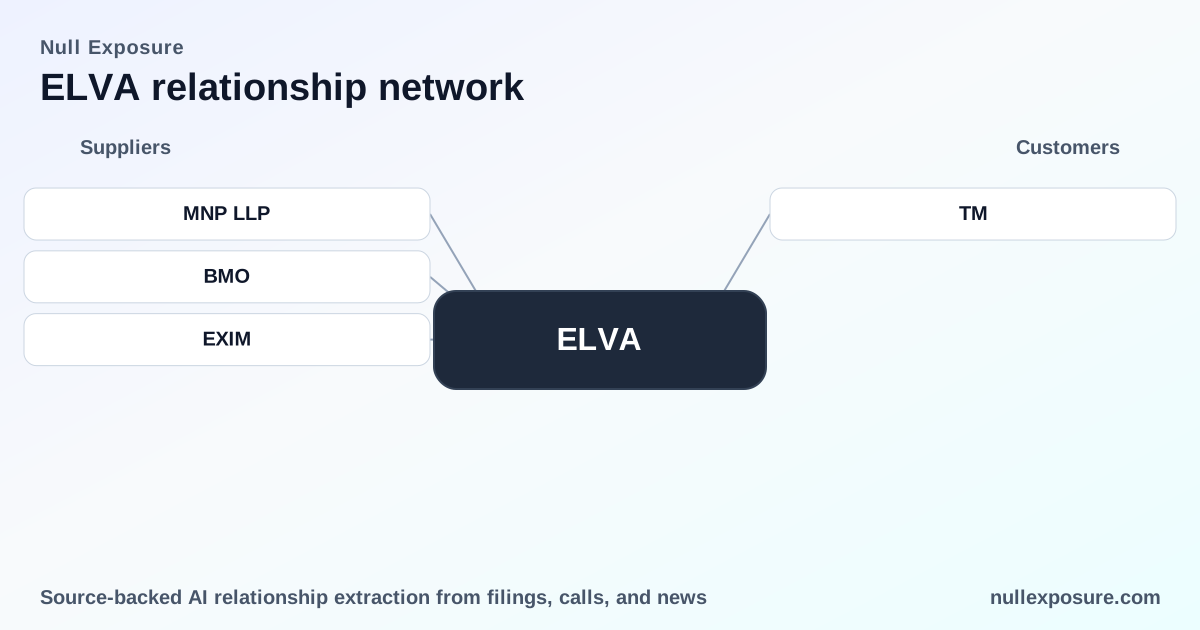
Electrovaya’s customer signal: DOE-backed data-center work and Toyota MHE orders point to commercial scaling
Electrovaya designs and manufactures lithium‑ion battery systems and monetizes through direct product sales of its Infinity battery technology, OEM integrations into material‑handling and vehicle platforms, and project contracts with institutional customers for grid‑resilience applications. Recent wins—most notably a Department of Energy‑funded consortium led by Binghamton University and disclosed orders into Toyota heavy‑duty MHE—shift Electrovaya from R&D mode toward revenue‑bearing deployments that are strategically valuable and commercially replicable. For a concise map of ELVA’s customer relationships and what they imply for revenue cadence and risk, see NullExposure’s company coverage at https://nullexposure.com/.
Market context: Electrovaya is a sub‑$500M market‑cap industrial equipment company (Market Cap ≈ $467M) with $63.8M in trailing revenue, positive operating margins, and concentrated insider ownership (insiders ~32.6%, institutions ~19.3%). Those balance‑sheet and ownership features shape how customer relationships convert into cash and how management negotiates contracts.
Why the Binghamton / DOE consortium matters for revenue mix and product validation
Electrovaya will supply its Infinity BESS for a DOE‑funded project led by Binghamton University that targets a 1.2 MWh next‑generation battery system for data‑center resilience and mission‑critical infrastructure. The program is explicitly designed to test peak shaving, backup power, and load management in a data‑center environment, offering an institutional reference customer and a pathway to repeatable project sales to enterprise and government buyers. According to DatacenterDyanamics (May 2026), the unit will be deployed at Binghamton University’s Center for Energy‑Smart Electronic Systems and integrated into a data‑center test environment; The Globe and Mail and Newswire corroborate that Electrovaya supplies its Infinity technology on this DOE‑backed effort (FY2026 reporting).
Toyota OEM integration: an industrial channel to recurring order flow
Management disclosed in the Q1 FY2026 earnings transcript that Electrovaya’s high‑voltage systems are slated for Toyota heavy‑duty material‑handling equipment (MHE) and are expected to go into multiple vehicle systems, with orders already in place. This type of OEM insertion converts Electrovaya’s battery modules into a recurring‑order channel and establishes product‑level validation within a major industrial partner. The company’s Q1 2026 transcript captures the reference to Toyota and confirms active orders (Electrovaya Q1 FY2026 earnings transcript, March 2026).
Customer relationships — compact, source‑anchored summaries
Binghamton University (DOE consortium)
Electrovaya will install an Infinity BESS at Binghamton University’s ES2 center as part of a DOE‑funded consortium to demonstrate a 1.2 MWh system for data centers, with explicit objectives around peak shaving, backup, and load management (FY2026). Source: DatacenterDyanamics / Newswire / The Globe and Mail, May 2026.
Toyota (listed in filings/transcript as TM)
Electrovaya’s high‑voltage battery system was identified in the Q1 FY2026 earnings transcript as being integrated into Toyota heavy‑duty MHE and multiple vehicle systems, with orders already recorded for those vehicle applications. Source: Electrovaya Q1 FY2026 earnings transcript (published March 2026 via company press release).
How these relationships reflect Electrovaya’s operating model and business constraints
-
Contracting posture: Electrovaya operates across two contracting modalities—project‑based institutional contracts (DOE/infrastructure pilots) and OEM supply agreements (MHE and vehicle platforms). This hybrid posture requires both project management capability and serial manufacturing discipline and shifts revenue recognition between milestone/project billing and product sales.
-
Concentration and commercial scale: The company is transitioning from validation to commercialization; current customer references are high‑value but limited in number, implying concentration risk if a small set of OEMs and pilots dominate near‑term revenue. Electrovaya’s insider ownership concentration (~32.6%) and relatively low institutional ownership (~19.3%) indicate significant founder/management control, which can accelerate decision cycles but concentrates governance risk.
-
Criticality of product: The product is positioned for mission‑critical applications (data centers, heavy‑duty MHE). Successful DOE demonstrations and Toyota OEM integrations increase system criticality for buyers, which supports pricing power and aftermarket service opportunities when deployments scale.
-
Maturity and margin profile: Electrovaya shows profitable operating margins on trailing metrics and positive EBITDA, but its valuation multiples (forward P/E and price‑to‑sales) reflect growth expectations; converting pilot and OEM wins into predictable volume is the next step to justify those multiples.
Investment implications — upside drivers and risk vectors
-
Upside drivers: repeatable project roll‑outs into data centers and conversion of OEM integrations into sustained production orders would materially improve revenue visibility and leverage fixed manufacturing costs to expand margins. The Toyota insertion is an especially high‑leverage commercial proof point if it scales across MHE product lines.
-
Key risks: order concentration from a small number of institutional pilots and a handful of OEM programs; execution risk in transitioning from pilot deployments to high‑volume manufacture; and working capital demands tied to project timelines. Electrovaya’s insider‑heavy ownership and modest institutional base create both an execution advantage and governance concentration risk.
What to watch next
- Contract awards and procurement terms from the DOE consortium that define revenue timing and margins for the Binghamton deployment (public updates expected in FY2026 press releases).
- Purchase‑order cadence and production ramp details from Toyota/MHE integrations that reveal whether the Toyota relationship is a one‑off qualification or a scalable OEM channel.
- Quarterly revenue mix disclosure that breaks out project versus product sales and reveals contribution margins as deployments scale.
For deeper tracking of ELVA customer relationships and the documents that evidence them, NullExposure maintains consolidated coverage and timeline annotations—visit https://nullexposure.com/ for our company dossier and alerts.
Bottom line: from lab to lanes and datacenters
Electrovaya is executing a clear two‑track commercialization strategy: institutional DOE‑backed projects that validate Infinity BESS in mission‑critical environments, and OEM integrations that convert product designs into recurring sales. The Binghamton/DOE partnership and Toyota MHE orders are complementary signals—one validates technical performance in a high‑value vertical, the other opens an industrial channel for serial production. Investors should value upcoming contract milestones and order flow disclosures as the decisive catalysts that convert promising references into durable revenue.