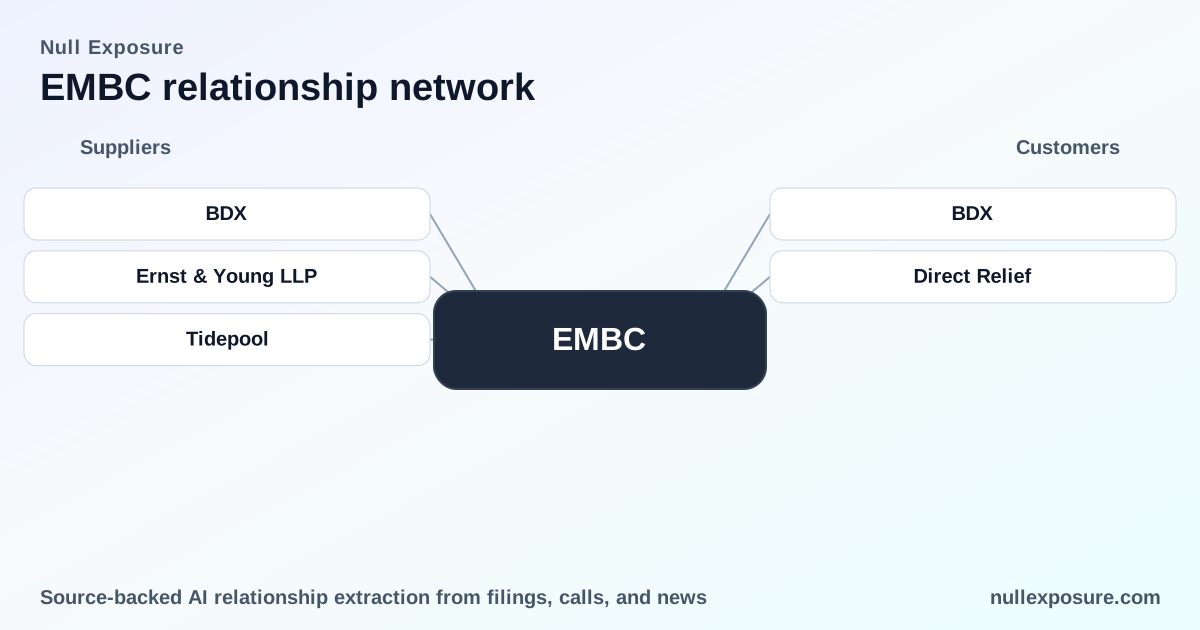
Embecta (EMBC) — Customer relationships that shape revenue and risk
Embecta is a focused medical-technology company that monetizes through the manufacture and sale of insulin delivery products (pens, pen needles, syringes) and selective contract manufacturing, with a complementary distribution footprint into wholesalers, hospitals and retail channels. Investors should evaluate both the commercial breadth of its core product business and the residual contract-manufacturing relationship with Becton, Dickinson and Company (BDX), which influences near-term revenue volatility and cash flows. Learn more at https://nullexposure.com/.
How Embecta runs the business and where money comes from
Embecta sells finished injection devices into traditional healthcare distribution channels and generates ancillary revenue by producing non-diabetes products under contract for other medical manufacturers. The primary revenue engine is the core injection product portfolio, with a downstream commercial model that relies on wholesalers, distributors and institutional purchasers to reach patients. Embecta also reports contract-manufacturing receipts when it produces product for other firms, creating a secondary but material revenue stream in some periods.
Operationally, Embecta shows characteristics important to investors:
- Concentration: management disclosures indicate that a substantial share of revenue is derived from a limited number of customers, a company-level signal that concentrates commercial exposure.
- Global scale: Embecta operates a worldwide manufacturing and distribution network, supplying products to customers in over 100 countries and serving an estimated patient base in the tens of millions, which both diversifies market opportunity and complicates supply-chain and regulatory exposures (company filings, FY2025).
- Channel posture: Embecta sells primarily as a seller to wholesalers and distributors and as a distributor into retail and institutional channels, reflecting a conventional medical-products go-to-market model that depends on third-party channel economics and relationships.
- Core product maturity: The business is anchored by protected injection-technology IP—management reports hundreds of patents—positioning Embecta’s core portfolio as the stable revenue base while contract manufacturing remains more variable.
These structural facts create an operating mix where stable core product sales coexist with episodic contract-manufacturing revenue, which investors should treat as non-core when modeling long-term margins and cash conversion.
A practical inventory of customer and partner relationships
Becton, Dickinson and Company (BDX)
Embecta continues to report contract manufacturing revenue and receivables tied to BDX, but that revenue has been declining as BD insources certain non-diabetes products back into its own operations. Embecta disclosed increases and decreases in contract-manufacturing revenue related to BD across FY2025 reporting and acknowledged receivables due from BD in its results (GlobeNewswire, Q3 FY2025 press release; GlobeNewswire and Yahoo Finance, FY2025 full-year results; Q1 FY2026 earnings transcript via InsiderMonkey).
Sources: Embecta FY2025 financial releases on GlobeNewswire (Aug 8, 2025; Nov 25, 2025) and subsequent earnings comments in a Q1 FY2026 transcript (InsiderMonkey).
Direct Relief
Embecta executed a significant corporate-donation relationship with Direct Relief, donating approximately 15 million units of pen needles and insulin syringes following a North America packaging transition, reflecting a large non-commercial transfer of product inventory tied to corporate social responsibility and channel adjustments (GlobeNewswire press release, Nov 14, 2025).
Source: GlobeNewswire press release (Nov 14, 2025).
What the BDX relationship concretely means for valuation and risk
The BDX connection is the single most relevant counterparty dynamic for investors in the near term. Embecta’s financials show both contractual sales to BD and amounts receivable from BD, and management has explained the decline in contract-manufacturing revenue as BD insources production of certain non-diabetes products. That trend has three direct implications for investors:
- Revenue volatility: contract-manufacturing receipts tied to BD are episodic and have declined, so sustainable top-line growth will be determined by core injection product sales rather than contract work (GlobeNewswire FY2025 filings; InsiderMonkey Q1 FY2026 transcript).
- Working capital exposure: receivables from large enterprise customers like BD are disclosed in filings and require monitoring as a component of near-term liquidity (Embecta FY2025 results, GlobeNewswire).
- Strategic clarity: the reduction in contract volume from BD forces Embecta to lean into its core pen/needle/syringe portfolio and distribution partnerships to replace lost contract revenue.
Company-level constraints that affect customer strategy
Treat the following as company-wide signals that shape how relationships operate and how management negotiates with partners:
- Large-enterprise counterparty profile: management acknowledges reliance on a small set of large customers for a substantial portion of revenue, increasing bargaining power asymmetries and concentration risk.
- Global footprint: distribution and manufacturing across 100+ countries increases addressable market but also introduces multi-jurisdictional complexity in contracting, pricing and payback schedules.
- Distribution and selling posture: Embecta’s commercial model is built on selling into wholesalers, institutional channels and retail—this positions the company as a conventional medical supplier rather than a direct-to-patient vendor.
- Mixed relationship stages: while many distributor/seller relationships are active, management also reports that distribution agreements in Asia Pacific and Latin America have terminated or expired, indicating deliberate portfolio pruning or renegotiation across regions.
- Product concentration: the business remains centered on core injection products, supported by an extensive patent estate—this makes product-market fit deep but narrows the levers for diversification.
These constraints translate into contracting posture that is defensive on pricing but proactive on channel management, and they should be integrated into financial models as structural assumptions rather than transient detail.
Investment implications and final takeaways
- Primary thesis: value derives from the stability and margin profile of Embecta’s core injection products, not from leftover contract-manufacturing revenue tied to BD. Recent disclosures confirm the decline of that contract stream and the need to monetize global distribution strength and product IP.
- Key risk: customer concentration and the insourcing dynamics with BDX create measurable topline and working-capital risk; investors must monitor receivable disclosures and contract-manufacturing run-rates reported in quarterly filings.
- Operational upside: a large patent portfolio and entrenched distribution relationships across retail, hospital and pharmacy channels support margin resilience and the ability to expand share where Embecta controls commercial access.
For a focused investor assessment of Embecta’s customer exposure and contract dynamics, review their quarterly filings alongside recent earnings commentary and select press releases. Additional research and historic filing consolidation are available at https://nullexposure.com/ for subscribers seeking deeper counterparty analysis.