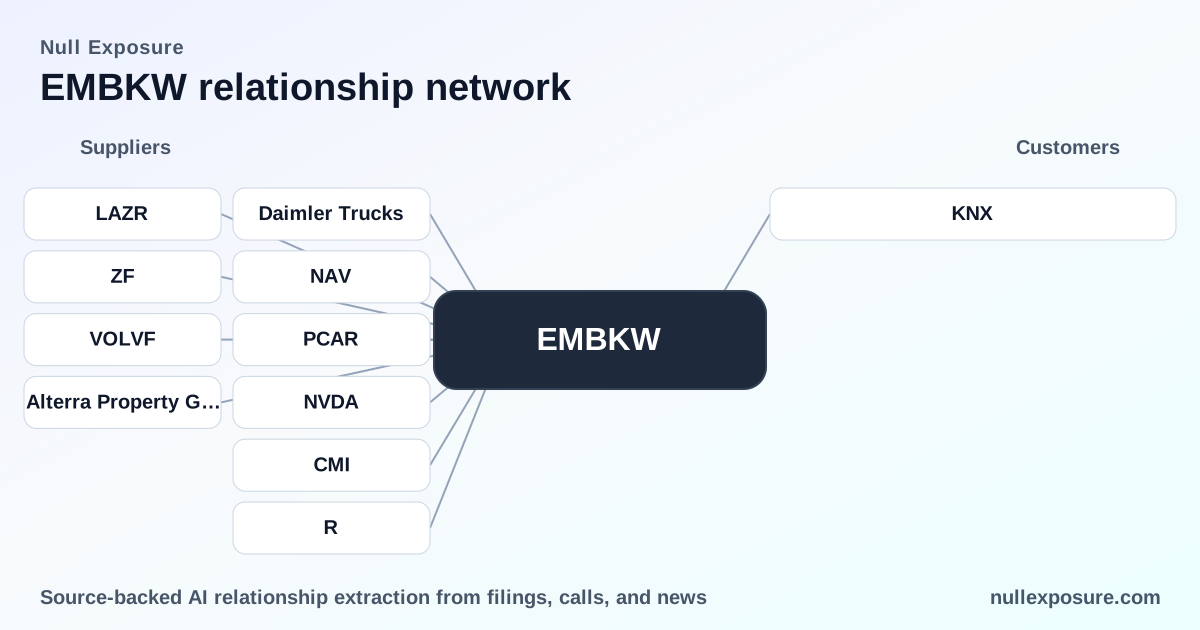
EMBKW — Embark’s customer footprint and what Knight‑Swift signals for commercialization
Embark builds autonomous driving systems for long‑haul trucking and monetizes by delivering Embark‑equipped vehicles and operational partnerships with large carriers. The company’s commercial strategy is execution‑driven: convert pilot integrations into fleet deployments where carriers operate Embark‑equipped trucks with their own personnel, creating recurring revenue from equipment deliveries, support and service arrangements. The Knight‑Swift relationship is the clearest public evidence that Embark has moved from lab pilots to carrier‑run operations. For a direct look at relationship data and commercial signals, visit https://nullexposure.com/.
Why Knight‑Swift matters to investors
Knight‑Swift is one of North America’s largest truckload carriers; a deployment with that partner transitions Embark into the operational mainstream rather than a research pilot. Embark’s announcement that it would deliver the first Embark‑equipped TTP truck to Knight‑Swift for carrier‑operated autonomous truck services in 2023 is a concrete progress marker toward commercial scale. According to Embark’s Q3 2022 financial results press release on GlobeNewswire (Nov. 8, 2022), the company expected to hand over that first truck as the carrier prepared to operate AV trucks with its own staff in 2023.
Key takeaway: a carrier‑operated deployment with Knight‑Swift signals that Embark’s product has reached a level of operational maturity acceptable to a major fleet operator, and that Embark is transitioning from R&D partnerships to customer billings.
Customer relationships: what the public record shows
Knight‑Swift (KNX)
Embark announced plans to deliver the first Embark‑equipped TTP truck to Knight‑Swift as the carrier prepared to operate autonomous trucks within its fleet with Knight‑Swift personnel in 2023. This was disclosed in Embark’s Q3 2022 financial results press release on GlobeNewswire (Nov. 8, 2022). The public record for customer relationships returned in the search contains this Knight‑Swift mention twice under the same Nov. 2022 disclosure.
What these relationships reveal about Embark’s operating model
The publicly visible customer interactions create a coherent picture of Embark’s commercial posture:
- Contracting posture: Embark is negotiating B2B commercial agreements with large fleet operators that transfer vehicle operation responsibility to the carrier. That posture implies contracts focused on equipment delivery, training, and ongoing operations support rather than pure technology licensing.
- Customer concentration: Early commercial traction is concentrated and relationship‑driven. With only Knight‑Swift named in the public filings returned here, Embark’s current revenue base will be sensitive to the success and expansion of a small number of carrier partners until broader adoption occurs.
- Criticality to customers: Embark’s product is operationally critical for carriers because it integrates into driver and fleet workflows; carriers operating Embark‑equipped trucks with their own staff create a deep integration that elevates switching costs once scale is achieved.
- Maturity of deployments: The Knight‑Swift engagement is a staged commercialization — delivery of Embark‑equipped trucks to carrier operations in 2023 is a transitional phase from pilot to revenue‑generating deployment, implying early but demonstrable operational maturity.
These are company‑level signals drawn from public communications; no contractual constraints or detailed commercial terms were returned in the relationship data set.
Risks that investors should weigh
- Concentration risk: With public disclosures limited to a small set of carrier relationships, revenue growth depends heavily on converting pilots into multi‑truck, multi‑route deployments and adding new carriers.
- Execution risk: Scaling from first deliveries to fleet‑level adoption requires logistics, parts supply, regulatory coordination, and carrier training — each an execution hurdle that will influence timing and margin.
- Regulatory and operational risk: Autonomous trucking faces complex regulatory regimes across states and regions; carrier‑operated deployments reduce one set of barriers but increase operational exposure if regulations change.
- Commercial terms opacity: Public filings cited here do not disclose contract lengths, pricing, or revenue share models; investors must treat revenue projections cautiously until more granular customer contract details are available.
Key takeaway: the Knight‑Swift deployment materially de‑risks product maturity but does not eliminate concentration and execution risk inherent in scaling a nascent hardware‑plus‑services business.
Near‑term catalysts and metrics to monitor
Investors should track:
- Additional carrier announcements confirming deliveries or service launches.
- Embark disclosures that translate deliveries into recurring revenue (service contracts, support fees, per‑mile arrangements).
- Incremental safety, reliability, and utilization metrics reported by Embark or its carriers.
- Regulatory approvals or pilot expansions across new states or routes.
A second useful reference point for monitoring Embark’s commercial progress is available at https://nullexposure.com/.
Bottom line: commercial progress is visible but early
Embark has crossed a meaningful commercial threshold with a carrier‑operated deployment to Knight‑Swift, demonstrating that large fleets are willing to accept and operate Embark‑equipped trucks. This transition is a positive inflection for revenue potential, but the business remains at an early scale with concentration and execution risk. Investors should reward confirmed multi‑truck rollouts and disclosed recurring revenue contracts while remaining disciplined about the timeline and margin implications of scaling operations.
Sources: Embark Q3 2022 financial results press release, GlobeNewswire (Nov. 8, 2022); company public disclosures FY2022.