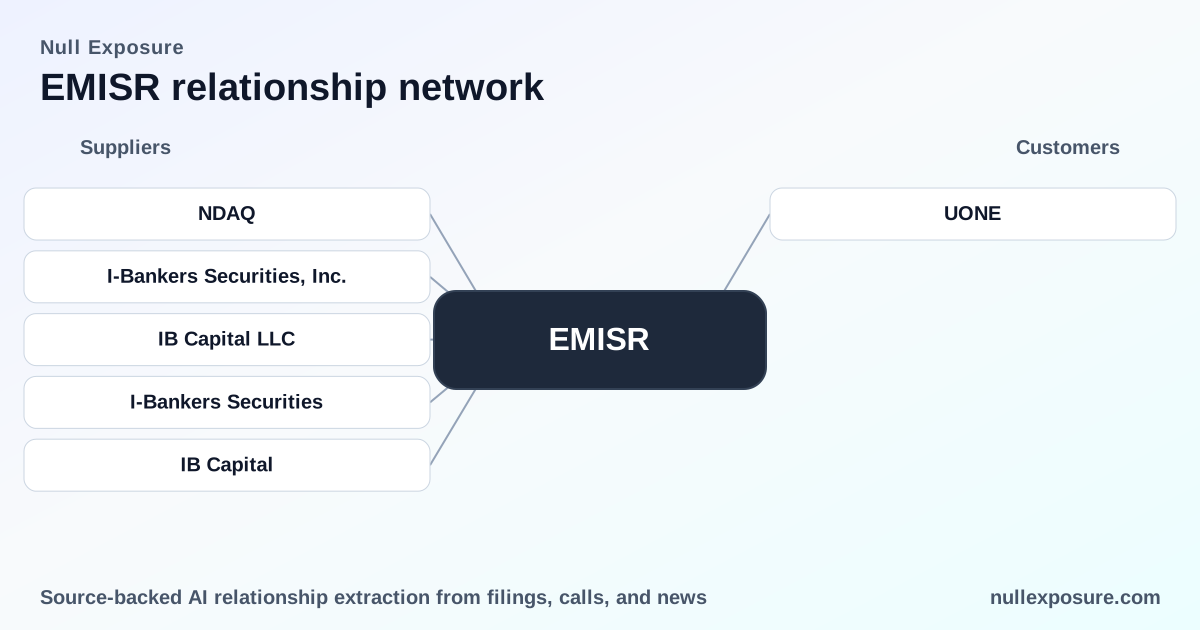
EMISR: Rights on a deal-driven vehicle — where value comes from and who the counterparties are
Emmis Acquisition Corp. Rights (EMISR) is a rights instrument tied to a deal-oriented acquisition vehicle that monetizes only when the sponsor locates and completes a qualifying business combination; investors in EMISR are effectively long the optionality of a successful merger and the sponsor’s ability to extract value from media and entertainment assets. The security carries no operating revenue or margin history, so valuation is driven entirely by deal execution, counterparty outcomes, and regulatory approvals. For a concise hub of ongoing coverage, see NullExposure’s homepage: https://nullexposure.com/
What EMISR actually owns — a compact operating thesis
EMISR represents a claim on future upside that only crystallizes through an M&A event or specified corporate action. There are no reported revenues, earnings, or balance-sheet operating metrics for the rights themselves; the instrument’s value therefore tracks three practical levers: (1) the probability and timing of a completed business combination, (2) the quality and liquidity of the target, and (3) any action by the sponsor to monetize or restructure rights pre- or post-combination. This makes the instrument intensely event-driven and highly sensitive to counterparties and regulatory developments.
Why a radio-asset sale matters to rights holders
A recent FCC-approved transaction involving Emmis Corp.—the broader media group historically associated with Emmis Acquisition activity—sheds light on the sponsor’s asset posture. The sale of four Indianapolis radio stations to Urban One for $25 million is a material signpost: it reduces legacy operating exposure for the Emmis franchise and converts illiquid radio assets into cash or deal capital that the sponsor can reallocate toward acquisition targets or shareholder distributions. Inside Indiana Business reported the FCC approval in March 2026, confirming regulatory clearance for the transaction (https://www.insideindianabusiness.com/articles/fcc-approves-urban-ones-purchase-of-emmis-radio-stations).
For ongoing deal flow and counterparty intelligence on EMISR-related activity, NullExposure maintains a running dossier at https://nullexposure.com/
Counterparty snapshots — what the public record shows
-
UONE (inferred symbol UONE)
The Federal Communications Commission approved a roughly $25 million purchase that transfers four Indianapolis radio stations from Emmis Corp. to Urban One; this transaction converts legacy radio assets into a traded-counterparty outcome that can materially affect sponsor capital allocation. Source: Inside Indiana Business, March 2026 (https://www.insideindianabusiness.com/articles/fcc-approves-urban-ones-purchase-of-emmis-radio-stations). -
Urban One (UONE)
Urban One is the acquirer in the FCC-cleared deal to buy four Indianapolis stations from Emmis Corp. for $25 million, a transaction that both reinforces Urban One’s local footprint and provides Emmis-related entities with a cash realization event. Source: Inside Indiana Business, March 2026 (https://www.insideindianabusiness.com/articles/fcc-approves-urban-ones-purchase-of-emmis-radio-stations).
Note: both relationship entries reference the same public news report; the duplication signals that the same transaction is being matched to slightly different counterparty labels in open-source aggregation.
Constraints and operating-model characteristics investors should factor in
There are no explicit constraint excerpts attached to EMISR in the available record; treat the following as company-level signals derived from the securities type and activity profile rather than relationship-specific constraints.
-
Contracting posture — opportunistic and concentrated. As a rights instrument tied to an acquisition vehicle, EMISR’s contracting posture is transactional: the sponsor enters discrete, often bespoke deals rather than recurring supply contracts. That concentrates execution risk around a small number of counterparties and closing events.
-
Concentration risk — high. Value depends on one or a few successful business combinations and on the sponsor’s access to counterparties and financing. The recent sale of Emmis radio assets to Urban One underscores that a limited number of asset dispositions can materially alter the sponsor’s balance of deal capital.
-
Criticality — binary for investors. For holders of the rights, counterparties and regulatory approvals are critical triggers—either enabling conversion/exercise value or leaving the instrument out-of-the-money. For counterparties like Urban One, the deal is incremental to operating scale but not existential.
-
Maturity — early / event-driven. Rights instruments are by design finite and contingent; absent a completed business combination, they carry little to no operating track record. EMISR shows zero reported revenues or earnings, consistent with a pre-combination or non-operating security.
Investment implications and risk checklist
-
Event risk dominates: EMISR’s return profile is driven by the sponsor’s ability to close a business combination within any applicable timeframe and to select a target with tradable fundamentals. The Urban One transaction is useful evidence that Emmis-related entities can monetise assets, but this single event does not reduce overall deal risk.
-
Regulatory clearances matter: The FCC’s approval for the Urban One purchase demonstrates that the regulatory pathway can be cleared on material media transactions—an operational positive for sponsors targeting regulated assets.
-
Liquidity and transparency are limited: The rights instrument discloses no operating metrics; investors should expect low liquidity and asymmetric information until a definitive merger agreement is announced.
-
Counterparty outcomes feed sponsor flexibility: Asset sales to parties like Urban One convert operating assets into cash, improving the sponsor’s optionality. If the sponsor redeploys proceeds into higher-quality targets, rights revaluation could follow; if proceeds are insufficient or misallocated, downside persists.
Practical takeaways for portfolio managers
-
Treat EMISR as a pure play on merger execution and regulatory approvals, not as an operating company exposure. Position sizing should reflect binary payoffs and low secondary-market liquidity.
-
Monitor sponsor disclosures and counterparty transactions (like the Urban One acquisition) as leading indicators of deal intent and capital availability.
-
Use regulatory filings and local industry press—such as the Inside Indiana Business report in March 2026—for near-real-time intelligence on asset dispositions that influence sponsor firepower.
Bottom line
EMISR is a rights instrument whose value is entirely event-driven; the March 2026 FCC-approved sale of four Indianapolis stations to Urban One exemplifies the kind of counterparty transaction that can materially alter the sponsor’s capital posture. For investors and operators, the primary questions are: will the sponsor redeploy realized proceeds into a compelling combination, and can it clear the remaining regulatory and financing hurdles? For ongoing monitoring and contextual intelligence, visit NullExposure’s research hub: https://nullexposure.com/