Eastern Company (EML): Customer Relationships, the Factory No.9 Sale, and What Investors Should Know
Eastern Company designs, manufactures, and sells engineered industrial hardware and turnkey solutions, monetizing through product sales and long-running engineered contracts in its single Engineered Solutions segment. Revenue is driven by manufacturing and custom tooling work, with notable customer concentrations and a North American sales focus that shapes contract terms and credit exposure. For a concise map of customer ties and commercial risk, visit https://nullexposure.com/.
A clear transaction: Eastern sold Factory No.9 assets to a Philip Morris subsidiary
Eastern disposed of the land, buildings and currently rented equipment of its Factory No.9 to United Tobacco Co. (UTC), a subsidiary of Philip Morris International, for EGP 1.58 billion (reported as roughly $32.66 million). This was reported in industry press in July 2024 and covered by Tobacco Reporter citing Ahram Online.
According to the coverage, the transaction is an asset sale (land, buildings and rented equipment) rather than a sale of operating business units, which has direct balance-sheet and cash-flow implications. (Tobacco Reporter / Ahram Online, July 2024)
Why this sale matters to investors: liquidity, strategic focus, and capitalization
The Factory No.9 sale is a discrete, cash-generating transaction that reduces Eastern’s non-core asset footprint and injects near-term liquidity. For investors, the sale:
- Improves operational focus by removing a property and associated leased equipment from the portfolio.
- Provides a cash inflow roughly comparable in scale to large customer revenue relationships the company reports, which can be deployed to operations, pay down short-term liabilities, or fund capital expenditure.
This sale does not eliminate customer concentration risk intrinsic to Eastern’s business; it is an asset monetization rather than a wholesale shift in customer composition.
How Eastern’s customer relationships actually operate
Eastern sells engineered products and recognizes revenue under ASC 606 when control transfers to customers. The company’s operating model combines standard product sales and contract manufacturing for industrial clients. Key structural features that govern customer relationships:
- Seller posture: Eastern is principally a manufacturer and seller of engineered solutions, designing and delivering components and assemblies to industrial customers under a mix of spot and contract arrangements.
- Contracting posture (signal): There is evidence Eastern uses percentage-of-completion accounting (efforts-expended) on some tool-and-mold contracts, producing a long-term contracting signal for parts of the business — this implies multi-period delivery and billing profiles for certain customers.
- Regional concentration: Sales are primarily to North American customers, which concentrates market and currency exposure in that geography.
- Segment concentration: The company reports a single Engineered Solutions segment that aggregates diverse manufactured hardware, tooling and security/access products.
- Revenue scale per customer: Company disclosures identify customers in the $10m–$100m spend band, indicating materially sized single-customer revenues are a persistent feature of the business.
These characteristics create a classic industrial supplier profile: custom engineering work, some long-duration contracts, and significant customer concentration.
Customer concentration and credit risk: the hard numbers
Eastern discloses a material credit concentration: one customer represented 14% of accounts receivable at year-end and generated $35.6 million of revenue in 2024 (12% of the Engineered Solutions segment). That concentration is a direct commercial risk—large receivables tied to a single counterparty can amplify working-capital strain if collection weakens. This is a company-level disclosure reflecting materiality, not tied to any single publically-named buyer in the filings.
Relationship-by-relationship summary (complete coverage)
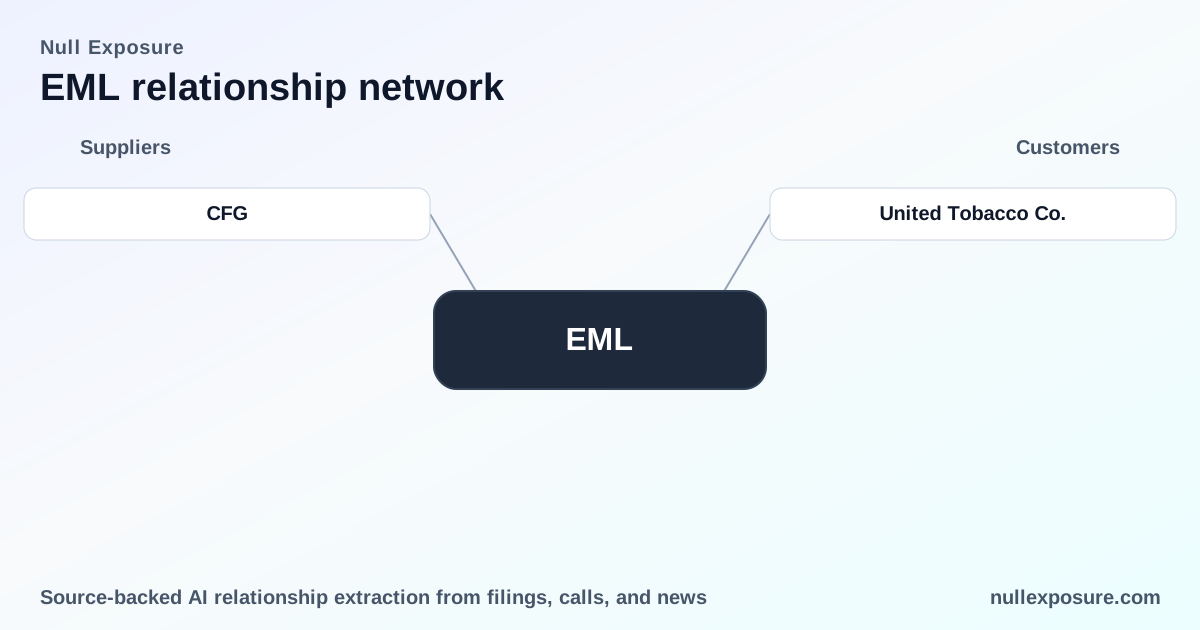
- United Tobacco Co. — Eastern sold Factory No.9 assets (land, buildings and rented equipment) to United Tobacco Co., a subsidiary of Philip Morris International, for EGP 1.58 billion (about $32.66 million). This was reported by Tobacco Reporter citing Ahram Online in July 2024 and represents a property asset sale rather than an operating-customer revenue change. (Tobacco Reporter / Ahram Online, July 2024)
This article covers every customer relationship reported in the available results; the Factory No.9 sale is the single, discrete customer-facing transaction surfaced in public coverage.
Operational constraints that shape deal economics
Several constraint signals from company disclosures and reporting color how management negotiates with customers and manages risk:
- Long-term contract posture (moderate confidence): Eastern’s use of the efforts-expended method for certain Big 3 Mold projects indicates some engagements are recognized over time, creating revenue that is lumpy and tied to project milestones rather than steady product sales.
- North American concentration (high confidence): Foreign sales are primarily to customers in North America; this focuses both demand risk and receivables exposure geographically.
- Material counterparty concentration (high confidence): The company-level disclosure of a customer representing double-digit percentages of receivables and Engineered Solutions revenue is a high-impact single-customer exposure that constrains downside protection.
- Seller role and active relationships (moderate-to-high confidence): Eastern functions as a seller of engineered products and maintains active receivable exposure from customers, making credit management and working capital policies central to financial stability.
- Manufacturing segment dynamics (high confidence): The single Engineered Solutions reporting structure means performance is sensitive to cycles in tooling, automotive and industrial demand.
- Spend-band signal (high confidence): The presence of $10m–$100m customer revenue relationships implies any loss or delay from a large customer meaningfully affects top-line and cash conversion.
These are company-level signals and should be read as structural constraints on Eastern’s business model rather than attributes of any one reported purchaser unless specifically named.
Investor implications and near-term watchlist
- Concentration risk is the primary credit and operational vulnerability. A single large customer exposure creates earnings and receivables volatility.
- Asset monetizations like the Factory No.9 sale are constructive for liquidity but do not substitute for diversified customer demand. Use proceeds to reduce debt or fund capacity improvements that expand addressable markets.
- Contract mix matters: Long-duration engineering contracts bring margin stability when execution is strong but translate to revenue recognition and cash-timing risk when projects slip.
- Geographic focus simplifies market exposure but heightens sensitivity to North American industrial cycles and trade dynamics.
For investors and operators evaluating counterparties and credit exposure, a structured relationship map and monitoring cadence are essential — more detailed relationship intelligence is available at https://nullexposure.com/.
Bottom line
Eastern is a concentrated, manufacturing-led supplier with a mix of long-term contracts and high-single-customer exposure. The Factory No.9 sale to a Philip Morris subsidiary is a meaningful liquidity event but does not resolve the underlying concentration in receivables and revenue. Investors should treat Eastern as an industrial operator whose upside depends on execution against bespoke contracts and whose downside is amplified by customer concentration and North American cyclicality.
For ongoing monitoring and deeper relationship insights, visit https://nullexposure.com/.