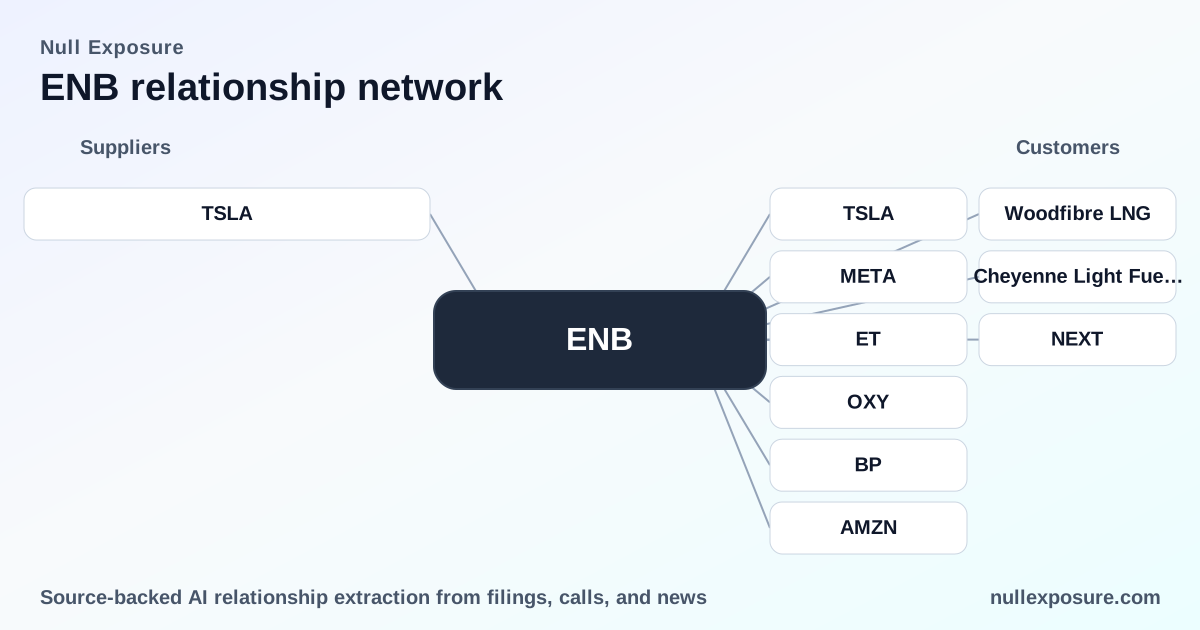
Enbridge's customer map: contract durability and the strategic partners that underwrite future growth
Enbridge monetizes a coast‑to‑coast energy infrastructure matrix by collecting regulated tolls and long‑term contract revenues from pipeline transportation, storage and power generation assets, while selectively developing merchant and contracted renewable and utility‑scale projects for corporate off‑takers. Revenue predictability rests on a mix of long‑dated PPAs, regulated cost‑of‑service frameworks and take‑or‑pay arrangements, complemented by usage‑based interruptible services and project‑level collaborations with large energy and tech customers. For investors, the question is not whether Enbridge has customers, but how contract structure, counterparty quality and project criticality translate into cash flow durability and capital allocation priorities. For more investor‑oriented signals and relationship analytics, visit https://nullexposure.com/.
How Enbridge contracts and where that matters
Enbridge’s operating model is shaped by contract maturity and regulatory framing rather than volatile commodity exposure. Company filings through December 2025 disclose leases and contracts that range up to 40 years and note that “the vast majority of the power produced from these facilities is sold under long‑term PPAs.” That profile implies high revenue visibility for generation and transportation lines while leaving a modest share of interruptible, volume‑sensitive revenue that can amplify cyclical swings in low‑demand periods.
- Contracting posture: Predominantly long‑term and framework agreements with explicit regulated tolling in core pipeline businesses; take‑or‑pay and long‑dated PPAs underpin renewables and CO2 infrastructure.
- Concentration and criticality: Enbridge services large industrial and technology customers (data centres, LNG developers, majors) whose operations are often mission‑critical and supported by firm offtake or capacity arrangements.
- Maturity and spend profile: Balance between mature regulated pipelines and high‑capex sanctioned projects; evidence of multi‑hundred‑million dollar project spend and portfolio expansions that carry 100M+ spend characteristics.
- Commercial roles: Enbridge functions primarily as a service provider and transporter, while also acting as a buyer in commodity or generation contracts where it makes commercial sense.
Customer relationships and what each partner signals
Below I cover every partner referenced in Enbridge’s recent public record. Each entry is a concise, plain‑English summary with the relevant public source.
Tesla (TSLA)
Enbridge described a battery energy storage system that will be supplied and operated by Tesla and expandable to 200 MW pending utility approval expected in H1 2026, positioning Tesla as the equipment and O&M partner on Enbridge’s BESS projects. (Enbridge Q4 2025 earnings call transcript, March 7, 2026.)
Meta Platforms (META)
Meta is a strategic off‑taker for Enbridge renewables: Enbridge disclosed power purchase agreements and a $400M Texas onshore wind project plus a 152 MW Easter wind project where Meta signed the PPA to support its data‑centre operations. These deals represent corporate PPA demand driving merchant renewable capex. (Enbridge Q3/Q4 2025 remarks; Enbridge press release March 9, 2026; Finviz/Globe and Mail coverage, FY2026.)
Amazon (AMZN)
Amazon is named among major technology and data‑centre customers backing over 2 GW of renewable power projects in Enbridge’s development pipeline, indicating large‑scale corporate demand for contracted green power. (Enbridge Q3 2025 earnings call, March 2026.)
Energy Transfer (ET)
Energy Transfer is a pipeline capacity collaborator: Enbridge announced a second phase of mainline optimization that will utilize Dakota Access Pipeline capacity in partnership with Energy Transfer, reflecting asset‑level cooperation to improve throughput. (Enbridge Q3 2025 earnings call, March 2026.)
Occidental Petroleum (OXY)
Enbridge will partner 50/50 with Occidental on the Pelican CO2 Hub, where Enbridge manages pipeline infrastructure and Oxy manages sequestration; the project is supported by a long‑term take‑or‑pay offtake with an investment‑grade counterparty and is expected in service in 2029 — a signal of high‑certainty cash flows for the CO2 transport leg. (Enbridge Q3 2025 earnings commentary and company filings, FY2025.)
BP (BP)
Enbridge is expanding its Canyon system to provide transportation services for BP’s sanctioned Tiber Offshore development, underlining Enbridge’s role as an integrated midstream transport provider to energy majors. (Enbridge Q3 2025 earnings call, March 2026.)
TVA (TVE)
The Tennessee Valley Authority has an agreement with Enbridge for the Kingston project, a ~122‑mile pipeline across six Tennessee counties, illustrating Enbridge’s engagements with regional utilities and public authority counterparties. (WPLN reporting on TVA‑Enbridge agreement, FY2024 context.)
Cheyenne Light Fuel and Power (CLFP)
Enbridge’s press materials state that BESS capacity will be contracted under a long‑term fixed‑price battery tolling agreement with Cheyenne Light, using the same LPCS tariff and with Tesla supplying and maintaining the batteries — a hybrid commercial model blending regulated tariffs and tolling contracts. (Enbridge press release March 9, 2026.)
NextDecade (NEXT)
Enbridge sanctioned the Bay Runner extension to the Whistler Pipeline to serve NextDecade’s Rio Grande LNG development, demonstrating Enbridge’s role in enabling LNG export projects through targeted pipeline expansions. (Enbridge media release March 9, 2026.)
Woodfibre LNG
Regulatory reports show the Sunrise pipeline expansion is positioned to supply the Woodfibre LNG export facility, slated to begin operations in 2027, which is consistent with Enbridge’s strategy of aligning pipeline capacity with near‑term LNG demand. (Pipeline‑Journal coverage on CER recommendation, FY2026.)
What this customer map means for investors
Across these relationships, two investment realities stand out. First, Enbridge’s cash flows are structurally supported by long‑dated commercial frameworks (PPAs, take‑or‑pay, regulated tariffs) that reduce volume volatility for core assets. Company filings through year‑end 2025 confirm long lease terms and widespread use of long‑term contracts for transportation and power sales. Second, strategic collaborations with global tech names and energy majors both diversify demand across sectors and concentrate project risk into a smaller number of large capex initiatives — high dollar projects that are fundamental to near‑term organic growth but require execution and counterparty performance.
Key risk and upside vectors are equally clear: execution on sanctioned projects (BESS, Wind, CO2 hubs, LNG connectors) can meaningfully lift regulated and contracted EBITDA; conversely, delays in permits, utility approvals (e.g., BESS expansion) or off‑taker contract scope changes would stress near‑term capital deployment and returns.
If you want a deeper, transaction‑level readout of these contracts and their cash‑flow implications, our platform synthesizes public filings, earnings transcripts and corporate releases into an investor‑grade relationship map — visit https://nullexposure.com/ for methodology and subscription details.