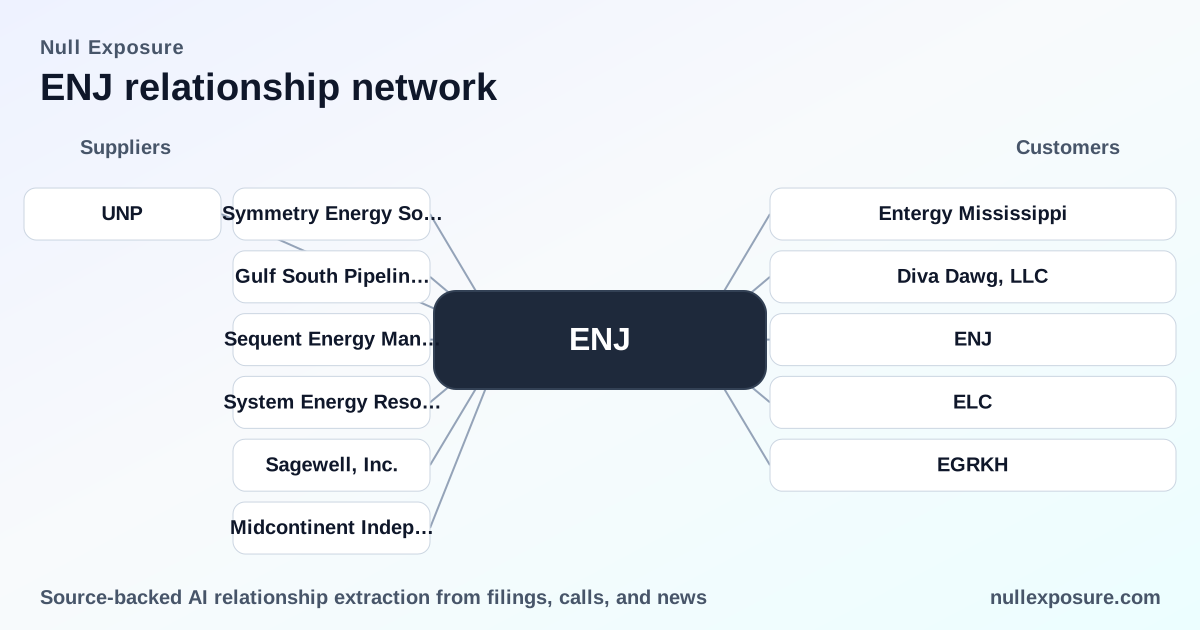
Entergy New Orleans (ENJ): Customer Relationships that Drive Cash and Regulatory Risk
Entergy New Orleans operates and monetizes as a regulated utility providing electric (and a small legacy natural gas) service to the City of New Orleans and surrounding customers. Its commercial model combines core retail electricity sales with affiliate power purchase arrangements and regulatory riders that recover capital and storm-related costs, producing predictable top-line cash flows but concentrating revenue exposure inside regulated frameworks and a handful of counterparties. Explore more customer intelligence at https://nullexposure.com/ for full context and filings.
Investment thesis in one paragraph
ENJ’s business is primarily retail electricity distribution with monetization through regulated rates, cost‑recovery riders and affiliate power contracts; materially, several affiliated Entergy companies are counterparties to the Unit Power Sales Agreement that supplies the Grand Gulf nuclear plant’s output, while the company also manages short‑term market sales and municipal/regulatory cost‑recovery frameworks that shape near‑term cash flow. Regulation and affiliate contracting are the structural drivers of revenue and the principal concentration risk.
How the company contracts and where the money flows
ENJ’s operating model is a hybrid of regulated retail distribution and centralized generation contracts. The 2024 Form 10‑K discloses the Unit Power Sales Agreement under which System Energy (Grand Gulf) sells its capacity and energy to four affiliated purchasers—Entergy Arkansas, Entergy Louisiana, Entergy Mississippi, and Entergy New Orleans—with specified percentage allocations. Those affiliate payments are System Energy’s only source of operating revenue, making these relationships commercially critical even though no single retail customer accounts for over 10% of consolidated revenue. (Source: ENJ 2024 Form 10‑K.)
- Contract posture: long-term anchor (Unit Power Sales Agreement) combined with framework and short-term rider programs approved by local regulators for resilience and storm hardening; the company also executes day‑ahead spot sales in ISO markets for incremental energy. (Source: ENJ 2024 Form 10‑K; regulatory filings cited in the 2024 disclosures.)
- Counterparty mix: a regulated retail base dominated by residential customers, meaningful large industrial/C&I demand (data centers, petroleum and chemical industries), and a small share of governmental accounts—this shapes revenue stability and political/regulatory sensitivity. (Source: ENJ 2024 Form 10‑K.)
- Capital intensity and spend bands: multi‑hundred‑million dollar generation investments and multi‑million rider recoveries are embedded in planning, with recent projects and recovery mechanisms in the $10m–$100m and $100m+ ranges. (Source: ENJ 2024 Form 10‑K.)
Contracting constraints that shape credit and growth
ENJ’s cash flows are shaped by regulatory approvals and structured riders: the Louisiana Public Service Commission and local City Council approvals produced a resilience framework and a shorter two‑year resilience plan, both with explicit recovery mechanisms through forward‑looking riders with periodic true‑ups. That creates a predictable channel for capital recovery, but subjects near‑term cash and earnings to regulatory timing and approval risk. The Unit Power Sales Agreement locks long‑dated supply allocations (Grand Gulf operating license through 2044) and fixed percentage shares among four affiliates, making System Energy highly dependent on those intercompany payments for operating revenue. (Source: ENJ 2024 Form 10‑K.)
Explore primary filings and relationship detail at https://nullexposure.com/ to reconcile regulatory timing against cash flow.
Customers and counterparties investors should map (each relationship from the record)
Entergy Mississippi
Entergy Mississippi is an affiliated purchaser under the Unit Power Sales Agreement and received approximately $16.4 million per month in 2024 under that arrangement, and it has executed large customer supply and service agreements to serve new data center demand (e.g., AWS projects). (Source: ENJ 2024 Form 10‑K; March 2024 filings cited in the 2024 Form 10‑K.)
Diva Dawg, LLC
Diva Dawg, LLC is a small commercial customer cited in local reporting after receiving a large utility bill; the mention signals retail billing and collections exposure at the small‑business level rather than strategic revenue concentration. (Source: WDSU local news coverage on customer billing; article referenced in 2026 news sentiment results.)
Delta Utilities
Delta Utilities is the newly formed acquirer of Entergy’s local natural gas business; reporting shows Entergy New Orleans completed or is completing the sale of its gas system to Delta Utilities, shifting parts of gas distribution operations out of ENJ’s ongoing utility footprint. (Source: Axios coverage, June 2025; WDSU reporting noting the acquisition timeline.)
Entergy New Orleans (as a counterparty)
Entergy New Orleans is both the corporate entity and a buyer under the Unit Power Sales Agreement, allocated roughly 17% of Grand Gulf’s capacity and energy and included in the consolidated affiliate purchase schedule. The company also implemented resilience riders and filed local plans with the City Council for storm hardening cost recovery. (Source: ENJ 2024 Form 10‑K; local City Council and regulatory disclosures summarized in the 10‑K.)
Entergy Louisiana
Entergy Louisiana is an affiliate buyer of Grand Gulf output (about a 14% allocation) and files with the LPSC for resource approvals related to large new customers such as data centers; the LPSC‑approved frameworks and ancillary orders have led to recorded regulatory liabilities and credits tied to securitization proceedings. (Source: ENJ 2024 Form 10‑K.)
EGRKH
EGRKH appears in the reporting as the ticker representation associated with affiliate purchase disclosures; filings show the Grand Gulf output allocations and consequent monthly payment flows tied to that reporting entity, reflecting the intra‑group sales that underpin System Energy’s revenue. (Source: ENJ 2024 Form 10‑K.)
Entergy Arkansas
Entergy Arkansas is the largest affiliate purchaser under the Unit Power Sales Agreement (approximately a 36% allocation) and had average monthly payments in 2024 in the range disclosed for its allocation (about $16.8 million). The company has also pursued rate filings and special rider tariffs that affect recovery of these intercompany costs from retail customers. (Source: ENJ 2024 Form 10‑K.)
What this means for investors — risks and levers
- Regulatory dependence is the dominant risk: FERC, LPSC and local councils determine recoverability of costs and riders; the company discloses the risk that regulators could disallow full cost recovery, which would materially affect operating results despite the affiliate sales construct. (Source: ENJ 2024 Form 10‑K.)
- Concentration through affiliate contracts is critical operationally but not necessarily a single‑customer revenue concentration: while no retail customer accounts for more than 10% of revenues, System Energy’s exclusive reliance on affiliate payments for its operating revenue makes those intercompany contracts a critical audit and valuation focal point. (Source: ENJ 2024 Form 10‑K.)
- Growth pathways are anchored in large C&I and data center wins: executed supply agreements for new data center demand and filings to support service to major cloud and technology customers are growth catalysts that also require incremental capital and regulatory approval. (Source: ENJ 2024 Form 10‑K.)
- Near‑term cash recovery is shaped by rider mechanics and storm restoration timing: the company has implemented short‑term resilience riders and true‑up mechanics that accelerate recovery but increase sensitivity to regulatory timing and public scrutiny. (Source: ENJ 2024 regulatory disclosures summarized in the 10‑K.)
Final takeaways
- ENJ’s cash flows are driven by regulated retail tariffs and a small set of affiliate power purchase agreements that are operationally critical.
- Investors should prioritize monitoring regulatory decisions, rider true‑ups, and the status of the Unit Power Sales Agreement allocations when assessing credit and valuation.
For direct access to the filings and relationship tracking used in this note, visit https://nullexposure.com/.