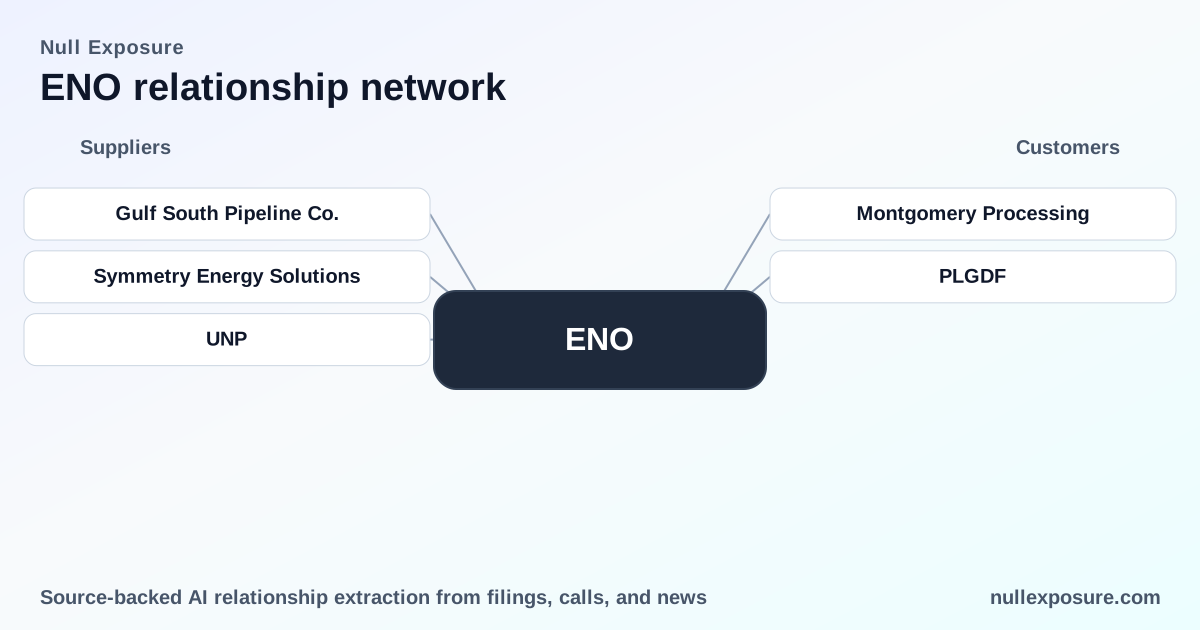
Entergy New Orleans (ENO): Customer relationships and what they signal for investors
Entergy New Orleans operates as a regulated electric and small-scale gas utility, monetizing primarily through rates approved in regulatory proceedings and periodic riders that pass through fuel and storm-related costs. ENO’s cash flow profile depends on long-term power purchase agreements, volumetric energy sales to a mix of residential, commercial, industrial and governmental customers, and regulatory mechanisms that permit recovery of specific programmatic expenses. For investors evaluating counterparty exposure and revenue durability, the company’s 2024 Form 10‑K provides explicit disclosures on recent asset sales and the nature of its customer base that shape concentration, contract tenor, and rate recovery risk. For broader analysis tools and relationship intelligence, visit https://nullexposure.com/.
Executive takeaway: regulated seller with mixed counterparty exposure
Entergy New Orleans is a regulated seller of electricity and gas embedded in a multi-state utility group. Its revenue generation is shaped by three structural factors: (1) regulatory-determined pricing and riders that create predictable, usage-linked cash flows; (2) long-term contracted supply arrangements that lock in generation costs or capacity obligations; and (3) customer concentration risk driven by large industrial and data-center customers at certain operating companies within the Entergy group. These dynamics produce a core utility cash flow profile — stable, rate-regulated, and sensitive to regulatory outcomes and large-customer demand.
Why these relationship disclosures matter to investors
- Regulatory recovery is effectively the monetization conduit; riders and rate cases determine short- to medium-term cash flow variability.
- Contract tenor (long‑term PPAs) increases predictability of supply cost but also creates fixed obligations that could shift regulatory priorities.
- Customer concentration is mixed: no single customer exceeds 10% of consolidated revenues, but certain operating companies rely materially on a small set of large customers, which raises project and credit concentration risk.
Operating model and constraints that shape customer economics
The 2024 filing contains several company-level signals that describe ENO’s contracting posture, counterparty mix, geography, and materiality profile:
- Contracting posture: long-term orientation. ENO references long-term purchased power agreements (PPAs) selected through RFP processes, which indicates an operating model that relies on extended-duration supply contracts to secure capacity and energy. (ENO 2024 Form 10‑K)
- Usage‑based monetization through riders. The company and its utility peers recover fuel and purchased energy costs via energy cost recovery riders and similar mechanisms, making revenue partially volumetric and linked to consumption. (ENO 2024 Form 10‑K)
- Counterparty mix is broad but includes government and very large enterprise customers. The filing discloses sales to residential, commercial, industrial and governmental classes, and specifically documents efforts to serve very large customers such as data centers (e.g., a Meta Platforms data center project referenced in October 2024 filings). This creates a layered exposure profile: many small accounts plus a limited number of high‑value enterprise relationships. (ENO 2024 Form 10‑K)
- Geographic concentration: North America (U.S.). Revenues and assets are concentrated within the United States, principally Arkansas, Louisiana, Mississippi, and Texas — including the City of New Orleans. Regulatory outcomes in these jurisdictions determine allowable rates. (ENO 2024 Form 10‑K)
- Materiality nuance: no single customer >10% of revenue, but project concentration exists. The company discloses that no individual customer exceeds 10% of revenues at the consolidated level, while also noting that investments to serve large data centers can create significant localized concentration risks for the relevant utility operating company. (ENO 2024 Form 10‑K)
- Role posture: primarily a seller with affiliated service provider arrangements. The registrant acts as the seller of electricity and gas; affiliated Entergy Services provides centralized management and administrative services. (ENO 2024 Form 10‑K)
- Spending and program impact signals. The filing includes examples of monthly recovery requests (for instance, an Entergy Mississippi filing to collect approximately $5.2 million per month for vegetation management and a storm provision), which illuminate the order of magnitude for regulatory-recovery spend bands. (ENO 2024 Form 10‑K)
These constraints together produce a business model that is regulated, volume‑sensitive, contract‑backed, geographically concentrated in the U.S., and exposed to large-customer project risk.
Customer relationships disclosed in the 2024 filing
Below are the relationships extracted from ENO’s FY2024 10‑K. Each entry is summarized in plain English and referenced to the company filing.
Montgomery Processing
Montgomery Processing is referenced in connection with the sale of regulated natural gas local distribution company businesses to affiliates of Bernhard Capital Partners Management LP, indicating ENO’s participation in asset divestiture activities linked to its gas distribution footprint. According to ENO’s 2024 Form 10‑K, these were implemented via separate purchase and sale agreements in FY2024. (ENO 2024 Form 10‑K)
Palisades
Palisades is discussed as a generation asset that was sold to Holtec International in June 2022, signifying a completed disposition of that plant and a reduction in company-owned generation capacity historically associated with Entergy. The 10‑K references the sale of the Palisades plant in its asset and operational disclosures. (ENO 2024 Form 10‑K)
PLGDF (inferred symbol for Palisades)
The identifier PLGDF appears as an inferred symbol referencing the same Palisades plant sale to Holtec International in June 2022, effectively duplicating the Palisades disclosure under an alternate name/symbol in the document metadata. The Form 10‑K includes the plant sale language and the PLGDF notation in related references. (ENO 2024 Form 10‑K)
Risk implications and investor checklist
- Regulatory outcomes are the single biggest driver of cash‑flow durability. Rate cases and rider approvals determine recoverability of fuel, storm, vegetation and major project costs. (ENO 2024 Form 10‑K)
- Large-customer projects create localized credit and concentration risk. While consolidated revenue concentration is below 10% per customer, targeted investments to serve data centers or industrial customers can materially influence a given operating company’s sales and cash flow. (ENO 2024 Form 10‑K)
- Asset dispositions change generation mix and contract exposure. Plant sales such as Palisades eliminate legacy generation risks but also shift reliance toward PPAs and market purchases. (ENO 2024 Form 10‑K)
- Counterparty diversity balances volumetric exposure. The customer mix (residential, commercial, industrial, governmental) provides a natural hedge against a downturn in any single segment; nonetheless, enterprise customers warrant active monitoring given their outsized demand profiles. (ENO 2024 Form 10‑K)
What to watch next
Investors should monitor upcoming regulatory filings and rate case outcomes in New Orleans and neighboring states, the status of long‑term PPAs and transmission approvals tied to large-customer projects, and any further asset sales that alter the company’s supply portfolio. For ongoing monitoring of ENO’s counterparty disclosures and to track relationship-level changes over time, see additional resources at https://nullexposure.com/.
Bold conclusions: ENO is a regulated seller with predictable recoveries, but concentrated project risk from large customers and the lifecycle of generation assets (sales, PPAs) materially shape future earnings volatility.