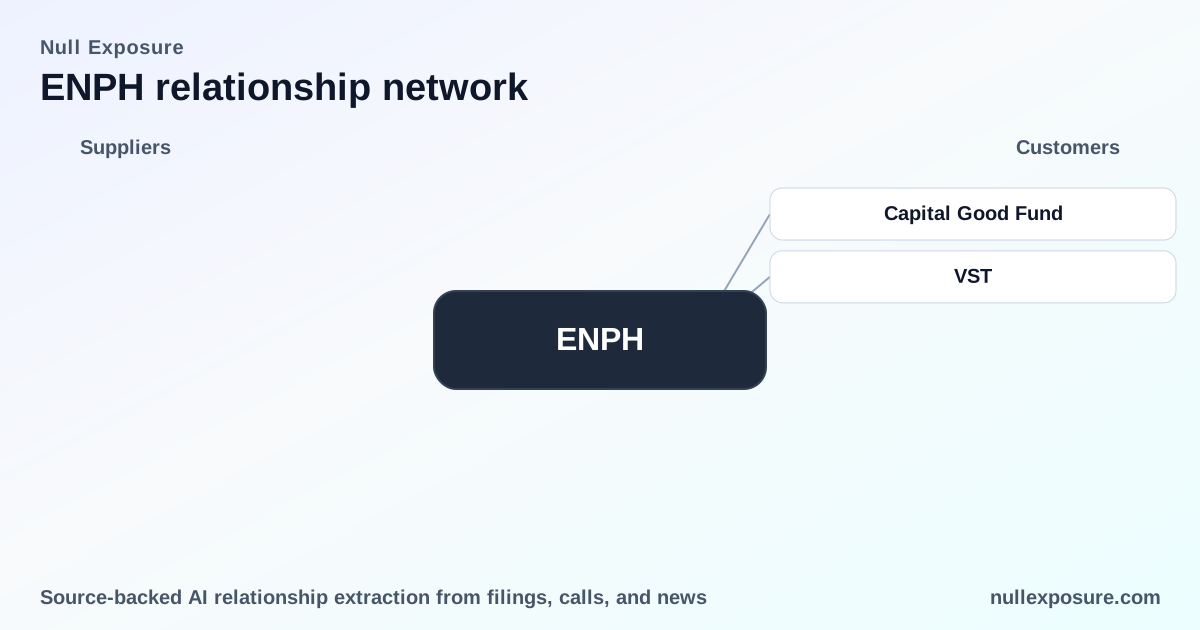
Enphase Energy (ENPH): Customer Relationships Drive Hardware Sales and Grid Services Growth
Enphase Energy designs and sells microinverters, battery systems and complementary cloud services; it monetizes by selling hardware (IQ Microinverters, IQ Batteries, chargers, gateways) to distributors, large installers and homeowners, while capturing recurring revenue through cloud-based monitoring and deferred service recognition tied to those hardware sales. The company’s commercial strategy combines traditional distributor-led hardware channels with strategic partnerships that push its batteries into virtual power plants (VPPs) and subscription programs — a model that amplifies unit sales while scaling software-enabled value capture across grid services. Learn more about how we track customer relationships and signals at Null Exposure.
What the customer footprint tells investors about Enphase's operating model
Enphase runs a hardware-first business with growing services attached. The balance between upfront device revenue and multi-year, deferred service recognition (notably the 7-year recognition window on gateway and energy router sales) means revenue volatility from device cycles but improving lifetime value as software and VPP integrations scale.
Key company-level operating signals:
- Contracting posture is short-term: sales are principally by purchase order with no long-term purchase commitments from distributors, installers or end customers, which creates revenue flexibility but also exposure to order timing and cancellations.
- Mixed counterparty mix: revenue streams flow from individual homeowners (direct online sales, warranty/support programs) and large enterprise buyers (distributors, installers, OEMs and strategic partners).
- Geographic concentration and global reach: the U.S. accounts for a majority of revenues (roughly 70% in recent years), while Enphase also reports deployments in over 160 countries — a revenue base that is both domestic-heavy and globally distributed.
- High customer concentration: one customer represented roughly 48% of net revenues in the most recent year, making relationship retention and terms with major partners a material commercial risk.
- Role and channel structure: the company primarily sells through distributors who resell to installers, while selectively selling direct to large installers and to consumers online.
- Product mix maturity: the core product is mature silicon hardware (microinverters) with adjacent hardware (batteries, EV chargers) and cloud services that are still scaling.
These constraints position Enphase as a hardware market leader with growing, strategic exposure to grid services and VPPs, but with notable commercial vulnerabilities tied to order cycles and a concentrated revenue profile.
Relationship roll call: who Enphase is actively partnering with
Capital Good Fund — expanding access and community projects
Enphase entered a partnership with the Capital Good Fund to supply IQ Microinverters for approximately 24 megawatts of small commercial and residential solar projects in Georgia and Pennsylvania, explicitly targeting underserved communities and leveraging domestic content incentives. This collaboration signals a deliberate push into mission-driven, PPA/lease-funded deployments. (GlobeNewswire press release, March 3, 2026; referenced in multiple outlets, March 2026.)
Vistra (VST) — batteries integrated into a utility-scale VPP aggregation program
Vistra expanded its residential battery aggregation program to include Enphase IQ Batteries, scaling a Texas-focused virtual power plant to support grid reliability and energy market participation. This partnership places Enphase hardware inside a utility-scale aggregation stack and creates a direct route for battery deployments tied to energy market revenue. (PR Newswire, March 2026.)
Ensol — deploying IQ Batteries in France via subscription
Enphase announced a collaboration with Ensol, a French residential solar and storage provider, to expand IQ Battery deployments through Ensol’s battery subscription program for homeowners, representing a channel approach to European battery penetration. This is a clear example of Enphase using partner subscription models to accelerate international battery growth. (GlobeNewswire, April 28, 2026.)
SUNE (SUNation Energy) — distribution and installer ecosystem presence
Enphase is named among the leading solar and storage brands maintained by SUNation’s platform, alongside competitors like Tesla, indicating continued channel relationships with installation and roof-to-panel integrators in the U.S. market. These listings reinforce Enphase’s entrenched position with national installers and reseller platforms. (Sunation Energy results release via GlobeNewswire, March 2026.)
Evergen — IQ Battery integration with Australian VPP orchestration
Enphase integrated IQ Batteries with Evergen, a major VPP orchestration platform in Australia and New Zealand, enabling retailer-led VPP participation and optimization for homeowners in that region. This partnership underscores the international strategy of embedding Enphase batteries within third-party grid orchestration stacks to expand VPP addresses. (GlobeNewswire disclosure of April 22, 2026; commentary in regional market coverage, April–May 2026.)
Why these relationships matter: growth vectors and downside exposures
These named partnerships collectively illuminate two strategic threads:
- Scale through aggregation and grid services: integrations with Vistra and Evergen move Enphase from pure device supplier to a node in value streams for grid services and energy markets — a higher-margin channel if customer acquisition and orchestration succeed.
- Market breadth via targeted channels: collaborations with Capital Good Fund and Ensol show the company is pursuing both mission-driven community deployments and subscription models in Europe, diversifying go-to-market beyond traditional distributor/installer networks.
At the same time, investors must weigh structural risks:
- Revenue concentration is material, with a single customer historically contributing near half of net revenues; customer-retention issues or pricing pressure from large buyers would materially affect top-line performance.
- Short-term purchase commitments amplify cyclicality, meaning quarter-to-quarter visibility is limited despite an expanding software-led value proposition.
- Channel dependency: heavy reliance on distributors and installers shapes unit growth velocity and puts emphasis on partner economics and inventory management.
Bold takeaway: Enphase’s competitive moat is rooted in its hardware installed base and growing software/VPP integrations; unlocking long-term margin expansion requires converting device-led installs into recurring grid service revenue while managing concentration and short-term order volatility.
Quick investor checklist
- Monitor quarterly commentary for changes in the identity of the largest customer and any sign of revenue de-concentration.
- Track deployments tied to VPP integrations (Vistra, Evergen) and subscription programs (Ensol, Capital Good Fund) as leading indicators of recurring service revenue expansion.
- Watch distributor inventory and purchase-order language for signs of order cadence shifts given the company’s short-term contracting posture.
For a deeper view of Enphase customer relationships and how they affect revenue risk and upside, visit Null Exposure.
Conclusion: Enphase runs a lucrative, hardware-dominant platform that is transitioning into higher-value grid services, evidenced by strategic partnerships across community finance, utility aggregation and international orchestration platforms; the investment case depends on execution — converting these partnerships into durable, recurring revenue while managing concentration and order-cycle risk.