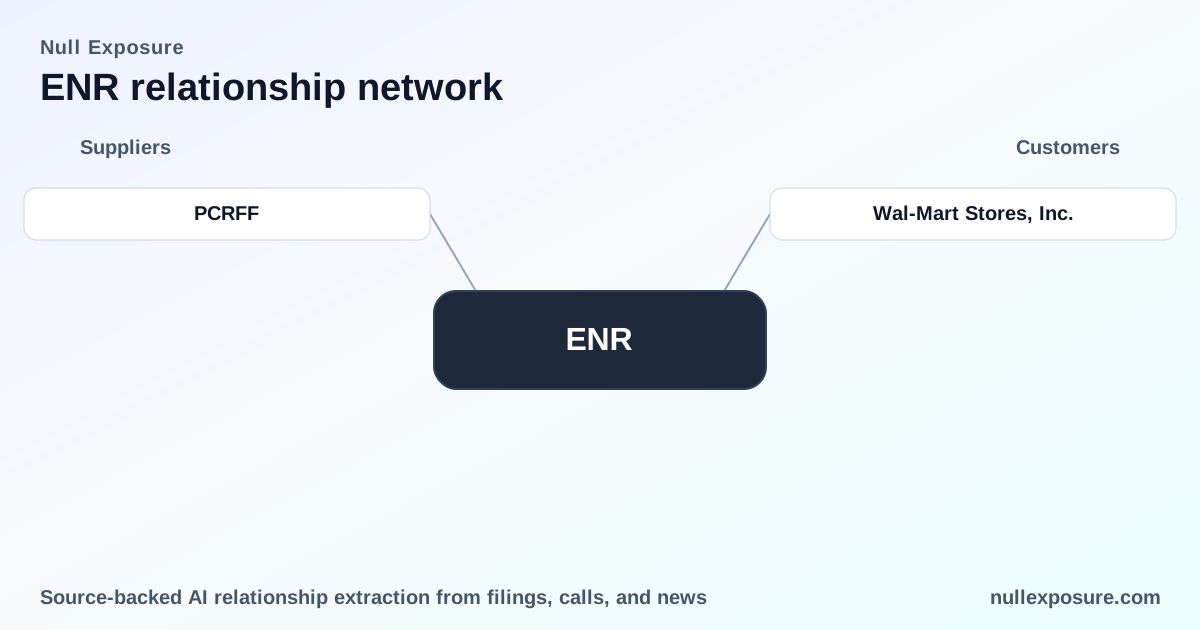
Energizer’s customer map: concentration, channels and where revenue actually sits
Energizer Holdings sells and monetizes primarily through the manufacture, branding and global distribution of batteries, portable lighting and related household products, combining direct retail sales with branded licensing agreements. Revenue comes from product sales to retail and wholesale channels plus royalties and license fees from partners that use Energizer’s brand in adjacent product lines — a hybrid industrial-consumer model that leverages scale, shelf presence and brand equity to convert unit volume into steady cash flow. For a quick look at the company’s investor tools and relationship analytics, visit https://nullexposure.com/.
Quick investment thesis
Energizer is a mature branded manufacturer that monetizes through recurring retail placement and selective licensing; concentration in large retail customers is the principal commercial risk, while the company’s diversified channel mix and licensing program provide margin levers and optionality. Investors should weigh a defensible consumer brand with modest operating leverage against dependency on a handful of high-volume partners.
What the customer list tells us about how Energizer contracts and sells
Energizer’s operating model mixes direct sales, distributor networks and brand licensing. The company discloses a sales model that includes a global direct sales force plus exclusive and non‑exclusive distributors and wholesalers, and also licenses the Energizer, Eveready and Rayovac brands for third‑party product lines. These characteristics imply a contracting posture that is flexible — a blend of transactional retail agreements and longer‑term licensing contracts — and a distribution footprint that is broad geographically but concentrated commercially (see concentration discussion below). This is a global, mature consumer-products supplier: contracts tend to be repetitive retail-supply or licensing arrangements rather than bespoke, single-project engineering contracts.
Key implications for investors
- Concentration risk is measurable given reliance on large retail partners for high-volume sales.
- Contracting posture is mixed: short-to-medium term supply agreements with retailers and longer-term, revenue-generating licensing deals.
- Channel diversification (retail + licensing + distributors) reduces single-channel exposure but does not eliminate large-customer effects on margins and working capital.
Every named relationship and what it means for ENR investors
Wal‑Mart Stores, Inc.
Wal‑Mart accounted for 12.8% of Energizer’s net sales in fiscal 2025, and was similarly significant in 2024 and 2023 (13.2% and 14.2% respectively), concentrated primarily in North America; this makes Wal‑Mart a top-tier retail counterparty whose purchasing rhythm and slotting decisions materially affect Energizer’s volumes and working capital. According to Energizer’s FY2025 Form 10‑K filing (filed for the fiscal year ended September 30, 2025).
BW‑P‑A (Babcock & Wilcox)
Babcock & Wilcox is referenced in multiple March 2026 press items about selecting Siemens Energy for power projects; the cited items show Babcock activity but do not expand on a direct commercial linkage to Energizer’s battery business in the public excerpt. Source: Babcock press release (March 9, 2026) and related market coverage (Marketscreener/Investing.com, March 2026).
NGG (National Grid / related)
A news item notes Siemens Energy’s appointment to build converter stations and Sumitomo’s cable supply for a project referenced in December 2025 coverage; the public excerpt ties to power‑infrastructure delivery rather than a retail battery relationship. Source: tech/news coverage cited on December 16, 2025 (investment news page referenced March 10, 2026).
CEPU (Central Puerto S.A.)
Central Puerto is mentioned in connection with a November 2025 technical assessment that led to a full stator replacement, per a corporate filing excerpt; the mention indicates equipment servicing/industrial energy activity rather than a consumer retail sale. Source: Central Puerto current report (referenced March 9, 2026).
FRMI (Fermi Inc / Fermi America)
Fermi appears in multiple March–May 2026 reports about acquiring gas turbines and mobilizing generation assets, with references to Siemens Energy equipment deliveries and regulatory permits; these items document energy‑project execution rather than consumer distribution. Source: PR Newswire/DatacenterDynamics/Finviz articles (March–May 2026).
AXIA (Axia Energia)
A Siemens Energy reference describes a Brazilian power‑grid modernization project covering 40 substations operated by AXIA Energia, including replacement of breakers and disconnectors; this speaks to grid modernization contracts in FY2025 rather than battery product retailing. Source: Siemens Energy reference material (FY2025 site posting, first seen March 9, 2026).
OKLO
Coverage notes binding agreements with large counterparties — including Meta, Siemens Energy and Liberty Energy — that indicate commercial interest in Aurora reactors and related technology, as reported in March 2026 commentary; this item is a sector note on advanced reactors and corporate counterparties. Source: simplywall.st (March 10, 2026).
(Note: the public excerpts for several entries come from energy and industrial project press coverage; each entry above is included verbatim from the relationship results and cited to the corresponding news or filing noted in the dataset.)
Revenue concentration and counterparty criticality
Wal‑Mart is the standout credit exposure in Energizer’s reported customer mix: 12.8% of sales in FY2025, with a trend of slightly higher shares in prior years. That level of concentration puts leverage on merchandising and promotional terms, credit, and inventory placement. At the same time, company disclosures identify a broad global footprint for sales and a mix of channels (mass merchandisers, drugstores, supermarkets, e‑commerce and specialty retailers), which softens but does not eliminate the strategic importance of a few large accounts.
Contracting posture, maturity and counterparty types (company-level signals)
Energizer’s public statements frame its commercial model as:
- Licensing of its major brands (Energizer, Eveready, Rayovac) to third parties for adjacent products, generating non‑unit-based revenue streams.
- Direct sales plus distributor/reseller networks, with both exclusive and non‑exclusive distributor relationships that imply variable dependency across regions.
- Customer base dominated by individual consumer channels (mass merchandisers, club stores, drug and convenience channels), meaning transactions are high-volume, retail-driven and operationally repetitive rather than bespoke engineering contracts. Collectively, these signals position Energizer as a mature branded consumer manufacturer with mixed contract tenors (shorter retail supply agreements and longer-term licensing arrangements).
Risks and monitoring checklist for investors
- Large-customer concentration (Wal‑Mart exposure) is the primary commercial risk to monitor; changes in Wal‑Mart buying patterns or promotional strategies will flow directly to sales and inventory dynamics.
- Channel mix stress: promotions and shelf placement negotiate margins and working capital; licensing provides margin diversification but is smaller in scale.
- Counterparty credit and geographic exposure: while sales are global, the North American retail ecosystem remains critical to near-term cash flow.
For deeper relationship analytics and up‑to‑date counterparty change tracking, our platform provides a consolidated view of filings and news items — explore more at https://nullexposure.com/.
Bottom line
Energizer is a durable consumer-brand manufacturer whose monetization rests on repeat retail sales and incremental licensing revenue, but the portfolio is not immune to retailer concentration effects. Wal‑Mart’s contribution above 10% of sales is the headline risk, while the company’s distributor/licensing footprint supports margin stability and geographic scale. Investors should focus on large‑account contract renewals, promotional cycles, and license expansion as the primary drivers of near‑term earnings variability.