Enanta Pharmaceuticals (ENTA): Royalty cashflow engine, AbbVie dependence, and a long-term OMERS monetization
Enanta discovers and develops small-molecule antivirals and liver-disease drugs and monetizes primarily through royalty income from AbbVie’s HCV regimen MAVYRET/MAVIRET, supplemented by product and collaboration milestones and R&D progress on its pipeline. The company has converted a meaningful slice of that royalty stream into upfront cash via a long-term royalty sale to OMERS, creating a predictable but capped funding leg that underpins operations while shifting future upside away from the balance sheet. Track these counterparty exposures at https://nullexposure.com/ for continuous investor monitoring.
Why royalties define Enanta's cash profile
Enanta’s headline revenues are dominated by royalty receipts tied to AbbVie’s global MAVYRET/MAVIRET net sales. Management reported that quarterly revenue can be described as royalty revenue from AbbVie — for example, Enanta disclosed $17.1 million of revenue for a quarter comprised of royalties on AbbVie’s MAVYRET sales in an earlier earnings call. A string of press releases and news items through FY2025–FY2026 reiterate that a portion of Enanta’s ongoing funding is supplied by royalties on the glecaprevir/pibrentasvir regimen. These cashflows give Enanta operating runway independent of product commercialization by Enanta itself, but they also concentrate counterparty and product risk.
Mapping Enanta's customer and counterparty exposures
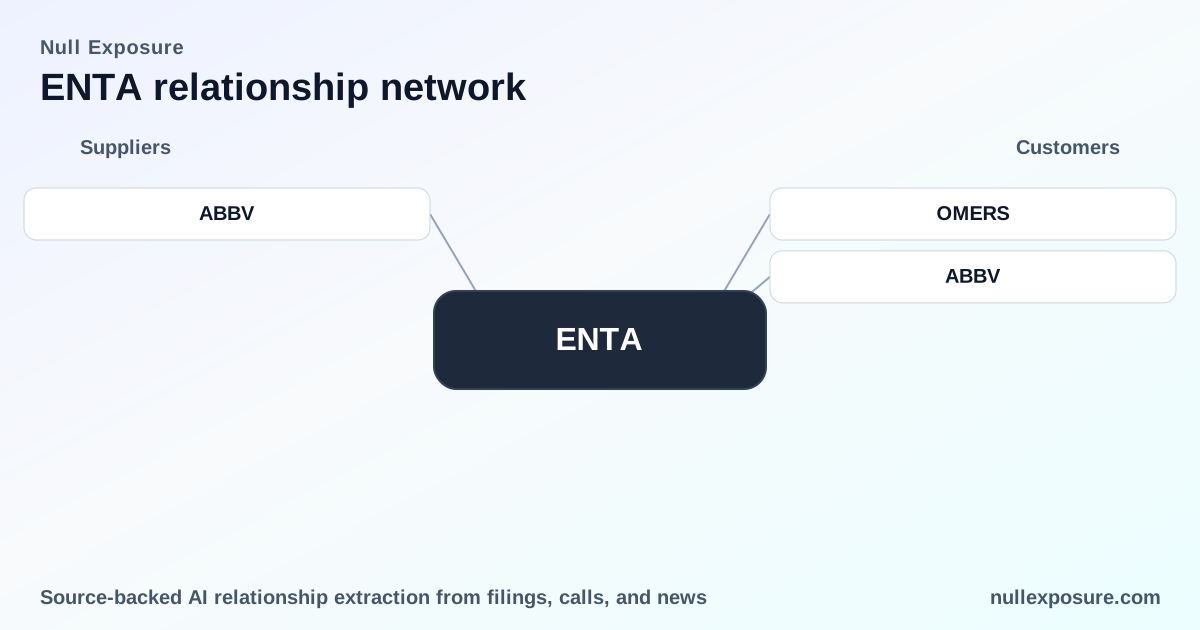
AbbVie (ABBV)
AbbVie is the commercial partner and the source of Enanta’s recurring royalty revenue for its protease inhibitor glecaprevir, which is sold as MAVYRET (U.S.) and MAVIRET (ex-U.S.). According to Enanta’s quarterly commentary and multiple FY2025–FY2026 press releases, royalty revenue from AbbVie’s MAVYRET/MAVIRET is the company’s principal revenue line, and quarterly totals (e.g., $14.9M and $17.1M in adjacent reporting periods) reflect that dependence (Enanta earnings call; company press releases and Yahoo Finance stories, FY2025–FY2026).
OMERS
OMERS purchased a majority share of Enanta’s future MAVYRET royalty receipts in April 2023; Enanta disclosed a royalty sale under which 54.5% of royalties after June 30, 2023 are paid to an OMERS affiliate in exchange for a $200,000 cash purchase price, with payments continuing through June 30, 2032 and subject to a cap equal to 1.42x the purchase price. This royalty monetization was reiterated in Enanta’s earnings commentary and subsequent press releases, and is explicitly called out as the counterparty receiving those ongoing royalty payments (Enanta earnings call; company press releases and filings, FY2025–FY2026).
PDF Solutions (PDFS)
Reports from March 2026 cite a large contract for Exensio Enterprise that “included Enanta’s database AI operation capabilities and scalable analytics,” indicating a commercial engagement or service relationship reported by PDF Solutions during their third-quarter commentary. This item appears in industry press coverage and suggests a non-royalty commercial interaction between Enanta and PDFS (The Globe and Mail / PDF Solutions Q3 FY2026 disclosure).
Contracting posture, concentration, criticality and maturity — what the arrangements imply
-
Contracting posture: Enanta executed a deliberate monetization strategy by selling a majority share of future MAVYRET royalties to OMERS in April 2023. That sale converts variable future cashflows into upfront (and then residual) contractual payments, signaling a preference for near-term certainty over uncapped future upside. The transaction terms (54.5% ceded, fixed purchase price, capped aggregate payments) reflect a typical long-term royalty purchase structure and a tilt toward liability-light funding.
-
Concentration: Revenue is concentrated. AbbVie’s MAVYRET royalties are the dominant revenue source across cited quarters; the OMERS sale compounds concentration in a different way by redirecting the bulk of those future royalties to a single buyer. Management commentary and multiple press releases across FY2025–FY2026 emphasize the materiality of AbbVie-derived royalties to reported revenue.
-
Criticality: The AbbVie relationship is critical to Enanta’s near-term operating cashflow. Quarterly figures and company statements show royalties from MAVYRET/MAVIRET funding operations and supporting R&D. The OMERS sale reduces Enanta’s share of future royalties, so while it delivers cash now, it also reduces future internally available funding, changing the company’s capital arithmetic.
-
Maturity: The OMERS agreement has an explicit maturity profile — royalties ceded through June 30, 2032 with a capped aggregate payout (1.42x purchase price), creating a predictable but time-limited shift in cashflow waterfalls. AbbVie’s commercial lifecycle for MAVYRET is a separate horizon risk, but Enanta’s contractual commitment to OMERS specifically defines the time window for ceded receipts.
These constraints are company- and contract-level signals that alter Enanta’s risk-return profile: monetization provides runway and lowers near-term volatility, but it reduces upside from any sustained AbbVie sales growth and leaves Enanta more dependent on remaining royalty slices plus internal R&D success.
Investment implications and risk checklist
-
Revenue visibility vs. upside concession: The OMERS sale increases near-term predictability but shrinks the company’s participation in future MAVYRET upside through 2032 (transactional terms disclosed in company commentary and filings).
-
Counterparty concentration risk: AbbVie is the principal revenue source; any material change to MAVYRET sales directly compresses Enanta’s top line and cash generation (earnings call and FY2025–FY2026 releases).
-
Credit-like counterparty: OMERS functions as a royalty buyer providing upfront capital; their claim on 54.5% of royalties through 2032 effectively operates like a secured funding tranche against AbbVie-origin royalties (company disclosure of the April 2023 royalty sale).
-
Operational diversification signal: The PDF Solutions mention suggests Enanta participates in data/analytics or partnership arrangements beyond pure royalty receipts, which provides a modest diversification vector but not a replacement for AbbVie-derived royalties (PDF Solutions Q3 FY2026 commentary).
-
Key balance-sheet and valuation context: Enanta’s Market Capitalization (~$422M) and recent profitability metrics reflect a company whose market value is driven by current royalty cashflows, pipeline optionality, and the altered future cashflow profile post-OMERS sale (company financial summary, latest reporting).
For an ongoing, real-time view of counterparties and contractual exposures, consult the relationship maps at https://nullexposure.com/.
Bottom line
Enanta’s model is straightforward: discover small-molecule drugs, retain royalty economics where possible, and monetize selectively to fund operations. The AbbVie royalties are the engine; the OMERS royalty sale is a strategic financing decision that trades future upside for near-term capital and predictability through 2032. Investors and operators evaluating ENTA should focus on AbbVie sales trends, tracking of the ceded versus retained royalty slices, and the company’s ability to convert R&D progress into new, uncapped value streams that can replace or supplement the income ceded to OMERS.