Evolus (EOLS): Customer Relationships and Commercial Footprint
Evolus monetizes a single, high-margin aesthetic product—Jeuveau—by selling directly to licensed aesthetic practitioners and through regional distribution partners in select markets; revenue is cash-pay driven and concentrated in the United States with a controlled international rollout. This commercial model delivers predictable per-unit economics but creates single-product concentration, channel complexity, and geographic execution risk that investors must weigh against continued international expansion. For a deeper look at Evolus’s customer exposures and partner strategy, visit https://nullexposure.com/.
Business model in one line: product-led, practitioner-sold, market-by-market
Evolus operates as a performance beauty company whose net revenues are derived from sales of Jeuveau and service revenue tied to distribution arrangements. The company sells primarily into the cash-pay aesthetic market where customers are licensed aesthetic practitioners who purchase product for direct patient treatments; in some countries Evolus uses distribution partners rather than a direct sales force. According to the company’s segment disclosures, Evolus currently reports a single operating segment and generates virtually all net revenues from Jeuveau.
Where the sales are today and why geography matters
Evolus’s commercial reach is concentrated in North America but has intentional presence in EMEA and APAC markets. U.S. revenue dominates—a company filing for the year ended December 31, 2024, showed the United States accounted for the vast majority of revenue versus international markets—underscoring domestic concentration as the core revenue engine. Jeuveau is currently sold in the United States, Canada, certain European countries and Australia, and the company is deploying market-specific models (direct vs. distributor) as it scales.
Partner relationships: France entry via Symatese and recent execution notes
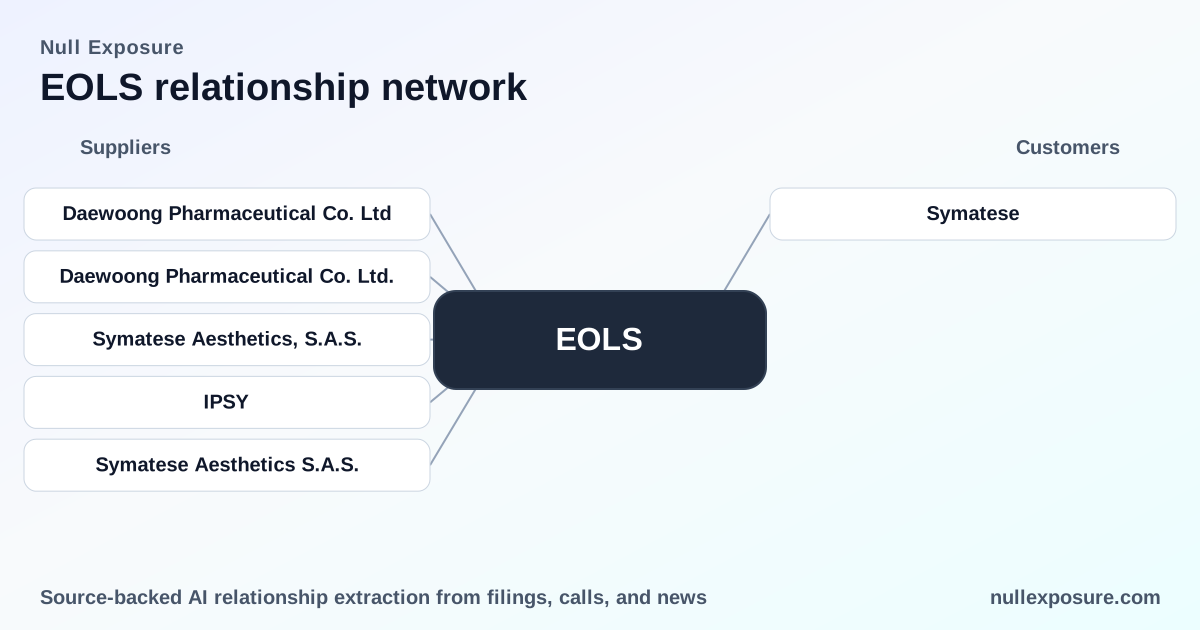
- Evolus entered France through a local partner, Symatese, as part of its FY2026 European expansion; the company reported this step as part of its recent international rollout. According to an earnings-call transcript published in March 2026, Evolus “entered France with our partner, Symatese” while also transitioning Germany to a direct sales model in Q4 and achieving strong growth across existing markets. (InsiderMonkey transcript of Q4 2025 earnings call, March 2026: https://www.insidermonkey.com/blog/evolus-inc-nasdaqeols-q4-2025-earnings-call-transcript-1709604/)
This relationship indicates Evolus uses a mixed channel strategy—selective distribution partners where local reach or regulatory complexity favors a third party, and direct operations where scale and control deliver higher margin and brand consistency.
What the constraints tell investors about Evolus’s operating posture
The available relationship and constraint signals map to a concise set of operating characteristics investors should track:
- Contracting posture — Hybrid seller/distributor model. Evolus acts as the seller of Jeuveau while relying on distribution partners in certain jurisdictions and direct sales in others; this creates contractual diversity and uneven operational control across markets.
- Counterparty type — Individual practitioners as primary customers. The company’s buyers are licensed aesthetic practitioners who purchase for cash-pay treatments, making practitioner adoption and retention central to demand.
- Geographic concentration and expansion profile. The business is U.S.-heavy, with strategic exposure to EMEA and APAC through selected market entries (e.g., France via Symatese, Australia availability) and a plan to expand further.
- Product concentration — Single-core product strategy. Evolus reports all net revenues from Jeuveau, which compresses revenue diversification and links valuation to sustained product demand and brand positioning.
- Relationship stage and maturity — Active commercialization. The company’s market activity is current and growth-oriented: it is actively selling Jeuveau across core markets, executing transitions (e.g., Germany moving to direct), and opening new country relationships via partners.
These signals are company-level cues drawn from Evolus’s disclosures and recent commentary; they frame where operational execution, regulatory approvals, and distribution economics will influence investor outcomes.
Financial and strategic implications for investors
- Revenue and scale: Evolus posted TTM revenue near $297 million and maintains a market capitalization in the low hundreds of millions; the business is revenue-generating but not yet consistently profitable on a GAAP basis. Investors should treat top-line growth and margin expansion as the primary levers to re-rate the equity.
- Concentration risk: Single-product dependency on Jeuveau increases sensitivity to competitive entries, pricing pressure, and practitioner adoption cycles. International partners can accelerate reach but also dilute per-unit economics.
- Execution signal — willingness to switch channel models: The Germany move to a direct model and the France partnership with Symatese both signal management’s flexible approach to commercialization—where a market justifies direct investment, Evolus will take on the cost and complexity; where local partnerships accelerate access, it will use distributors.
- Customer criticality: Licensed aesthetic practitioners are the critical interface to the cash-pay consumer; salesforce effectiveness, education programs, and brand positioning at the clinic level determine repeat purchase and market share.
What to watch next (operational readouts)
- Traction metrics in France and other newly opened EMEA/APAC markets, including clinic adoption and re-order rates for Jeuveau.
- Margin impact of distributor relationships versus direct sales as Evolus converts more markets to a direct model.
- Any pipeline for new product introductions or line extensions that reduce single-product concentration.
- Management commentary on working capital and inventory as international rollouts create timing variance in revenue recognition.
Bottom line
Evolus runs a product-focused, practitioner-distributed commercial model with clear strengths in unit economics and a high-leverage domestic business; international expansion through partners like Symatese is accelerating reach but preserves channel and execution risk. Investors should prioritize cadence of clinic-level adoption, gross-margin trends across distribution channels, and management’s discipline in converting markets to direct sales where economics justify the investment.
For a concise, market-facing summary tailored to underwriting and due diligence teams, see the company overview and relationship dossier at https://nullexposure.com/.