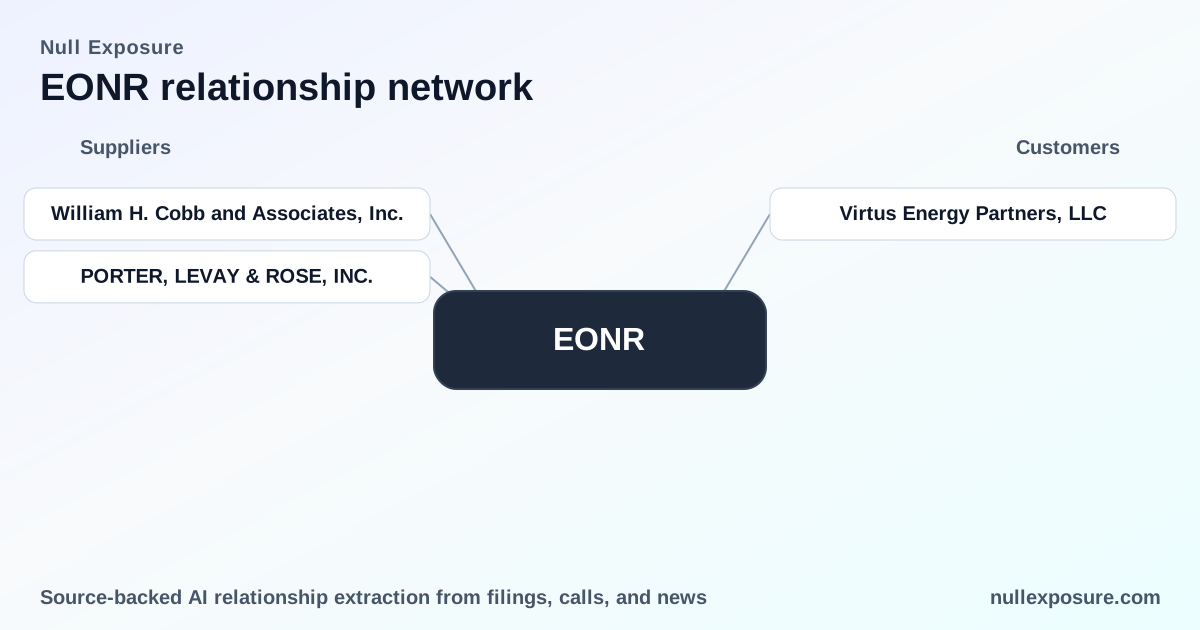
EON Resources (EONR) — Customer relationships that determine cashflow and risk
EON Resources is an independent E&P operator focused on Permian Basin acreage; it monetizes primarily by selling produced oil and gas from its working interests, supplemented by small ancillary service revenues and opportunistic equity financings. The company's revenue model is highly concentrated and operationally binary: production sold to a very small set of purchasers drives near-term cashflow, while farm-outs and equity facilities drive capital for drilling programs. For first-pass diligence on counterparty exposure, read on. For deeper relationship-level analytics visit https://nullexposure.com/.
How the customer footprint maps to value and vulnerability
EONR runs a classic small-cap E&P operating model: production-centric revenues with limited customer breadth. The company reports that it sold 100% of production to two customers in both 2023 and 2024, and that crude accounted for 86% of sales volumes in 2024. That concentration creates a tight mapping between counterparty payment performance, offtake terms, and EONR’s near-term liquidity and cashflow.
At the same time, EONR leverages non-offtake relationships to fund growth: the company utilizes equity purchase frameworks and farm-out agreements to underwrite capital-intensive drilling. These relationships convert balance-sheet capacity into drilling activity and reserve growth, but they also impose execution and timing risk.
Active partner: Virtus Energy Partners — large Permian farmout
EON Resources farmed out San Andres rights to Virtus Energy Partners, LLC as part of a $300+ million horizontal drilling program that contemplates up to 90 wells and an estimated reserve value of over $95 million in net PV-10. This is an operationally material, multi-year drilling partnership designed to accelerate development on San Andres assets. According to an Accesswire press release and reporting on Sep 11, 2025, the program was announced publicly; the news was aggregated on financial portals including Finviz. (Accesswire / OilPrice reporting, Sep 11, 2025; see aggregated listing at https://finviz.com/quote.ashx?t=EONR.)
Equity and financing framework: White Lion facility (company-level signal)
Company SEC disclosures describe a Common Stock Purchase Agreement that gives EON the right to sell up to $150 million of newly issued common shares to White Lion under a framework arrangement, subject to customary closing conditions and registration effectiveness, with the facility available through December 31, 2026. The agreement has been used in practice — the company issued 2,230,000 shares under the facility for roughly $2.63 million in net proceeds during the year ended December 31, 2024 — demonstrating the facility’s role as a near-term liquidity lever. (Company filings and fiscal disclosures, FY2024–FY2025.)
Ancillary commercial roles and revenue lines
EON also derives small but recurring service revenue from water services provided to third parties; other revenue was $487,109 in 2024, down modestly from 2023 due to operational disruptions. While not material to total revenue, these service contracts indicate a limited diversification of cash sources beyond core hydrocarbon offtake. (Company annual disclosures, FY2024.)
How the disclosed constraints translate into operating reality
The extracted relationship constraints form a coherent view of EONR’s business model and contracting posture:
-
Contracting posture — framework financing in place: EON has an explicit framework equity facility (White Lion) that provides contingent access to capital through late 2026; the facility has been tapped in small amounts, indicating an operational reliance on equity support when markets or cashflow require it. This is a structural liquidity backstop rather than an ongoing revenue contract.
-
Geographic concentration — North America / Permian focus: All proved reserves and operations are in the Permian Basin (west Texas / southeast New Mexico), which concentrates both geological upside and regional market risk (pricing differentials, midstream constraints).
-
Role as seller and service provider: The company primarily acts as a seller of produced hydrocarbons, generating the majority of revenues and cash; secondarily it provides water services and similar support services that contribute modest revenue and operational flexibility.
-
Relationship maturity and stage — active and operational: EON’s production is actively contracted; the farm-out with Virtus and the two-customer purchase pattern indicate live, economically meaningful relationships rather than exploratory or nascent partnerships.
-
Spend and capital flows — small equity drawdowns to fund operations: Recent use of the equity purchase agreement was in the $1M–$10M range, consistent with small-cap capital injections that supplement operating cashflow for near-term needs. Separately, the Virtus program is a multi-hundred‑million dollar development commitment that materially increases capital intensity if carried out.
Implications for investors and operators
-
Revenue concentration is the dominant risk. With production sales split across two customers, counterparty credit terms, pricing mechanics, and settlement timing have outsized impact on free cashflow and working capital.
-
Capital structure flexibility exists but is limited. The White Lion framework provides optionality to raise equity through 2026, but historical use has been modest — signaling both availability and practical limits on dilution and timing.
-
Growth is driven by partner-funded development. The Virtus farmout is the primary vehicle for scaling San Andres production; successful execution would expand reserves and cashflow, while delays or cost overruns would stress liquidity.
-
Geographic concentration concentrates both upside and operational risk. Permian exposure gives premium basin economics but also concentrates exposure to local midstream, regulatory, and labor dynamics.
Quick reference for the relationships disclosed
-
Virtus Energy Partners, LLC — EON farmed out San Andres rights to Virtus in a $300+ million horizontal drilling program covering up to 90 wells and an estimated net PV-10 reserve value north of $95 million; publicly announced Sep 11, 2025 (Accesswire / OilPrice; aggregated on Finviz: https://finviz.com/quote.ashx?t=EONR).
-
White Lion (Common Stock Purchase Agreement) — the company has a framework equity purchase facility allowing sales up to $150 million in aggregate to White Lion through Dec 31, 2026; the facility was used for a $2.63 million net proceeds issuance during the year ended Dec 31, 2024 (company filings, FY2024–FY2025).
-
Third-party water services customers — EON provides water services that generated about $487k of revenue in 2024, a small but recurring non-production revenue stream affected by supply line disruptions in Q3 2024 (company annual disclosures, FY2024).
For a consolidated counterparty map and relationship scoring model that tracks concentration, contract type, and funding optionality, start your diligence at https://nullexposure.com/.
Final read: trade-offs and monitoring priorities
EONR’s commercial profile is straightforward: production sales to very few buyers drive near-term cashflow; partner-funded development and an equity purchase facility fund growth and provide liquidity optionality. Investors should monitor three inputs closely: (1) payment and offtake terms with the two principal buyers, (2) execution and capital calls under the Virtus drilling program, and (3) the availability and pricing of the White Lion equity facility as a backstop to capital shortfalls. These three levers determine whether EONR converts Permian reserves into durable free cashflow or rotates through episodic financing and dilution.