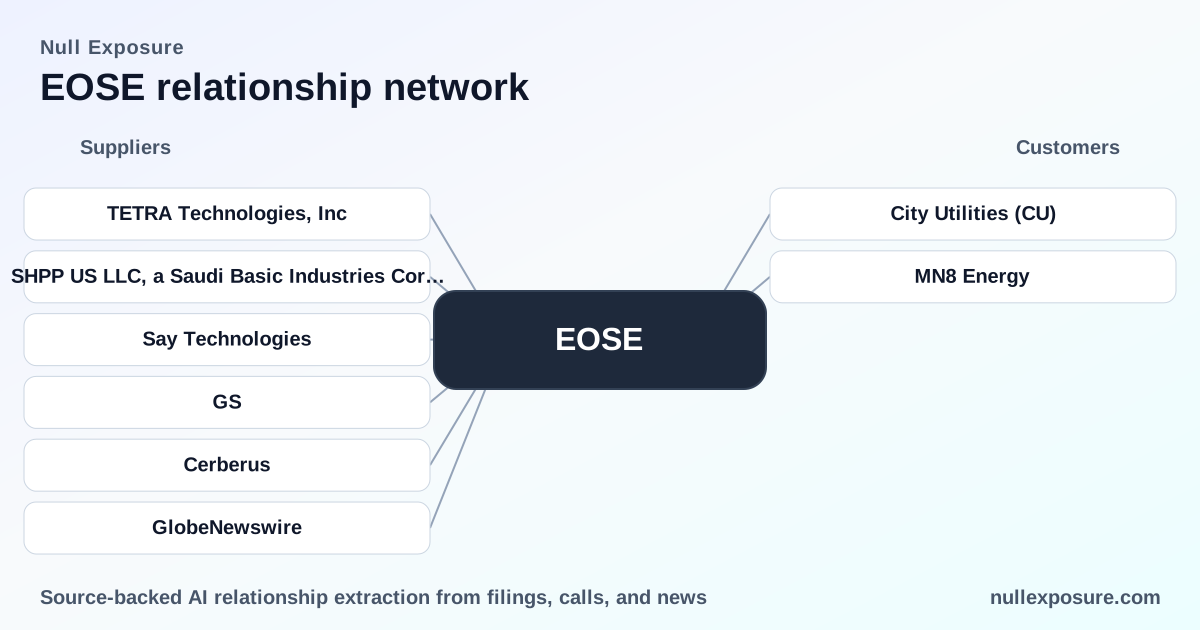
Eos Energy Enterprises (EOSE): Customer Relationships That Drive Capacity — and Concentration
Eos Energy Enterprises designs, manufactures and sells zinc-based battery storage systems, monetizing through hardware sales, multi-year supply agreements, and long-term maintenance contracts to utilities and commercial & industrial developers in North America. Its operating model blends manufacturing scale with project-level execution: the company sells turn‑key DC battery energy storage systems, signs multi-year master supply agreements, and supports installations with long-term maintenance plans — a model that delivers recurring serviceable revenue but concentrates execution risk around a small set of large customers. Learn more about how Eos’s customer book translates into revenue and project backlog at https://nullexposure.com/.
What the customer roster tells investors
Eos’s disclosed customer relationships reveal a targeted commercial strategy: large, project-based orders with utility and developer partners, often secured through long-term contractual frameworks. The footprint is overwhelmingly North American, with pronounced revenue concentration: the company reported two customers representing 50.6% and 33.2% of 2024 revenue, which elevates counterparty and execution risk even as large orders underpin scale economics. According to Eos’s FY2024 Form 10‑K, the firm operates primarily in the United States and is moving substantial capacity into utility and private-power projects.
Below I cover every disclosed customer relationship found in the public record, followed by the operational constraints that define how those relationships scale and risk-profile the business.
Customer relationships (what each one means for Eos)
City Utilities (CU) — a utility-scale, award-winning order in Missouri
In November 2024 Eos announced a customer agreement to provide 216 MWh of energy storage for two Missouri project sites with City Utilities, signaling a meaningful utility-scale deployment in the firm’s service territory. This disclosure is drawn from Eos’s FY2024 Form 10‑K, where the company describes the City Utilities agreement and its role in the 2024 delivery pipeline.
TURBINE‑X Energy — a strategic joint development agreement for AI‑power projects
Eos signed a joint development agreement with TURBINE‑X Energy to supply up to 2 GWh of battery capacity aimed at AI-focused private power projects, a transaction highlighted in SahmCapital coverage in April 2026 and reiterated in subsequent commentary. The agreement positions Eos to capture project-level demand from hyperscale/AI-adjacent power customers and reflects the company’s push into higher-volume, private-power deployments (SahmCapital, April 2026).
Charge Bliss, Inc. — firm order for a critical care hospital microgrid
Eos received a firm 2 MW order from Charge Bliss, Inc. to supply its Znyth® battery system for a critical care hospital microgrid, according to a public notice referenced on TradingView in 2026. This customer-level win illustrates Eos’s traction in C&I and microgrid applications where reliability and specialized integration are critical (TradingView, FY2026).
MN8 Energy — a large-tier developer supply agreement
Eos announced a supply agreement with MN8 Energy for up to 750 MWh, reported in October 2025 coverage, positioning MN8 — a large independent renewable developer — as a meaningful channel partner for utility-scale deployments. This deal underscores Eos’s strategy of partnering with major developers to secure multi-project supply runs (SahmCapital, October 21, 2025).
Operating constraints and what they imply for revenue stability
Eos’s public disclosures and filings reveal several company-level operating characteristics that shape how customer relationships convert to cash flow:
-
Long-term contracting posture: The company executes multi-year Master Supply Agreements and provides long-term maintenance plans; Eos cited a 500 MWh MSA (Pine Gate Renewables) covering deliveries over five years in its disclosures, which underscores a deliberate move toward predictable, spread-out revenue recognition and serviceable recurring revenue. Long-term MSAs improve visibility but amplify dependence on large counterparties to honor long delivery schedules (FY2024 Form 10‑K evidence).
-
North America concentration: Nearly all revenue is sourced from the United States and the company reports North America as its primary market. This concentration simplifies logistics and regulatory focus but concentrates regulatory, market, and demand risk in one geography.
-
High customer concentration: Two customers accounted for 50.6% and 33.2% of 2024 revenue, a material concentration that amplifies single‑counterparty execution risk and means successful delivery and payment by a handful of partners materially affects results.
-
Hardware- and manufacturing-centric model: Eos focuses on manufacturing and selling turn‑key DC battery systems and operates as a developer-facing supplier; manufacturing scale and unit-cost execution are central to margins rather than pure services or software monetization.
-
Active project pipeline: Multiple active orders and announced projects (City Utilities, IEP, MN8, others) indicate relationships are operationally active rather than exploratory, which implies near- to medium-term capex and working-capital demands as Eos fulfills contracts.
Risks and investment implications — balanced, directional takeaways
Eos’s model offers high upside through large, repeatable project contracts and potential scale effects in manufacturing cost per MWh. However, the combination of customer concentration and long delivery horizons creates concentrated counterparty and execution risk: a delayed or cancelled multi-hundred‑MWh order materially impacts near-term revenue and margin dynamics. Investors should weigh the upside from recent large agreements (e.g., TURBINE‑X’s 2 GWh JDA and MN8’s 750 MWh framework) against the necessity for flawless manufacturing throughput and tight working capital management.
For deeper context on counterparties and how Eos’s customer strategy maps to backlog and revenue recognition, visit https://nullexposure.com/.
Final read: where Eos sits in the market
Eos is executing a traditional project‑scale hardware play with service after-sales, positioned to benefit from large developer and utility deals. Key strengths: sizeable project wins, long-term MSAs, and a clear North American market focus. Key risks: concentrated revenue, the operational challenge of scaling manufacturing to multi‑GWh volumes, and delivery timing across long-term contracts. For investors evaluating Eos, the critical analysis centers on execution against announced orders and whether scale efficiencies reduce per‑MWh costs while preserving delivery schedules and cash flows.
If you want a portfolio‑level briefing on Eos’s counterparties and program delivery outlook, contact Null Exposure for a concise investor memorandum at https://nullexposure.com/.