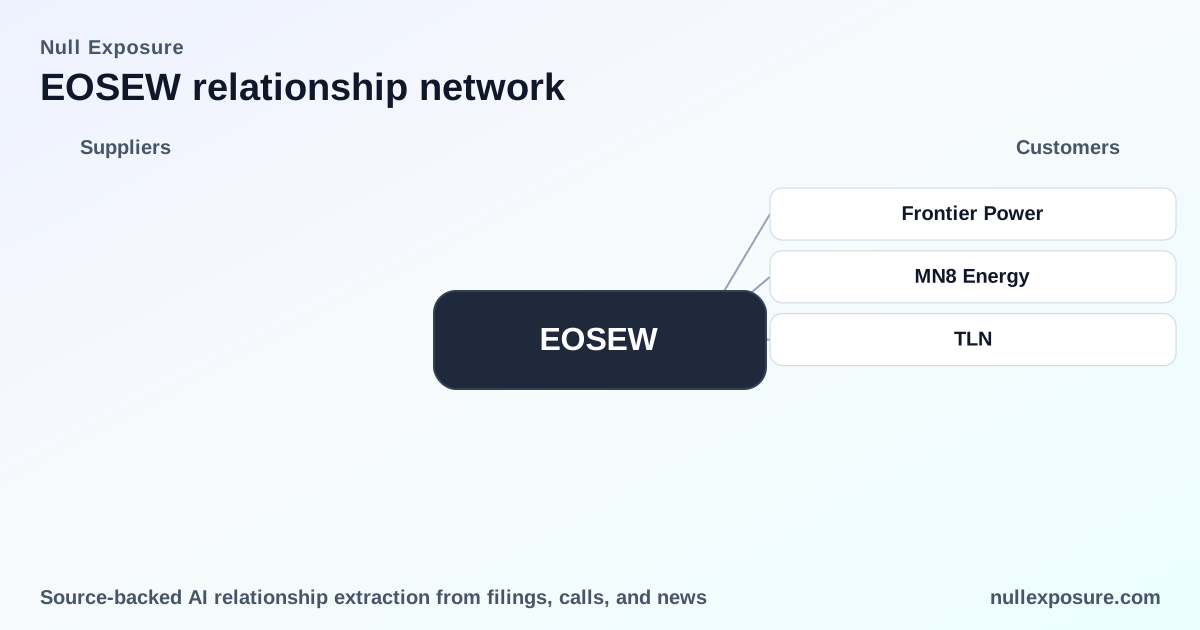
EOSEW Customer Landscape: Early commercial wins with targeted industrial partners
Eos Energy Enterprises sells zinc-based Z3™ battery systems and monetizes through supply agreements, purchase orders, master services agreements (MSAs), and joint development arrangements with renewable operators and utilities. The company is transitioning from pilot deployments to commercial supply contracts, collecting revenue across product sales and strategic partnerships that anchor multi-site storage programs and long-duration demonstrations. For investors, the customer list signals measured commercial traction in the utility-scale and renewables segments; the next milestone is converting these pilots and MSAs into predictable, scaled revenue. Visit https://nullexposure.com/ for a compact view of this relationship intelligence.
Why these customer relationships matter now
Eos’s recent announcements demonstrate a sales motion that leans on three commercial vehicles: MSAs/supply agreements for capacity sales, single purchase orders for demonstration deployments, and joint development agreements to embed technology into partner project pipelines. This mix produces a contracting posture that is transactional for near-term pilots and strategic for long-term pipeline access.
- Concentration and counterparty type: Customers are predominantly independent renewable operators and vertically integrated utilities — partners who can place repeat orders but also have the leverage to demand tailored integration and financing terms.
- Criticality: For partners running long‑duration storage demonstrations or multi‑site deployments, Eos’s Z3 product is a strategic component rather than an accessory, increasing the stickiness of completed projects.
- Maturity: Contracts reported are early commercial: MSAs, purchase orders and JDAs show proof-of-concept to low-volume commercial scale rather than mass deployment. Investors should treat these relationships as validation of technology-market fit rather than evidence of mature recurring revenue.
Relationships: line-by-line commercial evidence
MN8 Energy
Eos announced a 750‑megawatt-hour supply contract (MSA) with MN8 Energy, positioning a large independent renewable operator in the U.S. as a named buyer for Z3 systems; this is a material backbone order that validates Eos’s ability to contract at scale with project developers. According to Eos’s 2025 Q3 earnings call transcript (first posted March 7, 2026), the company described the agreement as a 750 MWh supply contract with MN8 Energy.
Frontier Power
Eos recorded a 228‑megawatt-hour purchase order from Frontier Power tied to several long‑duration storage demonstrations across multiple markets, reflecting demand for Z3 in proof-of-concept and demonstration settings in the UK and beyond. A November 25, 2025 news report referenced a 228 MWh order from Frontier Power for UK multi‑site long‑duration storage demonstrations, and the same deal was mentioned on Eos’s 2025 Q3 earnings call (March 2026).
TLN (ticker: TLN)
Eos described securing a strategic agreement framework with Talen Energy (TLN) that targets multi‑gigawatt-hour capacity across Pennsylvania, indicating an ambition to scale with an established power producer to address grid resilience and data‑center demand. The collaboration was discussed in Eos’s 2025 Q3 earnings call (March 7, 2026), and a March 2026 news summary reiterated a strategic framework with Talen targeting multi‑GWh deployments.
Talen Energy
Eos separately reiterated on its earnings call that it secured orders after quarter close, including a significant strategic agreement with Talen Energy, underlining immediate order flow plus a longer-term commercial framework with a major regional generator and grid services provider. The 2025 Q3 earnings call (first seen March 7, 2026) contains the company’s direct statement about this post‑quarter order and strategic arrangement.
Bimergen Energy Corporation
Eos entered a Joint Development Agreement (JDA) with Bimergen Energy Corporation to apply Eos’s zinc‑based battery systems in Bimergen’s battery storage projects, signaling a product‑plus‑services pathway that pairs technology supply with project development expertise. Investing.com coverage in early May 2026 reported the JDA and noted it aims to accelerate Bimergen’s project development using Eos technology.
What this roster implies about contract types and revenue profile
The customer activity demonstrates a hybrid go‑to‑market: MSAs like MN8’s imply the potential for multi‑project supply flow; single purchase orders like Frontier’s reflect demonstrator revenue and reference projects; and JDAs with Bimergen indicate co‑development and embedded pipeline access. This results in a revenue profile that blends lump-sum hardware sales, staged milestone payments and project‑level development economics. For underwriting forecasts, assume lumpy near‑term revenue with upside to multi‑year, multi‑GWh contracts if pilot programs convert.
Key risks and the execution checklist for investors
- Execution risk: Converting demonstrations and JDAs into serial purchase orders and consistent installation cadence is essential for predictable revenue.
- Concentration risk: Early customers are important references; if a small number of partners fail to scale, revenue growth will be constrained.
- Integration and commissioning: Utility and grid-scale customers demand dependable integration timelines; missed timelines will pressure margins and cash flow.
- Upside: Successful scaling with Talen and MN8 unlocks regional pipeline access and repeatable project wins, and JDAs can accelerate project development timelines if Eos supplies both technology and integration expertise.
Bottom line and next steps
Eos’s 2025–2026 customer disclosures show deliberate, measured commercialization: meaningful MSAs and purchase orders combined with JDAs and strategic frameworks lay the groundwork for scaling, but revenue remains dependent on converting pilots and proofs into repeatable, high‑volume deployments. For deeper tracking of these relationships and forthcoming contract milestones, visit https://nullexposure.com/ to monitor updates and source documents.
Key takeaway: the customer list validates product-market fit and opens a path to scale, but investors should price in execution and concentration risk until multi‑GWh contracts move from framework to delivery.