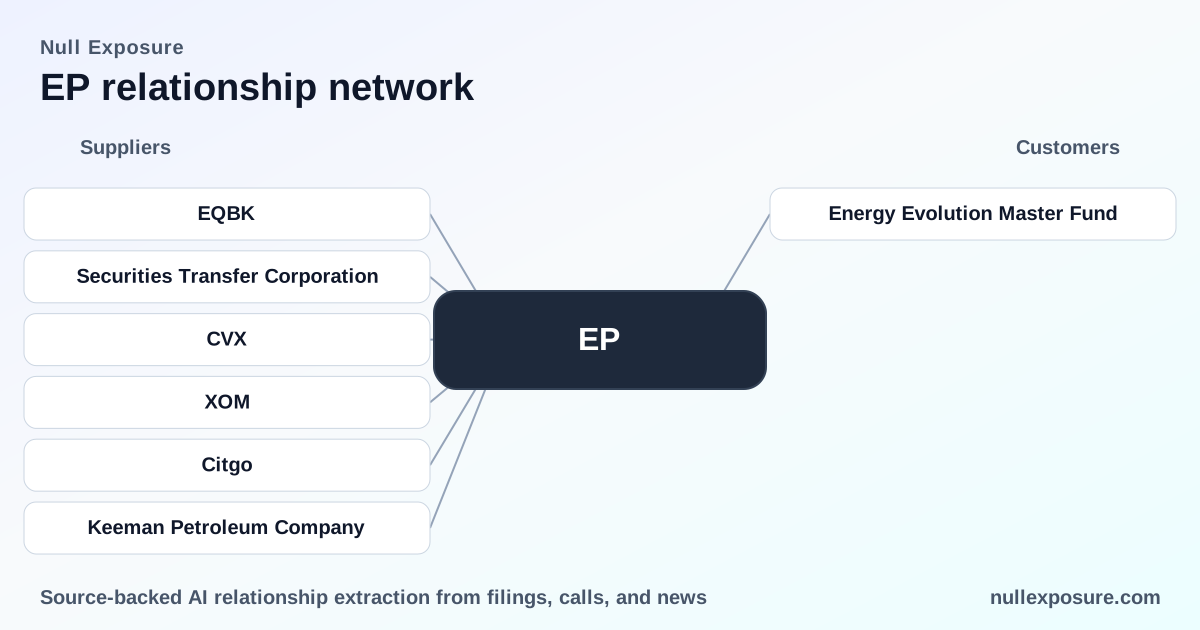
Empire Petroleum (EP): Customer Relationships, Commercial Posture, and Investor Implications
Empire Petroleum Corporation is an independent oil and gas exploration and production company that monetizes by selling produced crude oil, natural gas and NGLs into market-priced contracts, primarily to marketers, majors and pipeline companies. The company's revenue base is directly tied to physical production volumes and spot-market differentials; it operates with concentrated geographic exposure in the continental United States and a small set of large purchasers that drive most cash flow. For investors evaluating counterparty risk or portfolio concentration, the commercial model is simple but concentrated — upstream production sold into short-term, market-priced arrangements. Learn more about our coverage at https://nullexposure.com/.
Business model in plain English: upstream cash flows with short-term contracts
Empire operates as a classic upstream E&P: it acquires and develops reservoirs, produces hydrocarbons, and sells that production into the market. Revenue is generated exclusively from sales of oil, natural gas and NGLs, with reported trailing revenues of roughly $34.2 million and negative operating and net margins in the most recent filings. The company sells production under short-term contracts and routinely uses market-based pricing adjusted for quality differentials; the company discloses no firm delivery commitments. That contracting posture creates immediate price exposure and operational liquidity dependence on current commodity markets rather than long-term fixed-price contracts.
- Contracting posture: Substantially all product sales are short-term (contract terms of one year or less) and are often sold using market pricing at the lease location. This creates direct sensitivity to commodity price swings and differential compression.
- Counterparty profile: Buyers consist primarily of independent marketers, major oil and gas companies and gas pipeline companies, reflecting a mix of large-enterprise and mid-market counterparties.
- Geographic concentration: Production and proved reserves are concentrated in New Mexico, North Dakota, Montana, Texas and Louisiana — a single-country, regional footprint that amplifies local operational or regulatory risks.
- Revenue concentration and criticality: For the year ended December 31, 2024, 78% of production revenue flowed through four customers, a level the company explicitly categorizes as critical to near-term cash generation.
Collectively these attributes make Empire operationally straightforward but commercially concentrated and sensitive to short-term market dynamics, which is a core consideration for investors analyzing customer counterparty risk and revenue durability.
Who the company sells to — the named relationships
The dataset returned one named counterparty in the customer scope. Below is a concise, investor-focused summary.
- Energy Evolution Master Fund — Empire's public disclosures and market reports list Energy Evolution Master Fund in connection with a financing action tied to the company: a TradingView news note (March 9, 2026) reported that Energy Evolution Master Fund intends to fully participate in Empire Petroleum’s $6 million rights offering, indicating a financial relationship tied to the company’s capital raising rather than an operational buyer-seller contract. (TradingView, Mar 9, 2026)
This relationship is singular in the public results returned, and the referenced item is presented in the context of a strategic financing event rather than a routine purchaser-of-production disclosure.
Why the customer map matters for valuation and risk
Empire’s operating model and the constraints disclosed together produce a clear set of investor signals:
- High counterparty concentration is material and critical. The company itself reports that four customers accounted for 78% of oil, gas and NGLs sales in 2024; such concentration creates single-point dependencies that can depress realized prices or interrupt cash flow if a major purchaser changes terms.
- Short-term/spot contracting increases revenue volatility. The dominant use of market-based pricing and short contract tenors means Empire realizes current market prices and differentials; this posture delivers upside in strong commodity cycles but delivers no downstream contractual hedge against price declines.
- Buyer mix consists of large enterprises and independents. The company identifies purchasers as independent marketers, majors and pipeline companies, implying a mix of credit profiles but with probable bargaining leverage concentrated among a handful of counterparties.
- Geographic concentration adds operational single-region risk. Production clustered in a small set of U.S. basins concentrates exposure to local operating disruptions, weather events, or state-level regulatory changes.
- Active, core-product relationships. The revenue base is not ancillary; the sale of production is the core product and an active commercial relationship for the enterprise.
These signals combine into a risk profile that is sensitive to commodity cycles, counterparty negotiation power, and any disruption to the small set of major purchasers.
What investors should watch next
- Track purchaser churn and any shifts in the top-four customer list disclosed in subsequent filings; a change in mix could materially alter realized prices or working capital dynamics.
- Monitor how Empire manages its short-term contracting exposure — whether the company pursues hedging, longer-term offtake arrangements, or continues to rely predominantly on market pricing.
- Observe the outcome of the rights offering and participation by institutional or strategic counterparties; the March 2026 news item on participation intentions is relevant to balance-sheet resilience and liquidity. For background materials and follow-up analysis, visit https://nullexposure.com/.
Bottom line — concise investment takeaways
- Empire Petroleum operates a pure upstream cash-sales business with short-term market pricing and concentrated counterparty exposure.
- Revenue concentration (78% to four customers in 2024) and short-term/spot contracting are the primary commercial risks to model when valuing cash flow volatility and downside scenarios.
- The only explicit named counterparty in the public customer-scoped results is Energy Evolution Master Fund, linked to participation in a March 2026 rights offering, a development that is relevant for capital structure and liquidity but not necessarily indicative of a change in the day-to-day buyer base for production.
For deeper customer-level intelligence and ongoing monitoring of counterparty concentration, visit https://nullexposure.com/ for our coverage and datasets.