Edgewell Personal Care (EPC): Who Buys the Company’s Products and How That Shapes the Investment Case
Edgewell manufactures and sells personal care products—wet shaving, sun and skin care, and until recently, feminine care—primarily through large retailers and distributors. The company monetizes by selling finished goods and private-label manufacturing to retailers, capturing margin on branded and contract-manufactured products, and periodically reshaping its portfolio via asset sales to reduce leverage and refocus on higher-return categories. For investors, the revenue profile is retailer-driven, geographically diversified with North America at the core, and sensitive to concentration with a few large accounts accounting for meaningful shares of net sales. Learn more about how we extract customer signals at https://nullexposure.com/.
Quick thesis for investors
Edgewell is a distribution-led consumer staples operator: sales occur mostly through short-term purchase orders to major mass merchants and grocery chains, with private-label and branded channels complementing its retail relationships. Portfolio pruning (the sale of feminine care) reduces complexity and raises available cash for debt reduction and investment in core categories—an outcome that materially changes customer mix and near-term margin dynamics.
The three customer relationships that matter — and what they tell investors
Walmart: the largest single customer with scale implications
Walmart accounted for approximately 17.4% of Edgewell’s net sales in fiscal 2025, making it the company’s largest customer and a critical distribution partner in North America. This concentration creates negotiating leverage for the retailer and operational dependence for Edgewell; control of shelf space and promotions at Walmart materially affect Edgewell’s revenue and working capital cadence (Edgewell 2025 10‑K).
Target: a top retail account with category-level concentration
Target represented about 9.2% of net sales for Edgewell’s Sun and Skin Care segment and 10.1% for its Feminine Care segment in FY2025, reflecting Target’s strategic importance across multiple product lines. These figures indicate that Target is a high-value omnichannel partner for category penetration and national promotional activity (Edgewell 2025 10‑K).
Essity: buyer of Edgewell’s feminine care business and a transitional counterparty
Essity completed the acquisition of Edgewell’s feminine care business for $340 million in cash, acquiring Carefree, Stayfree and o.b. in North America and global Playtex feminine care rights; Edgewell agreed to provide at least one year of transition services across IT, supply chain, and sales to enable an orderly handover. The transaction materially changes Edgewell’s customer and product mix by removing a revenue stream while creating a short-term service relationship and immediate liquidity for debt reduction (Edgewell press release and Essity announcement, March 2026; Cision/PR Newswire coverage).
How these relationships translate into operating constraints and business signals
-
Contracting posture — short-term purchase orders dominate. Edgewell states that its purchase orders are short-term (less than one year) and single-delivery in nature, which gives buyers flexibility and places inventory and replenishment discipline on Edgewell’s operations. This manifests as a working-capital intensive sales model rather than long-term contractual revenue (company 10‑K disclosures).
-
Customer concentration is meaningful. With Walmart at 17.4% and Target representing double-digit segment shares, Edgewell’s earnings and cash flow are sensitive to promotional cycles and slotting decisions at a small number of mass merchants. Investors should treat buyer negotiations and promotional elasticity as first-order operational risks.
-
Geographic footprint is broad but North‑America centric. Edgewell runs dedicated commercial organizations across North America, EMEA, LATAM and APAC; however, principal revenue streams are generated primarily through North American retailers, underlining NA as the core profit pool even as the company serves international distributors (company 10‑K).
-
Role inside the value chain — seller and reseller functions. Edgewell generates revenue by selling finished goods to customers and also produces private-label products sold under retailers’ names (Edgewell Custom Brands). That dual role creates margin diversity but also ties the company to retailer pricing pressure.
-
Segment description — distribution and manufacturing. The business is distribution-first: finished product sales through retailers and distributors, combined with contract manufacturing for private label, which makes supply-chain execution and retailer logistics a critical competency.
-
Government contracts are immaterial. The company reports government contracts are not a material portion of net sales, so public-sector demand volatility is not a primary revenue driver.
Relationship-by-relationship catalogue (source-backed, plain-English)
-
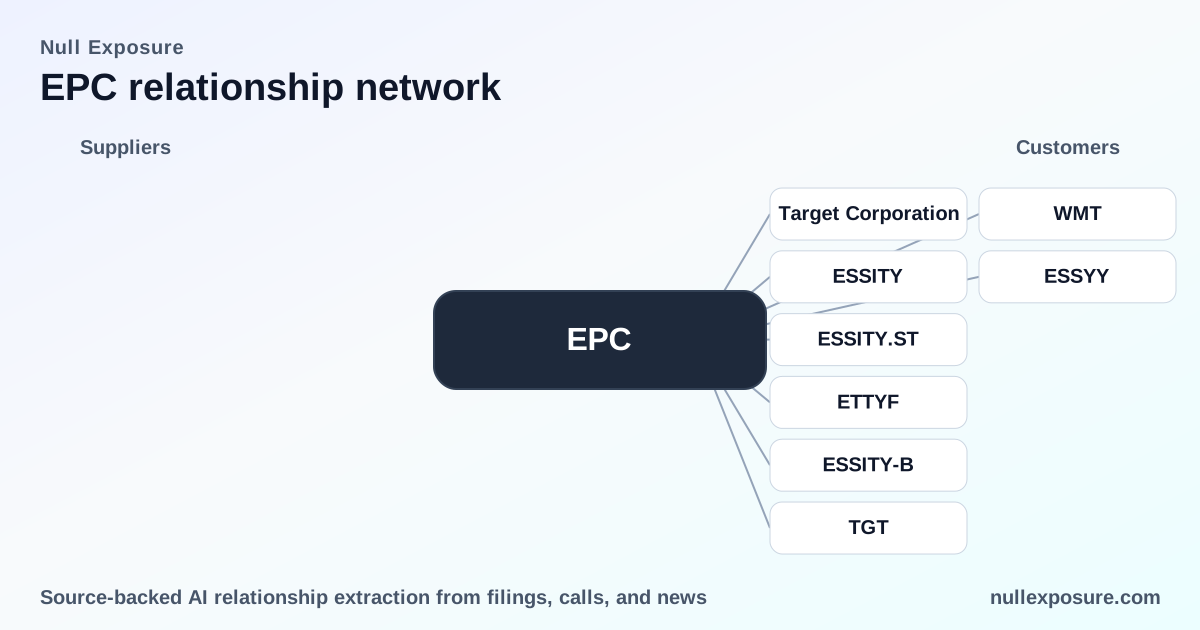
Target Corporation — Edgewell disclosed that Target represented roughly 9.2% of Sun & Skin Care sales and 10.1% of Feminine Care sales in FY2025; Target is therefore a high-visibility retail partner for multiple Edgewell categories (Edgewell 2025 10‑K).
-
Essity / ESSITY.ST / ESSITY-B / Essity AB (publ) / ETTYF / ESSYY (press variants) — Multiple outlets reported that Essity completed the purchase of Edgewell’s feminine care business for $340 million in cash, acquiring brands including Carefree, Stayfree, o.b., and Playtex rights; Edgewell will provide transition services for at least one year to support IT, supply chain and sales integration (Edgewell press release, PR Newswire and Essity Cision announcement, March 2026; wide press coverage via Finviz, Yahoo Finance, Tissue Online, Premium Beauty News).
-
Walmart / WMT — Edgewell disclosed that Walmart accounted for approximately 17.4% of net sales in fiscal 2025, identifying Walmart as the company’s largest single customer and a structural revenue driver in North America (Edgewell 2025 10‑K).
(Note: the press stream includes multiple news outlets and ticker representations for Essity; all report the same acquisition and post-close transition services arrangement—see PR Newswire, Cision, Finviz and MexicoBusiness coverage from March 2026.)
Investment implications — what to watch next
-
Revenue mix shift and leverage reduction are the immediate outcomes of the Essity sale. The $340 million cash inflow improves liquidity and funds debt reduction; investors should track how management deploys proceeds between buybacks, deleveraging, and capex for core categories.
-
Retailer execution is the dominating operational risk. Given Walmart and Target’s outsized shares, promotional cycles, private-label competition, and slotting decisions will govern near-term topline and margin variability.
-
Short-term contracting raises volatility in working capital and forecastability. Because customer orders are short-term, Edgewell’s quarterly revenue can swing with merchandising cadence; investors should model tighter working-capital turns and sensitivity to inventory absorption.
-
Transition services are a double-edged dynamic. The one-year TSAs with Essity provide recurring near-term service revenue and cash but prolong operational entanglement during integration, requiring disciplined execution to avoid margin leakage.
Final read
Edgewell’s business is retailer-concentrated, distribution-first, and undergoing portfolio simplification—a combination that reduces complexity but increases dependence on a small set of trading partners. For research teams evaluating Edgewell’s customer risk profile, prioritize Walmart and Target merchandising outcomes and monitor the effective redeployment of cash from the Essity sale. For deeper coverage of retailer concentration and counterparty exposures, visit https://nullexposure.com/ for our analysis platform.
Bold final takeaway: Edgewell is a North‑America-centric consumer products seller whose near-term financial trajectory hinges on execution with Walmart and Target and on disciplined use of proceeds from the Essity feminine-care divestiture.