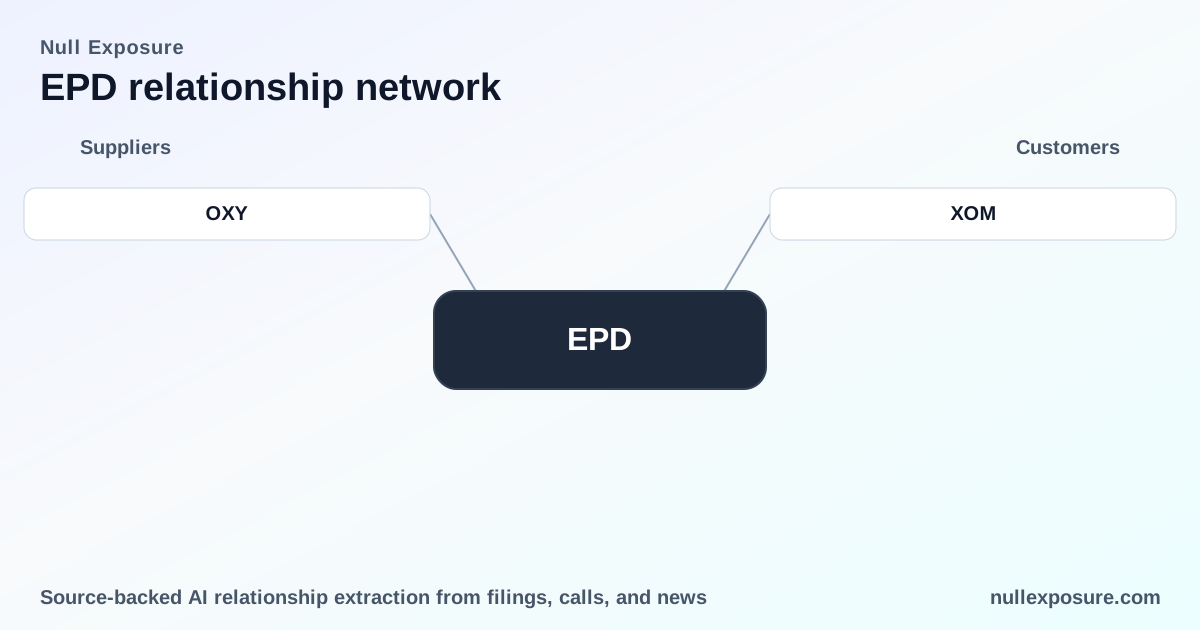
Enterprise Products Partners (EPD): Customer relationships and what they mean for cash flow durability
Enterprise Products Partners operates a capital-intensive midstream network that monetizes through a mix of long-term, fee-based infrastructure contracts and commodity sales of NGLs and refined products. The partnership captures stable transportation, storage and processing margin from producers and refiners while also realizing variable sales proceeds from NGL marketing and traded product inventory. For income-focused investors, EPD’s model blends predictable fee revenue with cyclical commodity exposure; for operators and analysts, customer relationships—particularly with major integrated oil companies—drive both utilization and the economics of incremental expansions. For a structured view of EPD’s customer exposures, see https://nullexposure.com/.
A single transaction that recalibrates a strategic pipeline relationship
ExxonMobil acquired a 40% stake in the Bahia NGL Pipeline from Enterprise Products Partners; the transaction transfers meaningful project exposure to a major integrated while preserving EPD’s ongoing role in pipeline operations and planned capacity expansion. According to company remarks cited in earnings commentary, the deal accompanies a planned expansion of the Bahia system to 1 million barrels per day and a 92-mile extension to serve Exxon’s Cowboy Processing Complex and Enterprise facilities in the Delaware Basin (Company earnings call transcript, March 9, 2026). A market summary of the transaction confirmed closing of the sale and the planned expansion timetable (news roundups, May 2026).
Every relationship mention in the record — concise summaries and sources
- Exxon Mobil Corporation (XOM) — a media note reported Exxon completed the acquisition of a 40% stake in the Bahia NGL Pipeline from EPD, formalizing a joint interest that supports the pipeline expansion plan (simplywall.st, May 4, 2026).
- Exxon Mobil Corporation (XOM) — the same acquisition was reported under Exxon’s corporate name in press aggregation, confirming the 40% transaction and its accounting as a completed sale in FY2026 commentary (simplywall.st, May 2–4, 2026).
- ExxonMobil — EPD’s FY2026 earnings call referenced ExxonMobil’s purchase of an undivided interest in the Bahia NGL pipeline and described the related project expansion and a 92-mile extension to tie Exxon’s Cowboy complex into Enterprise plants in the Delaware Basin (earnings call transcript, March 9, 2026).
- XOM (duplicate reporting) — the earnings discussion reiterated the commercial link between the Bahia expansion and Exxon’s processing and logistics footprint (earnings call transcript, March 9, 2026).
- ExxonMobil — a TradingView earnings summary noted completion of the sale of a 40% interest in the Bahia NGL Pipeline to ExxonMobil and restated the pipeline capacity expansion target to 1 million BPD by late 2027 (TradingView earnings release, March 9, 2026).
- XOM (TradingView duplicate) — the same TradingView release reiterated the sale and the expansion plan, underlining market reportage of the transaction and timing (TradingView, March 9, 2026).
What the relationship signals tell investors about EPD’s operating posture
EPD’s customer relationships describe a mature, industrial midstream operator that leverages long-term fee contracts for cash-flow stability while retaining spot and marketing exposure as a complementary earnings stream. The constraint evidence coalesces into several corporate-level signals:
- Contracting posture: The business is supported prominently by long-term, fee-based contracts and producer dedications with take-or-pay structures and inflation-linked rate escalators, which produce predictable base revenue. EPD also engages in spot sales and open-market purchases through its NGL marketing business, introducing measured commodity volatility into consolidated results.
- Counterparty profile and concentration: EPD transacts with both independent producers and major integrated oil and gas companies; its receivable mix shows concentration toward large enterprise counterparties. That concentration is material: in 2024 the partnership’s top 200 customers represented 96.4% of consolidated revenues, a signal of stable large-customer reliance but also of counterparty concentration risk.
- Geographic footprint: Operations are primarily North American—Gulf Coast, Southwest, Rocky Mountain, Northeast and Midwest — with assets that link U.S., Canadian and Gulf of Mexico supply basins to international markets, giving EPD a dominant regional supply-chain role with export optionality.
- Role breadth: EPD functions simultaneously as service provider (gathering, transportation, processing, fractionation and storage), manufacturer (PDH and other petrochemical operations), and seller (NGL and related product sales); that vertical integration supports margin capture across the value chain but increases asset and operational complexity.
- Materiality and maturity: The combination of large-cap assets, long-term contracts and high revenue concentration reflects mature, critical infrastructure—assets are capital-intensive, difficult to replicate, and core to producer-to-market connectivity.
- Growth posture: The company advances targeted expansions that are contract-backed—e.g., Mentone West 2 natural gas processing train planned for early 2026 service—indicating a pipeline of prospect-stage projects that convert producer commitments into future fee revenue.
Why the Exxon transaction matters strategically and financially
The sale of a 40% interest in the Bahia NGL Pipeline to ExxonMobil is consequential for three investor-relevant reasons:
- De-risking capital while preserving cash flow upside. Selling a non-controlling interest crystallizes value and reduces EPD’s near-term capital deployment on expansion while preserving fee-based throughput economics and operating control in many joint structures. The transaction monetizes part of a long-lived asset without fully exiting the business line.
- Validation from a major integrated. A strategic partner like ExxonMobil joining the project signals commercial access to feedstock and offtake that supports the planned capacity expansion to 1 million BPD, materially improving project bankability and utilization prospects.
- Shifts in counterparty exposure. The deal changes counterparty composition for that asset and shifts revenue crediting and project risk; investors should re-run concentration and counterparty stress scenarios given the new ownership mix.
Bottom line: durable cash flow with concentrated counterparty exposure
Enterprise Products Partners delivers stable, fee-oriented midstream cash flows that are supplemented by commodity-sensitive NGL marketing results. The company’s customer relationships are deeply embedded in long-term contracts with large producers and integrated majors, which supports distribution coverage and predictable utilization but concentrates counterparty credit and demand risk. The Exxon/Bahia transaction exemplifies EPD’s strategy of partnering and partial monetization to fund expansions while keeping essential operating roles.
For investors tracking counterparty exposures and the evolving ownership of critical midstream assets, Null Exposure provides structured customer relationship intelligence—visit https://nullexposure.com/ for more.