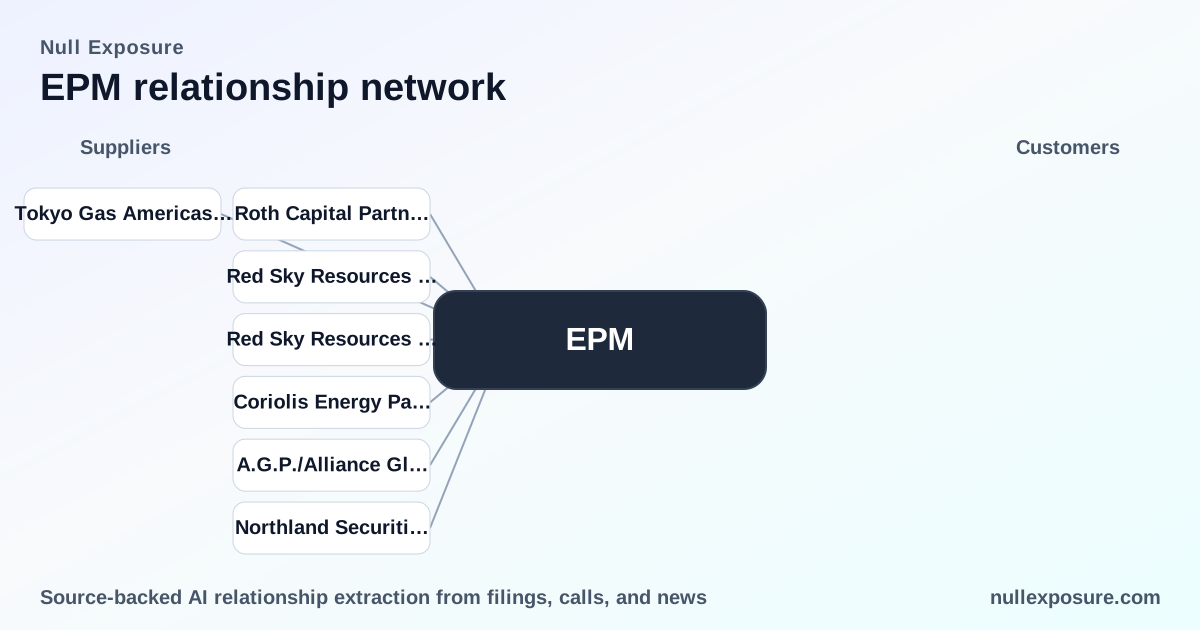
Evolution Petroleum (EPM): Customer Relationships That Drive Royalty Cash Flow
Evolution Petroleum monetizes through two complementary channels: direct production sales from working interests and cash flows from mineral royalties acquired across U.S. basins. The company converts upstream exposures into near-term cash by selling hydrocarbons under short-term, market-based contracts and by acquiring royalty positions that deliver production-linked receipts from third‑party operators. Evolution’s scale is modest (roughly $173m market cap with about $85.6m revenue trailing twelve months), but its business model is deliberately cash-flow oriented and dependent on operator performance and spot commodity pricing. For an investor, the central question is how stable those operator and purchaser relationships are, and how exposed the cash flow stream is to market swings — both subjects explored below. Learn more at https://nullexposure.com/.
What the customer map implies about Evolution’s operating posture
Evolution sells the majority of its crude oil, natural gas and NGL production under short‑term (less than 12 months) contracts at market‑based prices, and markets hydrocarbons regionally in the United States. This contracting posture establishes three persistent characteristics of the revenue model:
- Price exposure and cash‑flow variability: short‑term contracts mean revenues track spot market moves rather than fixed mid‑ or long‑term hedges, amplifying sensitivity to commodity cycles.
- Operator and regional dependency: revenue is sourced from U.S. production (Texas/New Mexico/Louisiana and Jonah Field references), so geopolitical risk is low but geographic concentration risk is meaningful for basin‑level shocks.
- Seller posture and marketability: Evolution acts as a seller of production and as a royalty owner; production is marketed in line with industry practices and is considered readily transportable and marketable in U.S. markets.
These company-level signals come from Evolution’s public disclosures describing contract terms and sales geography; they are structural to the business rather than tied to any single counterparty. The net effect for investors is that cash flow reliability depends on operator execution and short‑term price dynamics more than on long‑dated contractual protections.
The counterparties you should track (line‑by‑line)
Below are every relationship referenced in the available results, each summarized in plain English with the source noted.
TIGO
Evolution had a 50% stake in Tigo UNE that was acquired by Millicom, transferring full ownership to Millicom and consolidating the Colombia operation. According to an earnings call transcript for Millicom (FY2026), Millicom announced it acquired EPM’s 50% stake in Tigo UNE and now owns 100% of the Colombia operation (InsiderMonkey transcript, March 2026).
Coterra Energy
Coterra Energy is listed among the “high‑quality, well‑capitalized operators” tied to a mineral royalty package Evolution closed in August 2025; these operators produce the volumes that generate royalty receipts. This characterization comes from a GlobeNewswire press release announcing Evolution’s mineral royalty acquisition (GlobeNewswire, August 6, 2025).
Camino Natural Resources
Camino Natural Resources is named alongside other operators in Evolution’s August 2025 royalty acquisition announcement, implying Camino is an operator whose production underpins part of the acquired royalty cash flow (GlobeNewswire, August 6, 2025).
Canvas Energy
Canvas Energy is included in the same August 2025 press release as an operator associated with the mineral royalty purchase, and therefore is a counterparty whose wells and production profile matter to the royalty income stream (GlobeNewswire, August 6, 2025).
Mach Resources
Mach Resources appears in Evolution’s announcement of the mineral royalty acquisition as a producing operator connected to the acquired asset base; Mach’s performance feeds directly into the royalty receipts cited in the transaction release (GlobeNewswire, August 6, 2025).
Validus Energy
Validus Energy is also named in the August 2025 transaction release as one of the operators supporting the royalty portfolio; its production characteristics will influence the long‑term cash flow profile of the acquisition (GlobeNewswire, August 6, 2025).
(For full context on the suite of operators tied to the August 2025 royalty acquisition, see Evolution’s press release on GlobeNewswire.)
What those relationships mean for cash flow and risk
Evolution’s customer/partner list is a mix of operators that produce oil, gas and NGLs which in turn generate royalties, plus purchasers of its working interest production. The implications for investors are straightforward:
- Operator quality matters: Evolution bought a package described as supported by “high‑quality, well‑capitalized operators,” which is constructive for long‑run royalty stability if the characterization holds in practice (GlobeNewswire, Aug 2025). Operator capital discipline and drilling programs directly affect royalty volumes.
- Short‑term contracts increase market exposure: because substantially all production is sold under short‑term, market‑based contracts, revenues move with spot prices; hedging or acquisition of long‑dated cash flows would materially change volatility profile, but current disclosures emphasize market pricing.
- Geographic concentration focuses but simplifies exposure: cash flows derive from U.S. basins (Texas, New Mexico, Louisiana, Jonah Field), reducing sovereign risk while concentrating basin risk — a positive for clarity, a negative for diversification.
- Counterparty dispersion is moderate: the August 2025 acquisition lists multiple operators rather than a single producer, which reduces single‑operator concentration risk; however, the size and life‑cycle of each operator’s producing assets will determine realized cash flow longevity.
Practical checklist for analysts and operators
When evaluating Evolution as an investment or as a counterparty, focus on these high‑impact items:
- Validate operator production trends and decline curves for the specific royalty blocks listed in the August 2025 release.
- Monitor short‑term commodity price exposure and any shifts in Evolution’s hedging posture.
- Track any further dispositions (for example, the Tigo UNE stake sale announced in March 2026) that change the company’s asset mix or recurring revenue base.
- Review counterparty credit and capital programs for names cited in the royalty release — operator solvency and capital allocation dictate future royalty receipts.
For a consolidated view of Evolution’s counterparties and implications for premium finance strategies, visit our homepage at https://nullexposure.com/.
Bottom line — what investors should remember
Evolution Petroleum is a small, cash‑flow focused oil & gas company whose revenues are primarily generated under short‑term, market‑priced contracts and through acquired royalty positions supported by multiple operators. The August 2025 mineral royalty purchase diversified the company’s operator exposures across Camino, Canvas, Coterra, Mach and Validus, while the March 2026 transaction referenced by Millicom reflects a corporate disposition of an interest in Tigo UNE. Because the company sells production on short contracts and relies on third‑party operators for royalty volumes, investor returns are driven by commodity cycles and operator execution more than by long‑dated contractual protections. Quantitative valuation should therefore weigh spot price scenarios and operator production trajectories alongside Evolution’s steady dividend policy and modest scale.