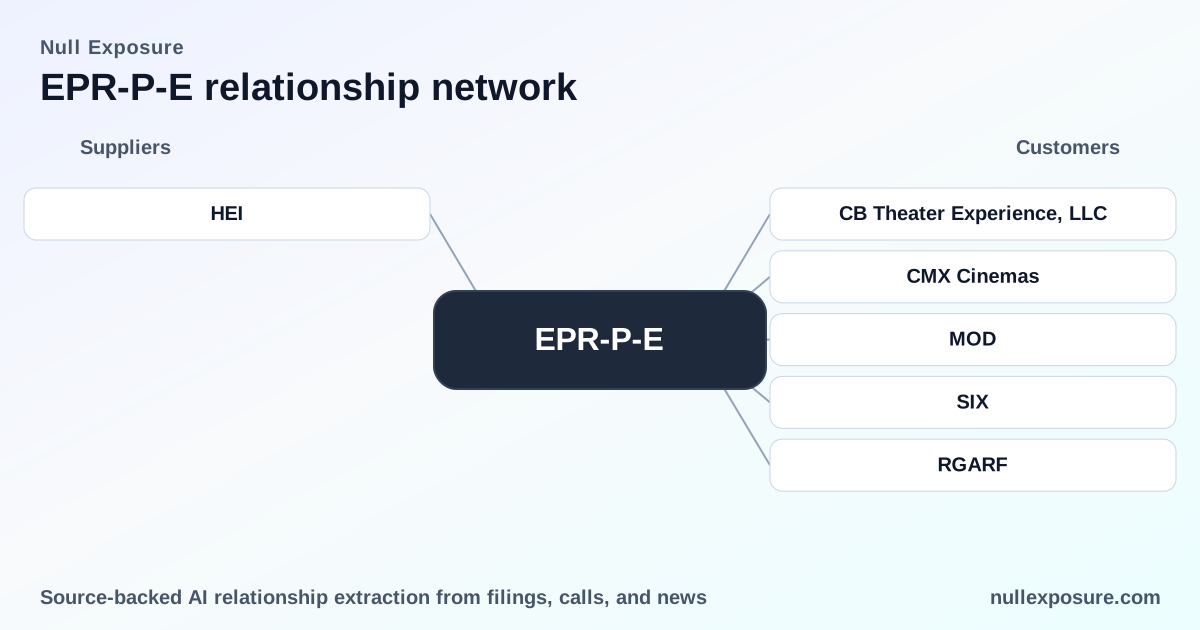
EPR-P-E: A Practical Map of EPR Properties’ Customer Relationships and Operational Posture
EPR Properties monetizes experiential real estate by acquiring and leasing destination leisure assets—movie theaters, water parks, ski resorts, Topgolf and regional amusement parks—under long-dated lease structures that tie real estate cash flows to operator performance. The Series E preferred (EPR-P-E) represents claim to the company’s capital structure while investors evaluate how operator relationships and leasing mechanics drive rent volatility and downside protection. For an operational lens on tenants and counterparties, this note unpacks every customer relationship surfaced in recent coverage and translates those links into actionable investor signals.
Discover how relationship intelligence informs capital allocation: https://nullexposure.com/
Why operator relationships matter for experiential REITs
EPR’s business model is operator-dependent: ownership of specialized facilities is only valuable if experienced operators deliver attendance and revenue that support contractual rents. The company’s public narrative and media coverage show a strategic preference for long-term master leases and revenue-sharing mechanics, which align incentives but also concentrate credit and execution risk around a handful of leisure operators. No standardized constraints were extracted in the available relationship metadata; as a company-level signal, that absence underscores the need for bottom-up verification of contract tenor, rent indexing, and percentage rent triggers on a per-asset basis.
Company-level operating characteristics to keep front of mind:
- Contracting posture: Evidence of long-term master leases and percentage rent linkage supports aligned economics between landlord and operator.
- Concentration: Portfolio concentrated in experiential sub-sectors—operators are distinct from standard commercial tenants and drive the asset’s performance.
- Criticality: Operator health is critical to cash flow; underperformance or operator default directly pressures rent receipts.
- Maturity: Relationships include both long-established operators and newer master-lease arrangements as EPR scales experiential holdings.
Relationship-by-relationship: what investors need to know
Below are concise, plain-English summaries for every customer relationship extracted in coverage, with source citations. Each line contains the core commercial fact and the reporting context.
-
Enchanted Parks — master-lease operator for six acquired U.S. parks. EPR completed acquisition of six U.S. amusement parks and executed a long-term master lease with Enchanted Parks, separating real estate ownership from park operations while tying rent to park performance. (Pulse2, May 2, 2026; Yahoo Finance, May 2026)
-
La Ronde Operations, Inc. — operator for La Ronde. La Ronde will be operated by La Ronde Operations, Inc. under the established regional-park operator model after the parks acquisition, preserving operational continuity for that asset. (Pulse2, May 2, 2026)
-
MOD (and Topgolf references) — experiential venue exposure. Media coverage groups Topgolf and MOD alongside EPR’s experiential portfolio as examples of how the REIT has moved beyond traditional property types into leisure destinations. This signals EPR’s exposure to fast-growing, branded leisure operators. (Ad-hoc-news.de, March 9, 2026)
-
Topgolf — asset class example within the experiential portfolio. Topgolf is cited as a class of experiential tenant that broadens EPR’s earnings base beyond theaters and parks, reflecting diversified operator types in the portfolio. (Ad-hoc-news.de, March 9, 2026)
-
CB Theater Experience, LLC — tenant-level rent default action. A statement of claim filed in FY2021 shows EPR Tuscaloosa, LLC seeking eviction after CB Theater Experience, LLC failed to pay $94,297.56 in rent for May, demonstrating EPR’s willingness to enforce lease covenants when operator performance breaks down. (Tuscaloosa Thread, reported March 9, 2026; original FY2021 filing)
-
CMX Cinemas — tenant implicated in eviction action. CMX was identified in reporting tied to the Tuscaloosa eviction, illustrating how theater operator distress can translate to landlord legal remedies and near-term cash-flow interruptions. (Tuscaloosa Thread, reported March 9, 2026; FY2021 claim)
-
Six Flags / SIX — historical operator relationship and asset turnover. Coverage references parks that were acquired from EPR Properties in prior transactions, underlining that EPR both disposes and acquires leisure assets as strategic conditions evolve. (Blooloop, FY2019 reporting cited March 9, 2026)
-
Regal / RGARF — theater lease revenue-sharing dynamics. Analysts highlighted that the North American box-office recovery and new revenue-sharing lease structures with chains like Regal are translating into higher percentage rents and improved alignment between EPR and operators, a meaningful driver of upside in rent receipts. (SimplyWallSt, FY2025 commentary, March 9, 2026)
What this relationship map implies for investors
-
Revenue alignment is a structural upside. Use of percentage rents and revenue-sharing with major theater chains and leisure operators converts operator outperformance into landlord upside, improving economic alignment across cycles. Evidence cited by SimplyWallSt points to meaningful improvement in percentage rent collection as box office recovered in 2025.
-
Operator credit and execution risk is the primary downside. The Tuscaloosa eviction involving CB Theater Experience / CMX demonstrates that EPR enforces lease terms, but enforcement introduces vacancy risk and potential capex requirements before re-leasing.
-
Portfolio flexibility through asset-level transactions. Historical buys and sells (Six Flags-related coverage) indicate EPR actively manages the portfolio, monetizing assets or reallocating capital when operator or market dynamics change.
-
Contracting posture reduces some landlord risk but raises counterparty concentration. Long-term master leases shelter EPR from day-to-day operations but concentrate counterparty risk; a default by a master-lessee affects multiple parks if the lease covers a portfolio.
Quick investor checklist:
- Verify tenor and percentage rent mechanics on a per-asset basis.
- Monitor major operator credit (Topgolf, Regal, regional park operators).
- Track enforcement outcomes and re-leasing timelines after disputes.
Explore more relationship-level intelligence and how it affects capital decisions at https://nullexposure.com/.
Bottom line
EPR’s experiential strategy is structurally different from traditional REITs: cash flows depend on operator economics as much as on real estate fundamentals. The relationships documented in recent coverage—ranging from master-lease operators like Enchanted Parks to theatre chains and single-asset disputes—create a profile of concentrated counterparty risk balanced by percentage-rent upside and active asset management. Investors in EPR-P-E should prioritize contract detail diligence and operator credit surveillance as the primary levers that will determine preferred-share resilience and dividend coverage going forward.