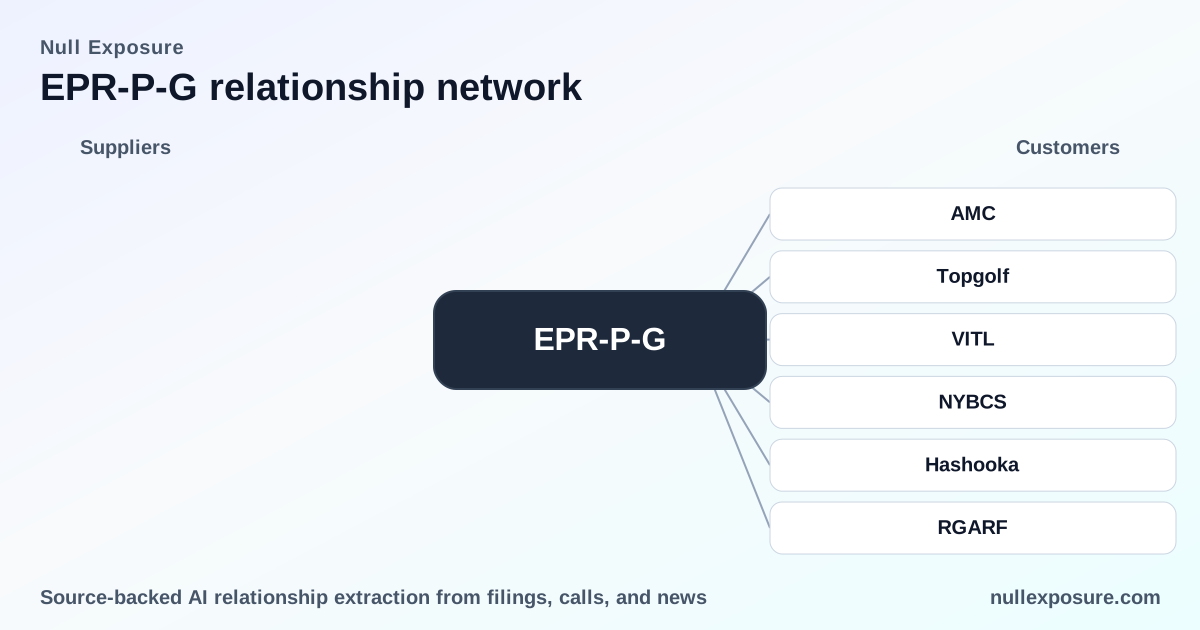
EPR-P-G: Revenue concentration in experiential real estate — what customers tell investors
EPR Properties monetizes a portfolio of experiential real estate—movie theaters, eat-and-play complexes, fitness and family-entertainment centers—by owning buildings and leasing them to specialized operators under multi-year leases that often combine base rent with percentage rent. The 5.750% Series G preferred shares deliver fixed dividend cash flows that are supported by this leased-revenue model; investor focus should be on tenant credit, revenue concentration among marquee operators, and the durability of percentage-rent streams. For a deeper look at counterparty exposure and operator mix, visit https://nullexposure.com/.
How EPR’s operating model converts tenants into predictable cash
EPR’s business is straightforward: buy experiential real estate, secure long-term operator leases, and collect rent (base + occasional percentage rent). Recent filings and public comments underline three structural features that drive cashflow and risk:
- Contracting posture: EPR relies on long-term leases that embed both fixed and variable (percentage) rent components; this gives stability while retaining upside from operator performance.
- Concentration: A relatively small group of large operators account for a material share of revenue, creating single-tenant and top-tenant concentration risk at the portfolio level.
- Maturity and diversification of operator relationships: The portfolio mixes established national chains (theaters, major entertainment brands) with growth-stage experiential concepts (fitness, golf entertainment, family centers), producing a blend of predictable cash and growth optionality.
These company-level signals are visible across the SEC filing coverage and investor transcripts summarized below; they shape credit risk for preferred holders and the sensitivity of dividend coverage to operator cycles.
Customer relationships in the public record — what to watch
Below are every customer relationship referenced in the available records, with a concise plain-English takeaway and the source.
AMC
EPR discloses material revenue exposure to AMC, reflecting AMC’s status as one of the REIT’s largest theater tenants and a driver of theater-related cash flows. According to a Simply Wall St note referencing FY2025 commentary (March 2026), EPR’s steady dividend declarations were discussed alongside revenue exposure tied to AMC.
AMC Entertainment
AMC Entertainment is cited directly as a top theater counterparty that underpins part of EPR’s theater rental income and headline investor concern. According to the same Simply Wall St coverage (March 2026), the company’s dividend posture was framed against exposure to AMC.
AMC Theaters
Multiple news notes consolidate that financial challenges at AMC Theaters continue to influence EPR’s revenue streams, highlighting theater concentration as a recurring theme in FY2025 reporting (GuruFocus coverage, May 2026).
Topgolf
Topgolf is a major contributor to EPR’s eat-and-play revenue, explicitly quantified in filings as a high-single-digit to low-double-digit percentage of total revenue in 2025; Topgolf accounted for about $102.3 million, or 14.2% of total revenue in 2025 per EPR’s SEC disclosures (reported via TradingView’s summary of the FY2026 10‑K, March 2026).
Advance Golf Partners
Advance Golf Partners is an operator contracted to lease and run certain golf course properties in EPR’s portfolio; management disclosed these sites will be operated by Advance Golf Partners in the Q4 2025 earnings transcript (Investing.com earnings transcript, May 2026).
AMC (second mention in FY2026 context)
EPR’s FY2026 commentary reiterates reliance on a small set of large customers, with AMC again named among top operators; this is documented in summaries of the company’s FY2026 filing referenced in TradingView (March 2026).
Topgolf (investor Q&A mention)
During earnings Q&A, analysts and management discussed Topgolf’s ownership change and its implications, with Topgolf repeatedly identified as one of EPR’s top tenants (Investing.com transcript, May 2026).
Premier Parks
EPR noted that Ocean Breeze is leased and operated by an affiliate of Premier Parks, signaling a longstanding operator partnership for certain seasonal/parkworld assets (Investing.com transcript, May 2026).
Bavarian Inn
The Bavarian Inn property, including an indoor water park and family-entertainment center, contributed meaningful year-over-year revenue and EBITDA gains once fully operational, as management reported in the Q4 2025 earnings transcript (Investing.com, May 2026).
Andretti Karting
EPR highlighted strong early performance from Andretti Karting’s Kansas City location, which opened in mid-November and contributed to near-term operational momentum (Investing.com transcript, May 2026).
Pinstack
EPR discussed its second Pinstack site (Northern Virginia) as an imminent opening expected to support growth in family entertainment, with planned opening timing disclosed in the transcript (Investing.com, May 2026).
VITAL Climbing
Management flagged a strategic relationship with VITAL Climbing, including expansion into Manhattan alongside an existing Williamsburg location, positioning fitness/wellness as a growth vertical (Investing.com transcript, May 2026).
Vital (Commercial Observer acquisition context)
EPR acquired three commercial condo units at 180 Broome Street that house rock-climbing gym Vital, a $34.1 million transaction for about 52,000 sq ft, establishing direct ownership exposure to that operator’s NYC footprint (Commercial Observer property records, February 2026).
VITL (ticker mention)
The Commercial Observer account repeats the Vital purchase details and local tenant mix, reiterating EPR’s direct property ownership at 180 Broome Street and Vital’s tenancy (Commercial Observer, February 2026).
Alyeska
EPR reported strong seasonal demand at Alyeska, bolstered by membership programs and alpine network affiliations, indicating resilience in its winter-resort assets (Investing.com transcript, May 2026).
Enchanted Forest Water Safari
The operator managing Enchanted Forest Water Safari delivered positive first full-year performance metrics, and EPR characterized the asset as performing well under its current operator (Investing.com transcript, May 2026).
NYBCS
Commercial Observer’s reporting on the 180 Broome Street acquisition lists NYBCS as a commercial tenant at the property, indicating a diversified tenant mix within that condo purchase (Commercial Observer, February 2026).
Hashooka
The same Commercial Observer item names Hashooka (a mobile caterer) among current commercial tenants at 180 Broome Street, reinforcing the micro-tenant structure of that urban asset (Commercial Observer, February 2026).
Regal (Investing.com transcript)
EPR disclosed that Regal drives the only meaningful percentage-rent component among its theater leases, and management embeds an estimate of Regal percentage rent into guidance (Investing.com Q4 2025 earnings transcript, May 2026).
Regal (SEC 10‑K mention via TradingView)
The FY2026 SEC filing summary reiterates that Regal, alongside a small set of other large operators, represents concentrated revenue exposure, reinforcing concentration risk highlighted elsewhere (TradingView summary of SEC 10‑K, March 2026).
What these relationships mean for preferred holders
- Revenue concentration is the dominant counterparty risk. Multiple filings and transcripts identify the same handful of operators as material contributors to revenue; that concentration is a core driver of dividend coverage risk for fixed-income preferred shares.
- Lease structure cushions downside but does not eliminate operator credit exposure. Long-term leases provide base rent stability, while percentage-rent arrangements introduce operational cyclicality tied to operator performance.
- Portfolio diversification is intentional but uneven. EPR is expanding into fitness, golf entertainment, and family centers—segments that add growth optionality but also bring varied operator credit profiles and development execution risk.
For investors in EPR‑P‑G, focus your diligence on operator credit trends (theater recovery metrics, Topgolf visitation, fitness/golf demand cycles) and how management’s leasing cadence converts underlying property performance into secured cash available for preferred dividends.
If you want a structured view of counterparty exposure and tenant-level signals, explore EPR’s relationship mapping and filings at https://nullexposure.com/.
Concluding note: EPR’s preferred shares are anchored in a leased-revenue model that blends stability and operator-linked upside; credit vigilance on a few marquee tenants and monitoring of new experiential operator rollouts are the primary levers for investors assessing dividend durability.