Essential Properties Realty Trust (EPRT): customer relationships and what they mean for investors
Essential Properties Realty Trust is an internally managed REIT that acquires, owns and manages primarily single-tenant, long‑term net‑leased properties leased to middle‑market operators in service and experience businesses. The company monetizes through stable contractual rent streams, opportunistic sale‑leasebacks and mortgage receivables tied to its portfolio of roughly 2,300 locations across 48 states, generating annualized base rent of about $555 million and near‑full occupancy. For a quick look at how we track these tenant relationships, visit https://nullexposure.com/.
Quick investor thesis
EPRT’s product is contractual rent: by focusing on long initial lease terms with middle‑market franchise and regional operators, EPRT converts property assets into predictable cashflows while retaining upside from portfolio growth and selective financings. That model produces high headline occupancy and concentrated exposure to consumer‑facing service concepts, which supports cashflow stability but concentrates demand risk in dining, entertainment and other experiential sectors.
How EPRT structures tenant relationships (company-level signals)
EPRT’s public disclosures make several operating characteristics clear. The company signs long‑term net leases—typically with initial terms of 15 years or more—so revenue is contractually protected and tenant obligations (insurance, property upkeep) sit on the lessee. Management defines its target lessees as middle‑market operators (roughly 10–250 locations, $20M–$1B revenue), and 91.5% of annualized base rent is attributable to service‑oriented and experience businesses, underscoring a sector tilt. Geographically, the portfolio is highly diversified across North America (48 states) and the top individual tenant represents no more than 3.4% of ABR, which reduces single‑counterparty concentration risk. These are company‑level business model signals drawn from the December 31, 2025 filing and recent earnings commentary.
Notable customer relationships and recent activity
Below I cover every counterparty listed in the available results, with short plain‑English summaries and source references.
-
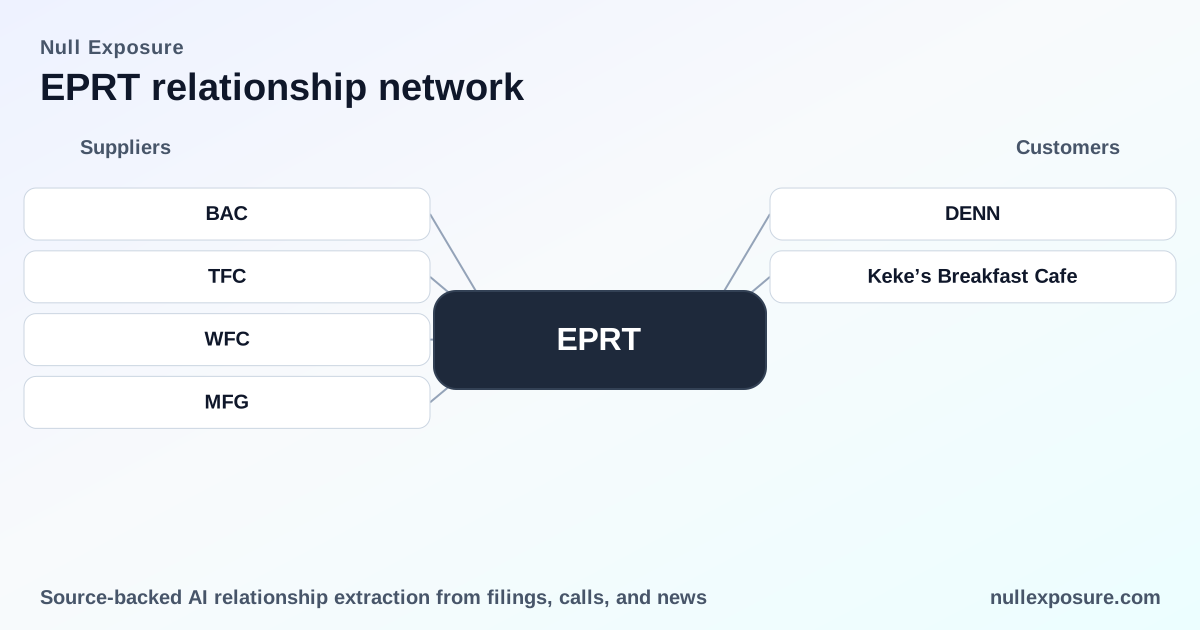
Denny’s (ticker DENN) — Essential Properties executed a meaningful programmatic relationship with Denny’s: in January EPRT completed a purchase of 74 properties and a $147 million sale‑leaseback tied to Denny’s privatization, reflecting a large, contiguous transaction that strengthens EPRT’s exposure to national casual‑dining franchisors. This was discussed on EPRT’s Q1 2026 earnings call and in filings describing the transaction (InsiderMonkey transcript, May 2026).
Source: company earnings call transcript coverage (InsiderMonkey, Q1 2026). -
DENN — A regional wire report documented a smaller, separate set of acquisitions that included four Bay Area restaurant properties occupied by Denny’s (and related breakfast concepts) for about $10 million, demonstrating EPRT’s mix of both portfolio‑scale deals and bolt‑on retail acquisitions.
Source: local news coverage captured by WhatNow citing Mercury News (March 9, 2026). -
Denny s — Earnings commentary reiterated the firm’s role in the broader Denny’s privatization and acquisition pipeline (same InsiderMonkey Q1 2026 transcript), confirming multiple touchpoints with that operator across transaction types.
Source: Q1 2026 earnings call transcript (InsiderMonkey, May 2026). -
American Signature — Management disclosed an impairment driven primarily by one site formerly occupied by American Signature, indicating localized asset performance issues requiring write‑downs rather than portfolio‑wide weakness. This item was discussed in the Q1 2026 earnings materials.
Source: Q1 2026 earnings call coverage (InsiderMonkey, May 2026). -
Applebee’s (ticker DIN) — Several properties that were in bankruptcy and tied to Applebee’s have been backfilled; management noted seven properties involved in that restructuring and confirmed replacement tenants or reopening activity, illustrating EPRT’s hands‑on asset management through tenant turnover events.
Source: Q1 2026 earnings call coverage (InsiderMonkey, May 2026). -
Keke’s Breakfast Cafe — Keke’s operates a small number of locations acquired in EPRT’s Bay Area purchase, reflecting the REIT’s exposure to local and regional breakfast concepts alongside national chains. Local reporting on the March 2026 acquisitions lists Keke’s as an occupant of one of the acquired sites.
Source: WhatNow summary of Mercury News reporting (March 9, 2026). -
Chicken & Pickle — Management identified Chicken & Pickle as part of the entertainment/experiential operator cohort; EPRT characterized the relationship as healthy with stable coverage, though top‑line growth is flat and will be monitored as part of the entertainment bucket.
Source: Q1 2026 earnings call coverage (InsiderMonkey, May 2026).
What the relationship map means for investors
EPRT’s customer roster and disclosures reveal a clear operating posture:
- Contracting posture: long‑term, tenant‑obligated leases. Long initial terms and triple‑net provisions shift operational burden to tenants and support predictability of rent receipts.
- Counterparty profile: middle‑market operators dominate. That strategy delivers yield but concentrates exposure in the health of regional franchisors and consumer spending at the middle‑market level.
- Concentration and diversification balance. The portfolio is geographically diversified, lowering regional recession risk, but sector concentration in services and experience businesses (≈91.5% ABR) creates sensitivity to discretionary spending cycles.
- Criticality and maturity: active, stabilized portfolio. With 99.7% occupancy as of Dec 31, 2025 and active sale‑leaseback deal flow (e.g., the Denny’s transactions), EPRT operates at scale and pursues a mix of stabilized assets and larger strategic transactions that can alter ABR composition.
- Operational roles: owner/seller and asset manager. The company’s disclosures position it primarily as landlord/seller of net‑leased real estate while also servicing lease financing and, in selective cases, loan receivables and direct financing lease structures.
Key takeaways for portfolio decisions
- Stability driver: long‑term net leases and tenant insurance requirements underwrite predictable cashflows.
- Return driver: portfolio growth via acquisitions and sale‑leasebacks (notably the Denny’s program) can expand ABR and scale quickly.
- Primary risk: sector concentration in dining/entertainment exposes EPRT to shifts in consumer discretionary demand and operator balance‑sheet stress at the middle‑market tier.
- Mitigant: geographic diversification and low tenant concentration (no tenant >3.4% ABR) reduce single‑counterparty shock.
For a concise, investor‑facing map of tenant relationships and to explore how these dynamics affect credit and cashflow modeling, visit https://nullexposure.com/.
Conclusion: EPRT’s model delivers contractual revenue stability supported by long leases and geographic scale, while its focus on mid‑market service operators concentrates exposure to discretionary demand cycles—an attractive risk‑return tradeoff for investors who underwrite sector cyclicality and operator credit.