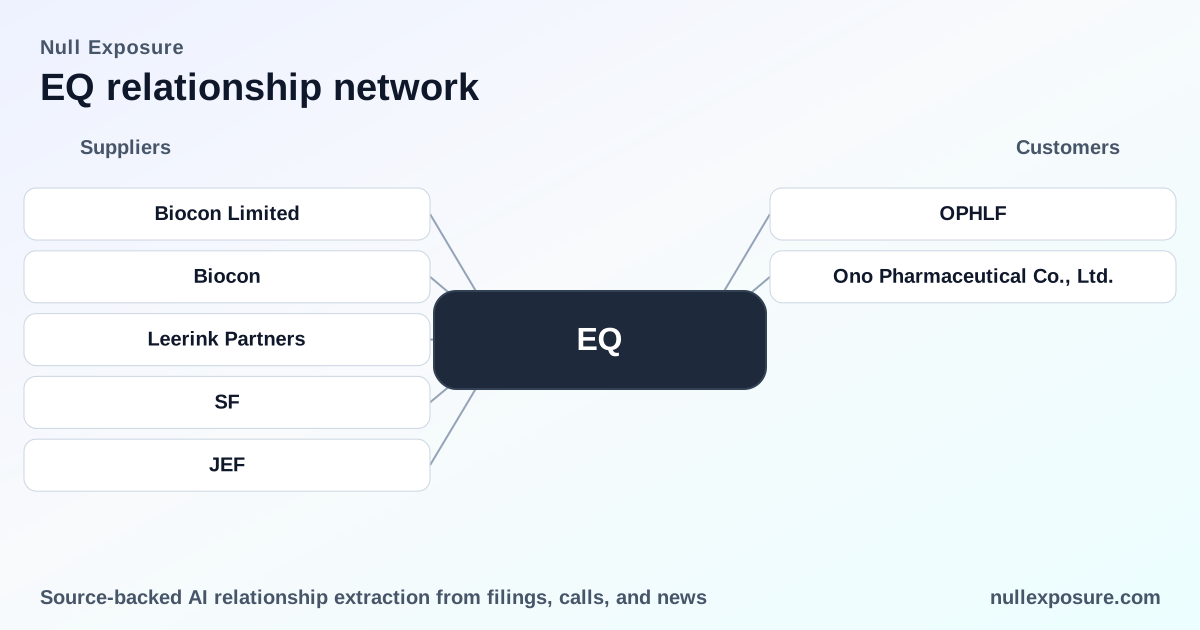
Equillium’s customer map: licensing, one-off revenue and a financing lifeline
Equillium operates as a clinical-stage biotech focused on immuno-inflammatory therapeutics and monetizes through a mix of upfront and milestone payments from licensing/asset transactions, development funding, and capital raises. Historically, the company’s revenue profile has been concentrated in a single major asset transaction and development funding tied to that asset; more recently Equillium supplemented cash flow through a direct financing with a healthcare-focused investor. For a quick gateway to the underlying signals and source material, see NullExposure’s homepage: https://nullexposure.com/.
Why relationships drive valuation more than product sales today
Equillium runs a single operating segment: novel therapeutics for immuno‑inflammatory disorders. As a clinical-stage company, revenue does not come from broad product sales but from discrete contractual arrangements — licenses, development funding and asset transfers. That means equity value is highly sensitive to (1) the presence and structure of counterparty deals, (2) the timing and durability of milestone and amortized upfront payments, and (3) access to investor capital when license receipts ebb.
- Concentration: All recorded revenue has historically come from a very small number of counterparties and transactions; this produces lumpiness in top-line recognition.
- Contracting posture: The company operates as both a licensor/seller of IP and a recipient of development funding; relevant accounting applied ASC 808/606 for the major asset sale/licensing arrangement.
- Criticality and maturity: Counterparties that control commercialization or development rights are functionally critical because Equillium is not yet a commercial-stage seller of products.
For additional context and to follow primary-source reporting on these relationships visit our homepage: https://nullexposure.com/.
RA Capital Management — financing partner supplying working capital
RA Capital Management entered into a definitive securities purchase agreement to provide approximately $35 million in gross proceeds to Equillium, supplying a near-term cash infusion that directly supports operations and clinical programs. According to a GlobeNewswire press release dated March 13, 2026, the financing is structured as a securities purchase agreement and was repeatedly noted by market outlets including Investing.com and InsiderMonkey in May 2026 coverage. (GlobeNewswire, March 13, 2026; Investing.com and InsiderMonkey, May 2026.)
Why investors should care: this financing reduces immediate cash risk and de-risks short-term runway, but it is a financing solution rather than recurring revenue — it shifts funding risk away from reliance on partner milestones to capital markets execution.
Ono Pharmaceutical / OPHLF — the desktop case study in concentrated licensing
Equillium’s most consequential customer relationship historically was with Ono Pharmaceutical (in some sources referenced under inferred symbol OPHLF). The partnership followed an exclusive option and an asset purchase agreement signed in December 2022 and produced significant upfront and contingent consideration, but the agreement was later terminated and revenue recognition changed materially across fiscal years.
- Equillium and Ono signed an exclusive option and asset purchase agreement for development and commercialization of itolizumab in December 2022, positioning Ono as the commercial counterparty for that asset. (RTTNews, FY2023 / December 2022.)
- By early disclosures, the deal generated $26 million in upfront cash and $138.5 million of potential contingent consideration reported at the time the agreement was consummated. (FierceBiotech coverage of the 2022 transaction.)
- Equillium recorded meaningful revenue tied to the Ono arrangement in 2024, but following termination of the Asset Purchase Agreement in October 2024 the company reported no revenue recognized in 2025 compared with $41.1 million recorded in 2024 related to the Ono agreement. (GlobeNewswire Q3 2025 operational update; GlobeNewswire FY2025–FY2026 disclosures.)
Why investors should care: Ono functioned as a single large counterparty whose deal structure produced lumpy, amortized revenue recognition and materially impacted Equillium’s revenue trajectory when the agreement unwind occurred. The company explicitly applied ASC 808 and ASC 606 in accounting for the license and development services tied to Ono, confirming the legal-economic framing of that relationship. (GlobeNewswire disclosures, FY2025 and FY2026.)
What each public signal says about contract risk and runway
The public record and disclosures combine to form a consistent operating profile:
- Geographic concentration: Equillium reports all revenue attributable to the United States and a single operating segment, which compresses geographic diversification and ties regulatory/commercial outcomes to a single market. (Company filings and related press materials reflected in FY2025 disclosures.)
- Licensee role (named): The company explicitly characterized Ono as a customer/licensee and applied collaborative‑arrangement accounting guidance in that context, which highlights the legal nature of the transfer of IP rights and associated R&D obligations. (ASC 808/606 discussion in company filings cited in FY2025.)
- Seller role (company-level signal): Equillium frames its commercial model as one where it will market, sell and distribute products via third‑party arrangements and could be subject to typical healthcare contractual and regulatory risk as a seller. This is a company-level posture, not limited to any single counterparty.
- Single-segment focus: The business remains a one-segment clinical-stage therapeutics developer, which reinforces dependency on external partners, licensing cash flows and capital markets. (Company reporting on segment structure.)
Investment implications and risk checklist
- Cash runway improved but not solved: The RA Capital financing meaningfully extends runway; it is a capital market solution rather than a durable revenue stream. Investors should track dilution and the terms of the securities purchase agreement in filings.
- Earnings volatility is structural: Past revenue was dominated by the Ono transaction; termination of that agreement produced a sudden drop to zero revenue for 2025, demonstrating high revenue concentration risk.
- Contractual and regulatory exposure: Equillium’s future revenue depends on licensing, R&D payment structures, and compliance with healthcare contracting rules — factors that can change both timing and recognition.
- Catalyst list: any new licensing deals, restructured agreements with prior counterparties, or clinical progress that unlocks milestones will materially re-rate the business; conversely, difficulty accessing further capital or failure to secure new partners will continue to compress enterprise value.
Bottom line: partnership-driven value with capital‑market backstops
Equillium’s business model is partnership-driven and therefore binary at points: single transactions can produce multi‑year revenue recognition or leave the company dependent on financings. The March 2026 RA Capital financing provides a measured near-term buffer, but the company’s valuation will continue to hinge on the company’s ability to reestablish durable licensing or commercialization arrangements comparable to the Ono transaction and to execute clinical milestones that translate into partner payments. For authoritative tracking of counterparties and evolving relationship signals consult NullExposure’s primary portal: https://nullexposure.com/.
Sources referenced in this article include Equillium press releases and financial disclosures reported via GlobeNewswire (Q3 2025 and FY2026 releases), a GlobeNewswire financing announcement (March 13, 2026), FierceBiotech reporting on the 2022 Ono transaction, RTTNews coverage of the December 2022 agreement, and market outlets including Investing.com and InsiderMonkey summarizing the RA Capital financing.