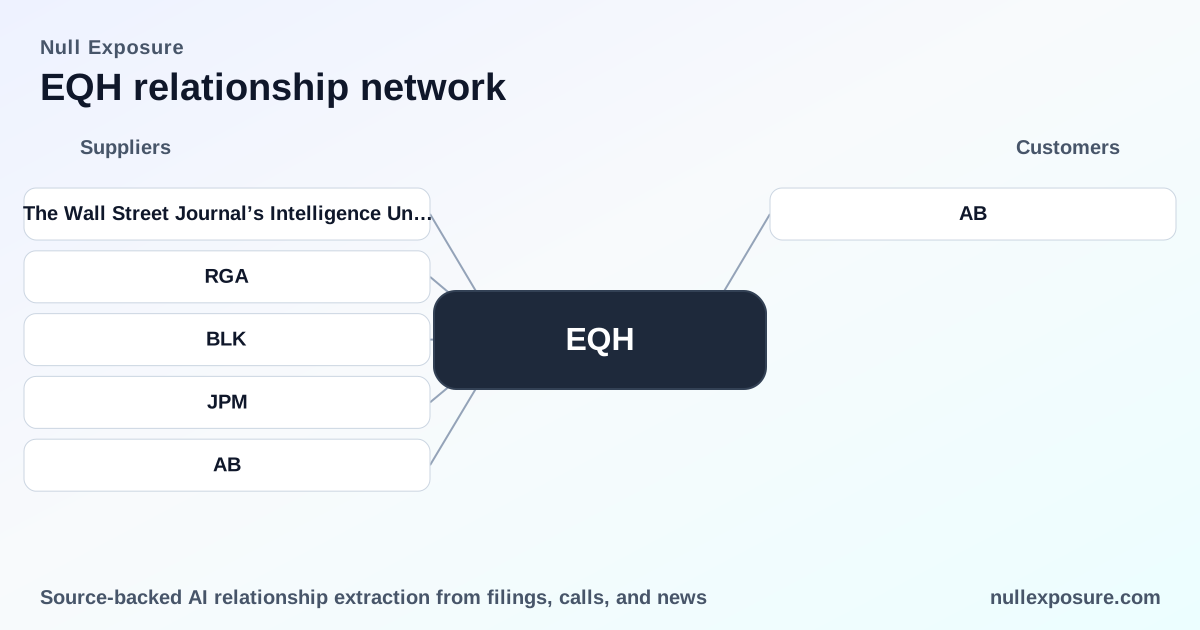
How EQH Monetizes Relationships: an investor primer
Equitable Holdings (EQH) is a diversified financial services firm that monetizes through insurance premiums, retirement and protection product fees, and asset-management fees earned on both proprietary and third‑party capital. The business combines insurance underwriting with fee-based asset management and related distribution services, creating recurring revenue streams that are both asset-sensitive and distribution-dependent. For a concise, relationship-focused view of EQH’s customer partners and the operating levers they create, see https://nullexposure.com/.
Quick investor thesis
EQH earns steady fee income from asset management and distribution while underwriting insurance liabilities that generate premiums and capital deployment opportunities. The company’s customer relationships—both as client and counterparty—drive fee revenue, capital commitments to third‑party asset managers, and occasional portfolio transfers that change capital and risk positions. These relationship dynamics are central to forecasting revenue mix, capital usage, and contract flexibility.
Major counterparty relationships you need to track
AllianceBernstein (AB / AllianceBernstein L.P.)
AllianceBernstein is a core asset-management partner for EQH. EQH is deploying significant capital to support AB’s private markets expansion and AB will onboard more than $10 billion of Equitable’s commercial mortgage portfolio in the second half of 2026, reflecting both capital commitment and portfolio transfer activity. According to InsuranceNewsNet (Mar 9, 2026), AB will onboard over $10 billion of EQH commercial mortgages in late 2026, and EQH’s press materials reported deploying most of a $20 billion capital commitment to support AB’s private markets franchise (The Globe and Mail, Mar 9, 2026). Additionally, AB’s Lifetime Income Strategy lists Equitable as a participating insurer, tying EQH into AB’s retail and institutional annuity and income solutions (StockTitan summary, Mar 2026).
XCHG (trading reference)
A public market reference lists Equitable Holdings as the issuer tied to the XCHG symbol for the relevant instrument. The TradingView page for AMEX‑XCHG references “Issuer Equitable Holdings, Inc.” (TradingView, FY2025), which functions as an identifier linking EQH to exchange-traded instruments and public market liquidity for related securities.
RGA (Reinsurance Group of America)
RGA recorded a transaction with subsidiaries of Equitable that affected its pro‑forma capital position, indicating a completed deal between EQH and RGA affiliates. RGA stated that, when factoring in the transaction with subsidiaries of Equitable Holdings (closed earlier on the announcement date), its pro‑forma excess capital was estimated at $2.3 billion (ReinsuranceNews, Mar 10, 2026). This confirms transactional activity between EQH and a major reinsurer that has direct capital and solvency implications for both firms.
(For a structured presentation of EQH’s counterparty footprint, visit https://nullexposure.com/.)
What the relationship signals mean for EQH’s operating model
-
Contracting posture: EQH’s asset-management arrangements include usage‑based, asset‑sensitive fee structures—AB’s Luxembourg subsidiary charges management fees calculated on average daily net assets and accrued daily; this is an explicit usage‑based arrangement referenced in AB disclosures. Many institutional and intermediary agreements are terminable on short notice (often 30 days or otherwise cancellable), which creates revenue volatility if flows or assets under management decline. Evidence for these short‑term termination features comes from AB’s management agreements language cited in public filings.
-
Counterparty mix and concentration: EQH serves a broad mix of individuals, small businesses, non‑profits, government entities (municipalities, educational plans) and mid‑market plans. That diversity dilutes concentration risk but creates complexity across distribution channels and product types—individual variable annuities rely on different sales economics than group retirement products.
-
Criticality and role depth: The company operates both as service provider and capital provider. EIM/EIMG (internal asset‑management entities) provide investment management and administrative services to related trusts, and AB acts as an external asset manager and distribution partner. The constraints data records material fees from related-party investment management: $755 million of revenue in 2024 for services to EQAT and 1290 Funds, signaling that internal asset‑management services are a material, recurring revenue stream for EQH.
-
Geographic and maturity profile: EQH’s asset-management footprint is global, with AB operating across the U.S., EMEA and Asia and Luxembourg entities servicing non‑U.S. funds. This supports diversified fee sources but also exposes EQH to cross‑jurisdictional regulatory and market cycles.
Risk and opportunity implications for investors
- Revenue sensitivity to asset levels and flows. Usage‑based fee contracts mean fee revenue scales with assets under management; portfolio transfers (like the $10B mortgage onboarding to AB) materially reallocate assets and fee pools.
- Contract fragility. Short‑term terminable agreements increase event-driven revenue risk; distribution agreements with intermediaries are cancellable and commission‑sensitive.
- Capital redeployment as a strategic lever. The $20 billion capital commitment to AB’s private markets is a strategic use of EQH’s balance sheet that generates fee income but reduces capital available for underwriting or buybacks. The RGA transaction demonstrates that EQH trades capital with reinsurers and alternate balance‑sheet partners to reshuffle risk and meet strategic objectives.
- Interconnected counterparty exposure. AB functions as fee generator, distribution partner and capital destination for EQH funds; RGA and other reinsurers alter solvency and capital metrics when transactions occur.
Relationship-by-relationship takeaways (concise)
-
AllianceBernstein (AB / AllianceBernstein L.P.): A strategic asset-management and distribution partner receiving capital and portfolio transfers from EQH, including a planned >$10B commercial mortgage onboarding in H2 2026 and support via a $20B capital commitment. (InsuranceNewsNet, Mar 9, 2026; The Globe and Mail press release, Mar 9, 2026; StockTitan, Mar 2026)
-
XCHG: Public market listing reference that identifies Equitable Holdings as the issuer for the XCHG instrument, anchoring EQH to exchange-traded product identification. (TradingView, FY2025)
-
RGA (Reinsurance Group of America): Counterparty to a closed transaction with EQH subsidiaries that materially influenced RGA’s pro‑forma excess capital, confirming active reinsurance and capital-transfer activity between the firms. (ReinsuranceNews, Mar 10, 2026)
Strategic read for operators and investors
EQH’s business model blends fee-driven asset management with capital‑intensive insurance underwriting; customer relationships—both as clients and as counterparties—drive where assets sit, how fees are earned, and how capital is deployed. Investors should watch asset transfers, capital commitments to external managers, and reinsurance trades as primary drivers of near‑term revenue mix and capital ratios. For focused, relationship-level intelligence and tracking tools, go to https://nullexposure.com/.
Bold positioning on partner activity, portfolio moves and contract structure provides the clearest signal set for forecasting EQH’s earnings and balance‑sheet trajectory.