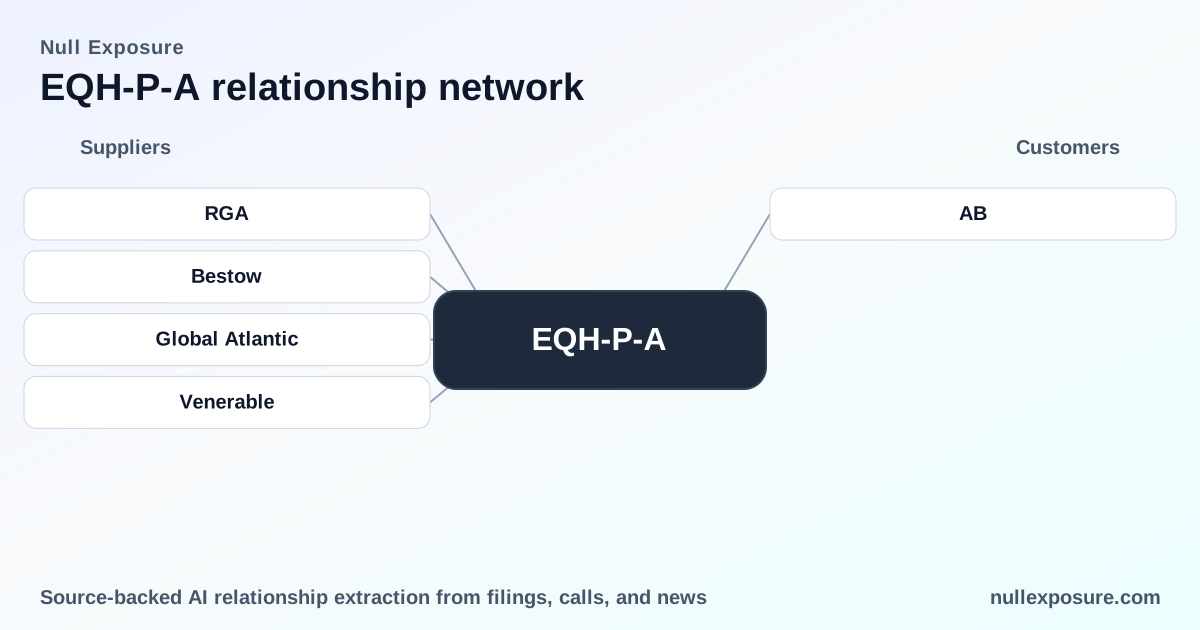
EQH-P-A: What Equitable’s AB Relationship Means for Investors
Equitable Holdings operates as a diversified financial services firm that underwrites life insurance, manages retirement products, and runs asset management operations; it monetizes through insurance premiums, asset-management fees, and investment spread income tied to a large on-balance-sheet portfolio. Recent disclosures about a major transfer of commercial mortgage loans to AllianceBernstein (AB) crystallize a strategic shift toward partnering with institutional asset managers to optimize balance-sheet economics and redeploy capital. For a concise briefing on how these counterparty moves change the investment profile, visit https://nullexposure.com/.
A clear operational move: selling scale to optimize capital
Equitable is executing a common insurance-sector playbook: de-risk the balance sheet by outsourcing or selling long-duration assets to third-party managers while retaining fee or distribution economics where possible. The deal with AB—publicly discussed during Equitable’s Q4 2025 earnings call—commits more than $10 billion of commercial mortgage loans to a single institutional partner in the second half of the fiscal year. That is a material asset transfer that reduces concentration of interest-rate and credit exposure on Equitable’s balance sheet and simultaneously outsources active management and operational servicing to a specialist manager.
All relationships covered, one by one
AB
AllianceBernstein (shortened in the transcript to “AB”) is set to onboard more than $10 billion of Equitable’s commercial mortgage loan portfolio in H2 2026, signaling a major third-party asset migration that reduces Equitable’s on-balance-sheet loan exposure. This was disclosed in Equitable’s Q4 2025 earnings call transcript reported by InsiderMonkey on March 9, 2026 (source: InsiderMonkey earnings call transcript, Q4 2025).
AllianceBernstein
AllianceBernstein is listed separately in the results and is the named institutional manager that will receive the same transfer: the onboarding of over $10 billion of commercial mortgage loans in the latter half of the year. The duplicate listing reflects the same engagement described in Equitable’s public remarks during the Q4 2025 earnings call (source: InsiderMonkey earnings call transcript, Q4 2025).
What the AB onboarding implies about Equitable’s operating model
- Contracting posture — strategic outsourcing rather than ad hoc trades. Equitable’s choice to shift a multi-billion-dollar warehouse of commercial mortgages to a single third party indicates structured, negotiated commercial arrangements rather than one-off sales.
- Concentration — single-counterparty concentration increases on the buyer side even as the seller diversifies its own risk. Transferring more than $10 billion to AB reduces Equitable’s direct credit and duration exposure, but it concentrates counterparty and operational dependence on AB for those assets.
- Criticality — high for capital management and liquidity profiles. Such a transfer materially affects regulatory capital styling, liquidity buffers, and the capacity to originate or hold similar assets going forward.
- Maturity — execution reflects a mature capital-management program. Equitable’s approach is consistent with an insurer executing advanced balance-sheet optimization, using sophisticated third-party distribution and asset-management partners.
These are company-level signals derived from the disclosed transaction, not constraint-level attributions, since no formal constraint records were returned in the dataset.
Key operational and investor implications
- Balance-sheet de-risking: By moving commercial mortgage loans off its balance sheet, Equitable improves liquidity and capital flexibility, which can support either additional underwriting or higher-distribution objectives.
- Counterparty risk shifts: The transfer reduces Equitable’s direct exposure but increases its economic exposure to AB through any residual servicing, fee or reputational linkage. Investors should track contractual terms—servicing rights, recourse, and indemnities—that determine ultimate risk transfer.
- Earnings and fee dynamics: There is potential for one-time gains or reduced net investment income depending on sale pricing versus net yields retained; over time, fee arrangements with AB could generate recurring revenue but at a different margin profile than direct asset yields.
- Execution and timing risk: Onboarding a large loan portfolio in a compressed timeline increases operational risk during the transition; successful transfer is a prerequisite for realizing the intended capital and earnings benefits.
For practitioners and researchers wanting continuous monitoring and granularly indexed relationship signals, consider broader intelligence offerings at https://nullexposure.com/.
Source and evidence posture
The relationship information is derived from an InsiderMonkey transcript of Equitable Holdings’ Q4 2025 earnings call, published March 9, 2026, in which management disclosed that AB/AllianceBernstein will onboard more than $10 billion of Equitable’s commercial mortgage loan portfolio in the second half of the year (InsiderMonkey, Q4 2025 earnings call transcript, March 9, 2026). Both entries in the results reference the same disclosure.
Investment takeaway: what investors should watch next
- Track execution milestones. Confirm whether the onboarding completes on schedule and whether servicing/payment performance is preserved post-transfer.
- Monitor contractual detail. Investors should obtain or interrogate disclosures around servicing agreements, recourse provisions, and any retained credit exposure.
- Assess capital redeployment. Watch how Equitable redeploys capital freed by the transfer — whether into new underwriting, buybacks, or liquidity buffers — as this decision will determine net earnings trajectory and risk profile.
- Evaluate counterparty health. AB’s capacity to integrate and manage that scale of loans matters; follow ABS/credit-market coverage and AB disclosures for signs of stress or repricing.
Boldly: this transaction reshapes Equitable’s asset profile and directly influences capital efficiency and income composition; successful execution will be a net positive for capital flexibility, while poor execution or unfavorable contractual economics could limit earnings upside.
Contact-level diligence and continuing monitoring of both Equitable disclosures and AB confirmations will be essential for anyone modeling future returns or assessing preferred-equity risk on EQH-P-A.