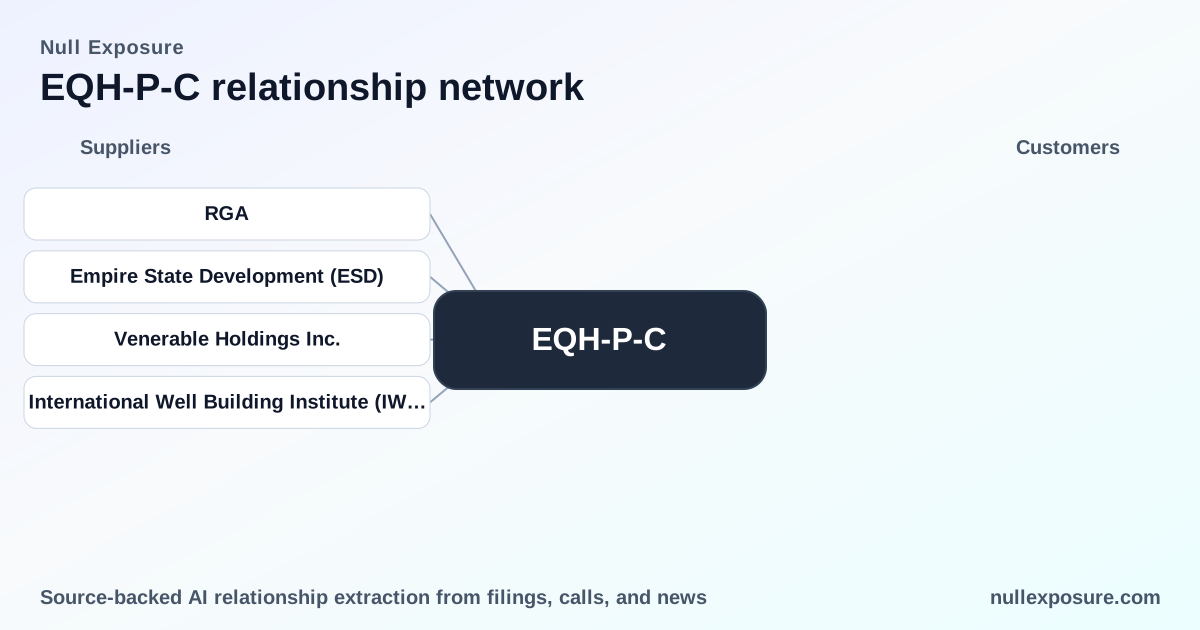
EQH-P-C (Equitable Holdings) — Customer Relationships That Drive Fee Growth and Risk Transfer
Equitable Holdings monetizes through a hybrid model: insurance underwriting and annuity products generate premium and fee income, while an owned distribution network and third‑party asset‑manager partnerships supply recurring advisory and asset‑management fees. Recent strategic moves — notably a large protection sale and a focus on RILAs and fee‑based annuities — reweight revenue toward fee income and third‑party product collaboration, reshaping counterparty exposure and margin dynamics.
Explore relationship signals and coverage at Null Exposure
Why relationships matter for equity and preferred holders
Equitable’s core economics depend on two relationship vectors: distribution (own sales force and recruited advisors) and asset‑management partners (who supply investment strategies and co‑branded product access). Those vectors determine pricing power, product innovation speed, and capital/lightness of business lines. The recent deal activity changes both the concentration of underwriting risk and the firm’s reliance on external managers to deliver differentiated annuity solutions.
Operating model and business‑model signals investors should track
- Contracting posture: Equitable operates a hybrid contracting model — it retains direct control through Equitable Advisors while outsourcing investment and product capabilities to large asset managers. This posture accelerates product innovation without requiring full in‑house asset management scale.
- Concentration and criticality: The owned distribution channel is a strategic asset that concentrates revenue generation, while partnerships with major managers are functionally critical to product competitiveness.
- Maturity: Product mix is shifting from protection underwritings toward fee‑based annuities and RILAs, signaling a move from capital‑intensive underwriting to higher‑margin, fee‑oriented businesses.
- Counterparty implications: Partnerships and the large protection divestiture change counterparty exposure — counterparties become both growth enablers and potential sources of operational dependency.
No explicit contractual constraints were reported in the source material; the signals above derive from announced transactions and disclosed distribution strategy.
Who Equitable is doing business with (and what that means)
Below are every customer/partner relationship flagged in the collected reporting, each summarized in plain English with source context.
Reinsurance Group of America (RGA)
Equitable planned to divest roughly 75% of its Protection business to RGA, a structural move that shifts insurer underwriting risk off Equitable’s balance sheet and accelerates a tilt to fee income; the transaction was expected to close by mid‑2025, according to an Investing.com SWOT analysis referencing FY2025 commentary. (Investing.com, SWOT/News analysis, FY2025)
Equitable Advisors
Equitable emphasizes direct distribution through Equitable Advisors as a stable revenue engine and competitive advantage, underscoring the firm’s strategy to rely on owned channels rather than outsourcing distribution entirely. (InsuranceNewsNet coverage of sales and distribution strategy, FY2025)
MAGIS Wealth Advisors
MAGIS Wealth Advisors, a father‑son team managing over $350 million, moved their practice to Equitable Advisors from Osaic, signaling active recruiting and organic AUM growth inside Equitable’s owned distribution network. This kind of advisor acquisition supports fee income expansion and client retention. (AdvisorHub announcement on advisor transition, FY2025)
AB (AllianceBernstein)
Equitable has partnership arrangements with major asset managers, including AB, to power new RILA and fee‑based annuity products; these collaborations are positioned to enable premium pricing and differentiated product features. (SahmCapital analysis referencing partnerships, FY2026)
BlackRock
BlackRock is listed among strategic asset‑manager partners that provide distribution and investment capability for Equitable’s annuity and fee‑based offerings, supporting product innovation and market access. (SahmCapital analysis referencing partnerships, FY2026)
JPMorgan
JPMorgan is likewise cited as a partner in Equitable’s strategy to deploy innovative annuity structures and fee‑based products, enhancing Equitable’s ability to target different investor segments and potentially improve margins. (SahmCapital analysis referencing partnerships, FY2026)
What these relationships imply for returns and risk
- Revenue reweighting: The RGA protection sale reduces exposure to mortality/lapse cycle volatility and releases capital, while higher emphasis on RILAs and fee annuities pushes toward recurring, fee‑based revenue and higher operating leverage. This is a margin‑positive structural shift.
- Distribution as a moat: Equitable Advisors and active advisor recruiting (e.g., MAGIS) preserve control over client access and distribution economics; owned distribution reduces customer acquisition cost sensitivity versus pure third‑party reliance.
- Partner reliance: Partnerships with BlackRock, AB, and JPMorgan accelerate product breadth and credibility, but they introduce counterparty concentration risk and shared economics that cap upside on investment spreads.
- Counterparty and operational risk: Moving protection risk to RGA de‑leverages underwriting volatility but increases reliance on the counterparty’s execution and integration; investors should monitor closing details and transitional services agreements.
For investors tracking preferred‑class sensitivity, these relationship shifts matter because capital and earnings volatility profiles change as protection risk is ceded and fee income grows.
Track ongoing relationship changes at Null Exposure
Investment takeaways — what to watch next
- Monitor regulatory and closing disclosures on the RGA transaction for transitional obligations and capital effects.
- Watch quarterly flows and recruitment metrics from Equitable Advisors to gauge AUM and fee revenue momentum.
- Follow product launches and marketed partnerships with BlackRock, AB, and JPMorgan to assess margin capture and competitive positioning.
- Track persistency and fee compression metrics in new RILA/annuity offers; those determine whether product innovation translates into durable earnings uplift.
Equitable’s pivot toward fee‑oriented products and reliance on major asset managers establishes a clearer, higher‑margin strategic profile. Investors should price in reduced underwriting volatility but increased operational and counterparty dependencies, and focus on distribution trends and partner economics to assess long‑term upside for holders of EQH‑P‑C.