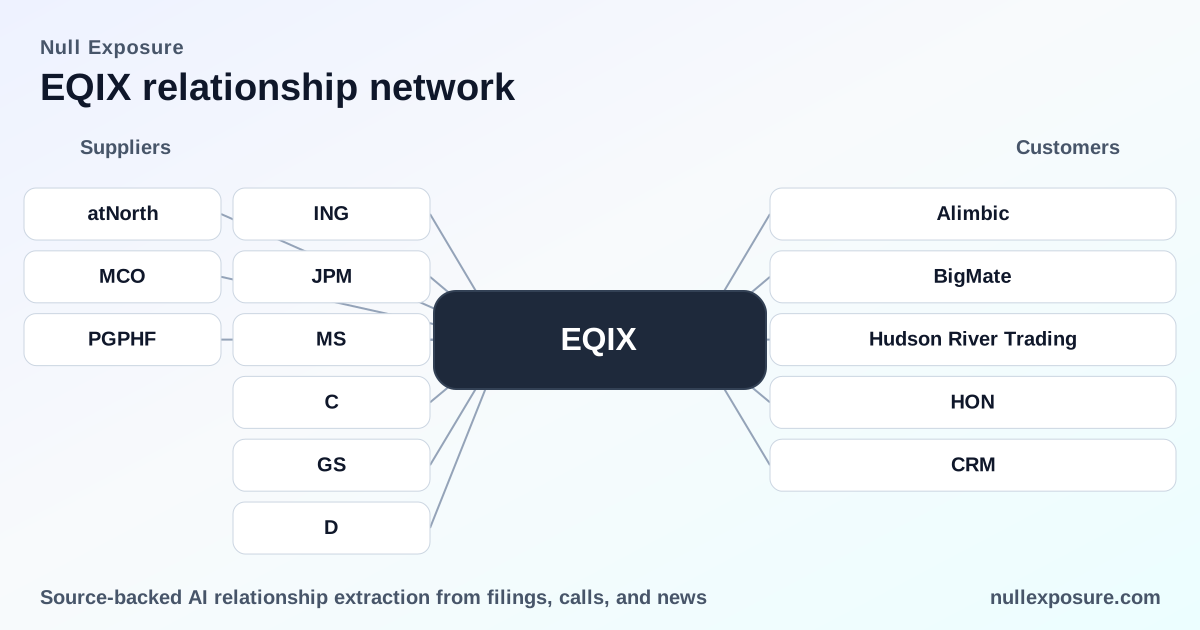
Equinix (EQIX): Customer relationships, strategic stickiness, and what investors should price in
Equinix operates a global network of carrier-neutral data centers and interconnection services, monetizing primarily through monthly recurring colocation, interconnection and managed infrastructure contracts that are typically fixed for one to five years and then auto-renew. Its business sells space, power and connectivity (including Fabric and xScale for hyperscalers) and earns durable cash flow from a diversified base of more than 10,500 customers across 280 data centers worldwide. For a concise commercial-risk diagnostic and customer roll-up, visit https://nullexposure.com/.
How Equinix contracts and why that matters for returns
Equinix’s commercial model is subscription-first and capital intensive. Contracts are routinely structured as fixed-duration arrangements that generate monthly recurring revenue (MRR) and generally run one to five years before automatic one-year renewals, producing high visibility into cash flow and strong retention. The firm recognizes revenue on a gross basis as the principal provider, reflecting that Equinix is responsible for delivering and pricing the underlying capacity and connectivity. Geographic diversification across Americas, EMEA and APAC underpins resilience, while a broad customer base means no single customer accounted for 10%+ of revenue in 2025, limiting counterparty concentration risk.
Key operating signals:
- Contracting posture: long-term, subscription-billed colocation and interconnection with predictable MRR.
- Customer profile: mix of large enterprises, hyperscalers, service providers and government contracts—critical infrastructure customers with high switching costs.
- Commercial maturity: over 10,500 customers and a global footprint that supports vertical specialization and scale economies.
- Revenue role: Equinix acts as the seller and prime operator of facilities and connectivity, with recurring revenue recognized ratably.
Client roster highlights — what each named relationship tells investors
Alimbic
Alimbic, an AI marketing analytics firm, chose Equinix for the scale and consistency of its global operations and the richness of its interconnection ecosystem, underscoring Equinix’s value to fast-growing AI-focused software vendors (Equinix Q4 2025 earnings call, March 2026).
Hudson River Trading
Hudson River Trading selected Equinix because the company’s global footprint and advanced cooling solutions deliver the latency and density needed for next-generation AI trading workloads, illustrating Equinix’s traction with latency-sensitive financial firms (Equinix Q4 2025 earnings call, March 2026).
BigMate
BigMate, a provider of workplace-safety AI, uses Equinix Fabric to securely connect edge devices, clouds and customer networks—an example of edge-to-cloud interconnection demand that drives recurring Fabric revenue (Equinix Q4 2025 earnings call, March 2026).
Salesforce (CRM)
Salesforce selected Equinix to create a private multi-cloud networking layer for its data and AI foundation, highlighting Equinix’s role as a network fabric provider for large SaaS platforms (Equinix Q4 2025 earnings call, March 2026).
Honeywell Corporation (HON)
Honeywell expanded its Equinix footprint for secure, flexible solutions and global Fabric connectivity in metros including Shanghai, Tokyo and London, showing the enterprise-class, multinational use cases that underpin Equinix’s global strategy (Equinix Q4 2025 earnings call, March 2026).
Microsoft, Google and Amazon (hyperscalers)
Microsoft, Google and Amazon are named as Equinix’s most important xScale customers and also the most capable of reducing third-party colocation dependence over time; these relationships are strategically critical but carry competitive and concentration dynamics investors must monitor (Simply Wall St narrative, FY2026).
SpinLaunch
SpinLaunch selected Equinix to host ultra-compact satellite teleports across Equinix’s interconnected facilities, demonstrating edge and teleport demand and how Equinix can extend into adjacent infrastructure services (Simply Wall St and MarketBeat reporting, May 2026).
PDC (Perpetuals.com / formerly EarlyWorks)
PDC provides financial market infrastructure-as-a-service from Equinix FR2 in Frankfurt—supporting 24/7 trading for crypto spot, derivatives and tokenized securities—illustrating Equinix’s role in regulated trading ecosystems and exchange-adjacent services (Press releases and regional reporting, May 2026).
Zoom (ZM)
Zoom’s ESG reporting noted 94% global renewable energy coverage for Equinix data centers used by the company, signaling Equinix’s competitiveness on sustainability—an increasingly material procurement criterion for enterprise customers (Zoom ESG/impact report, FY2025).
DigitalOcean (DOCN)
Historical coverage indicates DigitalOcean set up in Equinix’s Singapore facility, a reminder that cloud and small-to-mid cloud providers leverage Equinix for market entry and regional expansion (DatacenterDyanmics coverage, cited FY2026 context).
NBIS
NBIS and other AI infrastructure players reference Equinix locations (for example, Equinix Paris) and large new builds in the U.S. and Europe as part of their footprint strategy, underscoring Equinix’s role in hosting regional AI infrastructure and large-scale new builds (ts2.tech article, FY2025).
What these relationships collectively imply for investors
The roster shows broad-based product-market fit across hyperscalers, fintech, trading firms, enterprise industrials and niche tech plays. The mix validates Equinix’s multi-pronged go-to-market: colocation + Fabric interconnection + bespoke xScale for hyperscalers. That commercial diversity supports resilient cash flows, while the presence of hyperscalers introduces a strategic tension—these customers are highly valuable but also the ones with the greatest ability to internalize capacity over the long run.
Investor takeaways:
- Revenue visibility is high because of one-to-five year contracts and monthly billing; MRR-driven economics support predictable operations and capital planning.
- Concentration risk is controlled at the company level (no single customer >10% in 2025), but hyperscaler relationships are both high-value and strategic tail risks due to potential vertical integration.
- Criticality and switching costs are substantial for latency-sensitive and regulated customers (trading, exchanges, AI stacks), strengthening retention and pricing power.
- Geographic and sector diversification reduces single-market shocks; government contracts add complexity and regulatory risk but also sticky revenue streams.
- Sustainability and edge services (teleports, satellite ground segments) are expanding use cases that extend monetization beyond classic colocation.
Bottom line and next steps
Equinix’s customer signals show durable, subscription-based revenue with strategic exposure to both hyperscalers and mission-critical enterprises. The firm’s scale, interconnection assets and long-term contracts create high barriers to exit, but investors must weigh capex intensity and hyperscaler concentration dynamics in valuation. For more comprehensive, comparative diligence on Equinix’s counterparty and commercial risk, explore the full analysis at https://nullexposure.com/.
Bold takeaway: Equinix delivers predictable, subscription-like infrastructure revenue supported by global scale and highly sticky interconnection products, but hyperscaler dynamics and capital intensity remain the two principal valuation levers investors must track.