Equinor’s customer relationships: divestment, long‑term gas offtakes, and strategic JV partners
Equinor monetizes as a globally integrated energy company: upstream hydrocarbon production and trading, downstream marketing and refining, long‑term gas contracts, and selective investments in renewables and battery‑material ventures. The company converts asset sales and JV stakes into capital for core operations while locking in predictable cash flows through multi‑year offtakes and commercial partnerships. For investors, the mix of divestitures (Argentina onshore), long‑dated gas contracts (Central Europe), and JV commercialization (lithium) signals a balanced trade between portfolio re‑shaping and revenue resilience. For further context on how we source these relationship signals, visit https://nullexposure.com/.
What these relationships reveal about Equinor’s commercial strategy
Equinor runs a capital‑efficient, portfolio management posture: it sells non‑core upstream positions to redeploy capital or simplify geographic exposure, while it also enters joint ventures and offtake agreements where it can secure long‑term value. The company’s contracting posture is pragmatic — shorter, high‑value divestments alongside long‑dated offtakes for gas and offtake agreements tied to strategic industry partners. Concentration is low at the company level given global operations, but individual contracts (for example a 10‑year gas sale) can be highly critical for regional supply stability. Equinor’s standing as an established major gives counterparties confidence; these relationships reflect a mature operator leveraging scale to balance cash generation and strategic diversification.
Key financial context that underpins this posture: Equinor’s market capitalization is roughly $103 billion with trailing revenue around $106 billion and EBITDA of about $35 billion, supporting dividend distributions and sizeable JV commitments while retaining flexibility to execute divestitures.
Vista Energy — a strategic divestiture out of Vaca Muerta
Equinor signed an agreement to divest its full onshore position in Argentina’s Vaca Muerta basin to Vista Energy, reflecting a deliberate move to exit that onshore business and recycle capital. According to Equinor’s Feb. 2, 2026 press release and multiple March 2026 news reports, the transaction closed as a material sale of the Argentina onshore portfolio (news coverage cited transaction values in the neighborhood of $1.1 billion). (Equinor press release, Feb. 2, 2026; Finviz coverage, March 2026.)
YPF — local partner increases exposure in Vaca Muerta
Argentine oil company YPF acquired a portion of Equinor’s assets in Vaca Muerta, increasing its ownership in several blocks and taking a reported stake in Equinor Argentina; press coverage cited a nearly $170 million consideration and a 16.3% stake referenced in regional reporting. This is a localized transfer of operating exposure to a domestic player that preserves activity in the basin while reducing Equinor’s direct onshore footprint. (Insidermonkey transcript, Q4 2025; ad‑hoc‑news coverage, March 2026.)
Standard Lithium (SLI) — JV for large‑scale battery feedstock development
Equinor is a JV partner with Standard Lithium on the South West Arkansas (SWA) project, a greenfield lithium development that represents the company’s strategic exposure to battery raw materials. Standard Lithium’s project materials and company communications indicate remaining CAPEX will be financed through project debt (indications over $1.0 billion) and pro‑rata equity from Standard Lithium and Equinor — a structured project finance approach that shares execution risk with the JV partner. (Standard Lithium press release; CityBuzz coverage, Oct. 2025 / Standard Lithium news, FY2025/FY2026.)
Trafigura — offtake for battery‑quality lithium carbonate
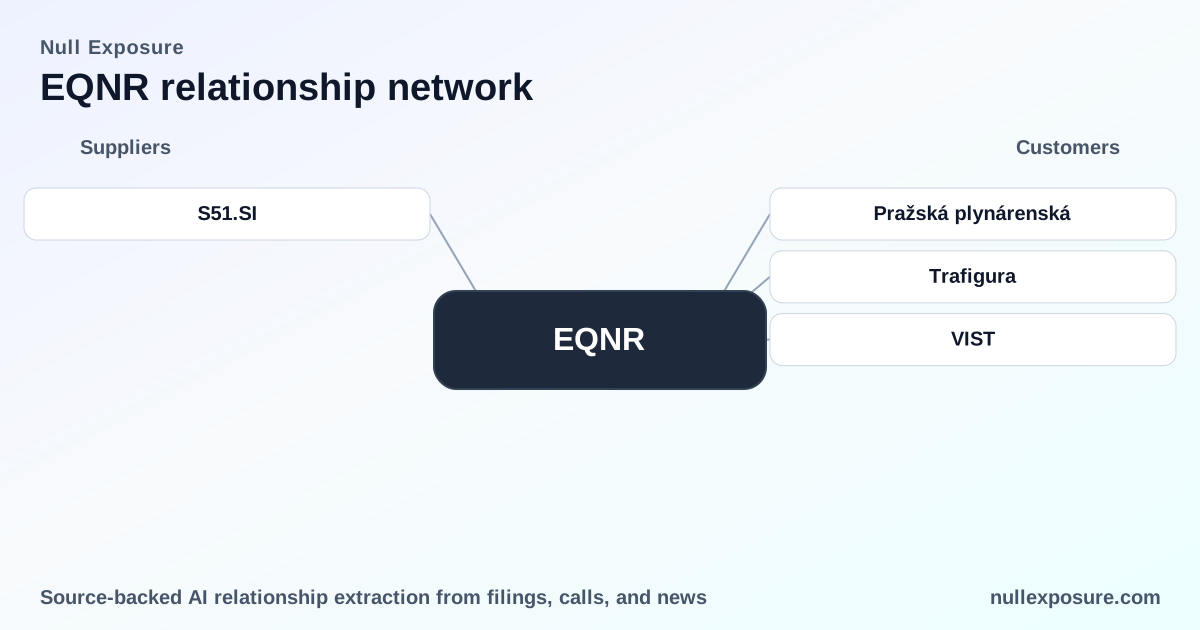
The Standard Lithium–Equinor joint initiative has signed a commercial agreement with Trafigura for battery‑quality lithium carbonate offtake, giving the JV a commercial anchor and user demand visibility for produced material. This offtake relationship is the type of downstream commercialization that de‑risks project economics prior to final investment decisions. (MarketScreener summary, FY2026.)
Pražská plynárenská — long‑dated gas supply into Central Europe
Equinor signed a 10‑year gas sale agreement with Pražská plynárenská securing Norwegian gas deliveries to the Czech Republic through 2035, which establishes a predictable revenue stream and strengthens regional supply ties. Multi‑year offtakes like this are core to Equinor’s strategy to monetize gas production via contracted sales rather than spot exposure alone. (Equinor Q4 and full‑year 2025 results release.)
The operating implications investors should focus on
- Capital recycling through divestitures: The Argentina onshore sale to Vista Energy and transfers to YPF show Equinor actively reshaping its upstream footprint, freeing capital for higher‑priority projects or shareholder returns.
- Diversification into energy transition supply chains: The Standard Lithium JV and the Trafigura offtake demonstrate Equinor’s commercial entry into battery raw materials, where project finance and offtake agreements are central to value realization.
- Revenue stability from long‑dated contracts: The 10‑year gas agreement with Pražská plynárenská is a concrete example of locking in mid‑term cash flows that reduce spot price volatility effects.
Collectively, these relationships show a two‑pronged commercial model: monetize non‑core upstream positions while building stable, contracted revenue and strategically entering adjacent markets (lithium) via partnerships.
Risk profile and counterparty considerations
- Commodity price exposure remains a core risk; divestitures reduce some operational risk but do not remove cyclicality from the P&L.
- Project execution and scale‑up risk exists for the SWA lithium project: project‑level financing and offtake terms will determine whether the JV can deliver on promised volumes and margins.
- Political and regulatory risk is material in jurisdictions like Argentina; transferring assets to local players reduces direct exposure but also signals a tactical withdrawal from complex operating environments.
Investors should evaluate these relationship signals alongside Equinor’s balance‑sheet capacity and distributable cash flow — the company’s dividend yield (~3.9%) and forward PE (~9.4) reflect both residual commodity upside and investor expectations for normalized earnings.
Data quality and constraint signals
The customer‑relationship feed returned no explicit constraints tied to individual counterparties. Treat that absence as a company‑level signal: no specific contractual constraints, exclusivities, or concentration flags were reported in this dataset, so relationship risk must be assessed through the commercial terms disclosed in press releases and media coverage rather than flagged contractual limitations.
Bottom line for investors
Equinor is executing a pragmatic portfolio strategy: divest non‑core onshore assets, entrench long‑dated gas sales, and selectively pursue adjacent growth (lithium) through JVs and commercial offtakes. That mix preserves cash generation and reduces direct exposure in complex jurisdictions while positioning the company to participate in energy transition value chains. For a deeper view of how these relationship signals are collected and how they translate into portfolio risk assessments, visit https://nullexposure.com/.
Key relationship sources: Equinor press releases (Feb. 2, 2026; Q4 & FY2025 results), mainstream financial news coverage on Vista Energy and Vaca Muerta (March 2026), Standard Lithium corporate releases (FY2025–FY2026), MarketScreener on the Trafigura offtake, and regional reporting on YPF’s stake acquisition (March 2026).