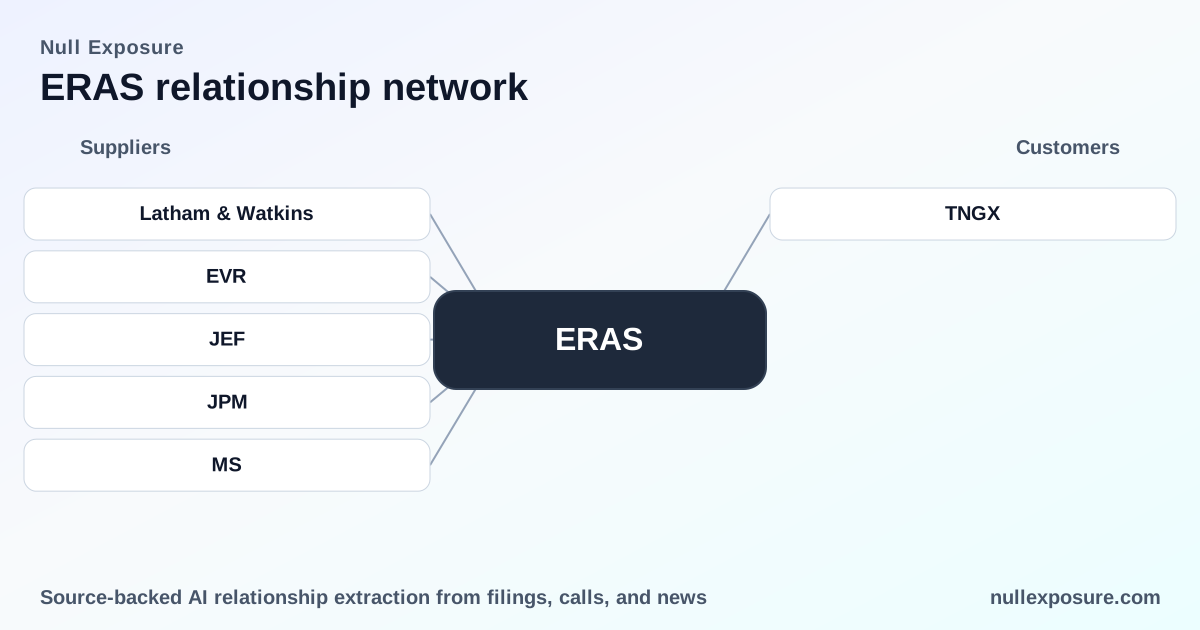
Erasca (ERAS) — Customer relationships and strategic implications
Erasca is a clinical-stage biopharma that develops targeted oncology therapies and monetizes through collaborations, clinical supply agreements, and regional licensing ahead of any product revenue; the company contributes investigational drug supply and IP while partners provide trial sponsorship, regulatory reach and regional commercialization rights. For practitioners who need centralized intelligence on counterparty relationships and commercial posture, visit NullExposure for structured signal tracking: https://nullexposure.com/.
Thesis — how ERAS creates value for partners and investors
Erasca’s commercial model is built on supplying clinical-stage molecules into combination studies and selectively licensing regional rights, preserving capital while generating validation and optionality. That operating stance translates into: (1) low near-term product revenue but high strategic leverage when clinical data create downstream licensing or co-development economics; (2) reliance on external sponsors to advance trials; and (3) value capture through staged licensing rather than immediate sales. These characteristics make Erasca a partnering-first biotech whose investor returns will track pipeline readouts and the economics of individual collaborations.
Why partner deals are the central growth vector
Erasca’s contracts so far emphasize clinical supply and collaboration, not fee-for-service manufacturing or broad commercial distribution. That posture conserves cash because Erasca supplies investigational drug to partners and transfers trial execution risk to them. The model produces validation and optionality—successful combination trials de-risk later-stage partnerships and licensing deals—while leaving revenue recognition and commercial scale dependent on future regulatory success and payor acceptance.
- Contracting posture: predominantly supply-and-collaboration; Erasca supplies ERAS-0015 at no charge in combination trials while partners sponsor and run studies.
- Concentration: relationships are concentrated with a small set of biotechnology partners and regional licensees; this increases correlation of Erasca’s near-term value to a few external trial outcomes.
- Criticality: Erasca’s molecule supply is mission-critical to partners’ combination trials; loss of access would materially delay partner programs.
- Maturity: engagements are early-stage (Phase 1/2), so commercial maturity is low and revenue is contingent on later clinical and regulatory milestones.
For additional relationship-level analysis and continuous monitoring, NullExposure provides curated signals and timeline views: https://nullexposure.com/.
Relationship log — every counterparty captured in the record
Tango Therapeutics (TNGX)
Erasca entered a clinical trial collaboration and supply agreement with Tango in which Erasca will supply ERAS-0015 at no cost while Tango sponsors the early to mid‑stage combination study of vopimetostat with ERAS-0015, focused on MTAP‑deleted pancreatic and RAS‑mutant lung cancers; the arrangement reduces Tango’s R&D expense and creates clinical validation for Erasca’s pan‑RAS candidate (FY2026). Source: SahmCapital reporting Tango’s Q4 and full‑year 2025 results and business highlights, March 2026 (reporting the clinical supply agreement).
Joyo Pharmatech
Erasca expanded a regional licensing arrangement with Joyo Pharmatech to cover China, Hong Kong and Macau, reflecting a strategy to monetize regional rights while keeping global development centered with Erasca and selective partners; the move follows encouraging early clinical signals from ERAS‑0015 (FY2026). Source: SahmCapital commentary on ERAS‑0015 trial progress and Asia licensing expansion, April–May 2026.
Note: multiple market reports and brokerage notes amplified the Tango supply deal in public markets—TradingView, The Globe and Mail, Investing.com and analyst coverage cited the agreement in March–May 2026—underscoring cross‑market attention to the collaboration (representative press coverage includes TradingView, March 9, 2026; Investing.com coverage, May 2026).
Operational constraints and company‑level signals
Erasca’s public disclosures and the relationship record generate a set of company‑level constraints that shape near‑term economics and risk:
- Payor exposure is material. Erasca explicitly links U.S. sales potential to coverage and reimbursement by government programs such as Medicare, Medicaid, TRICARE and the Veterans Administration, in addition to private insurers. This is a structural constraint on eventual commercial uptake and pricing power, not a counterparty‑specific note.
- Revenue timing and concentration risk. Current agreements are structured around clinical supply and licenses rather than commercial supply contracts, producing lumpy, milestone‑driven value and high outcome concentration on a few partner programs.
- Clinical dependency. The business model is critically dependent on Phase 1/2 readouts to convert trial validation into licensing or co-development revenue; operating maturity is therefore limited and diagnostic of future monetization.
These constraints indicate that Erasca is operating in a capital‑efficient partnership mode but remains exposed to reimbursement dynamics once products reach the market.
What the relationships imply for investors
- Validation without revenue: The Tango collaboration is validation for ERAS‑0015’s pan‑RAS approach and increases the molecule’s visibility in the oncology ecosystem while generating no immediate product revenue for Erasca. This is positive for program de‑risking and future licensing terms.
- Leverage into regional monetization: The Joyo Pharmatech license demonstrates a playbook of monetizing regional rights, enabling Erasca to fund development through non‑dilutive or semi‑dilutive deals while retaining global upside.
- Idiosyncratic event risk: Value realization hinges on a small number of clinical milestones and subsequent payor adoption; investors should price in binary event risk for Phase 1/2 outcomes and the longer path to reimbursement.
Bottom line and recommended focus areas
Erasca’s customer relationships reflect a deliberate partnership-first commercial model: supply clinical drug to collaborators, secure regional licenses, and convert trial validation into higher-value deals later in the pipeline. Key investor focus should be clinical readouts for ERAS‑0015, the economics of any follow‑on licensing deals, and the company’s ability to negotiate favorable milestone and royalty terms given eventual payor constraints.
For a practical, continuously updated view of Erasca’s counterparties and event chronology, see NullExposure’s relationship intelligence hub: https://nullexposure.com/.
This analysis covers every counterparty observed in the supplied record and synthesizes the operating implications that investors and operators need to track alongside clinical triggers and reimbursement developments.