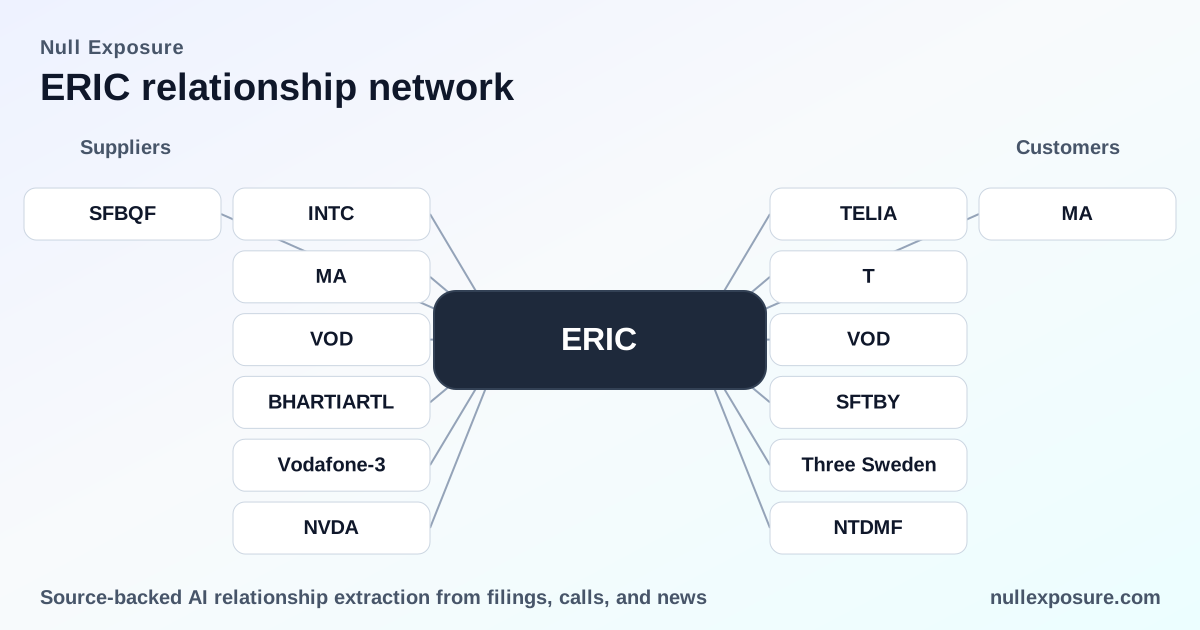
Ericsson (ERIC) — Customer Relationships That Drive 5G Revenue and Services Growth
Ericsson generates revenue by selling Radio Access Network (RAN) equipment, 5G Core software, cloud-native billing and managed services, and enterprise communications through its Vonage unit. The company monetizes via multi-year operator contracts and recurring software and services, with incremental enterprise and public-sector work (including U.S. government-focused operations) widening addressable markets and improving revenue visibility. For investors, the thesis is simple: carrier-scale, long-duration contracts plus software and services convert network share gains into higher recurring revenue and margin leverage. For primary research and commercial diligence, this note catalogs every customer relationship surfaced in our dataset and translates those signals into operational implications and risk vectors.
If you want ongoing monitoring and analytics on carrier partnerships and revenue signals, visit NullExposure for subscription options and research access.
How Ericsson wins contracts and what that implies for cash flow
Ericsson competes on a combination of technology leadership (RAN, AI-driven radio features), integration at scale (cloud-native core, OSS/BSS modernization), and multiyear service commitments. Contracts reported in recent months are typically five-year RAN agreements or multi-year cloud/billing engagements, which implies a contracting posture skewed toward long-duration, high-criticality engagements with incumbent and challenger carriers. The customer base is broad geographically, reducing single-market concentration risk, but the company remains structurally concentrated on a relatively small set of global tier-1 telcos and strategic national operators — winning or losing a handful of large RAN deals materially moves top-line growth.
From a business model perspective, Ericsson is transitioning to a larger software and services mix — reflected in recent cloud billing wins and AI/automation platform deals — which increases recurring revenue predictability and improves margin expansion potential as hardware cycles normalize.
Customer relationships: who’s buying from Ericsson today
Below are every relationship captured in the supplied results, summarized in plain English with source context.
-
Telia Company (TELIA) — Telia extended a four‑year Radio Access Network partnership with Ericsson across Sweden, Norway, Lithuania, and Estonia to accelerate 5G capabilities and network performance (reported Nov 6, 2025; covered by Simply Wall St, first seen Mar 2026).
Source: Simply Wall St reporting on the Telia four‑year RAN extension (Nov 2025 / first observed Mar 2026). -
ATEX — Industry filings and an earnings call transcript noted Ericsson among roughly 20 technology firms supporting band evolution for private and dedicated wireless networks, signaling Ericsson’s role in utility and enterprise spectrum policy discussions (2025Q4 earnings call excerpt).
Source: ATEX 2025 Q4 earnings call transcript (first observed Mar 2026). -
Chunghwa Telecom (CHT) — Chunghwa Telecom will deploy Ericsson’s Intelligent Automation Platform and rApps to accelerate AI‑driven network operations and prepare for next‑gen mobility; multiple press reports tie Ericsson to future mobile infrastructure collaborations in Taiwan (2025–2026 coverage).
Source: The Fast Mode and MarketScreener reporting on Ericsson–Chunghwa collaborations (Mar 2026). -
VTel Wireless — VTel selected Ericsson as its 5G Core and RAN supplier to build a 5G Standalone network for rural U.S. coverage, a win that showcases Ericsson’s addressable market in regional and rural operators (reported May 2026).
Source: Finviz and Simply Wall St coverage of VTel’s Ericsson selection (May 2026). -
AT&T (T) — AT&T and Ericsson demonstrated an AI‑driven 5G Cloud RAN feature and tested Ericsson’s AI‑native Link Adaptation on an AT&T‑matching Cloud RAN setup, indicating a deep technology collaboration and field validation (demonstration referenced in 2024–2026 public remarks).
Source: AT&T/Ericsson demonstration reporting and Ericsson earnings call remarks (2024Q3 mention; press around Mar 2026). -
Keysight Technologies (KEYS) — Keysight partnered with Ericsson to validate interoperability between Ericsson pre‑6G base stations and prototype devices using test equipment, signaling Ericsson’s upstream R&D partnerships for next‑generation radios (reported Mar 2026).
Source: iConnect007 reporting on Keysight–Ericsson interoperability work (Mar 2026). -
Mastercard (MA) — Ericsson announced collaborations with Mastercard to integrate 5G‑ready connectivity into digital payments platforms, positioning Ericsson in enterprise payments and edge use cases beyond core telecoms (reported Mar 2026).
Source: Simply Wall St and Finviz coverage of the Ericsson–Mastercard collaboration (Mar 2026). -
Microsoft (MSFT) — Ericsson disclosed collaborations with Microsoft to link 5G connectivity with enterprise cloud platforms, reinforcing Ericsson’s push into enterprise digital transformation and platform integrations (reported Mar 2026).
Source: Simply Wall St coverage of the Ericsson–Microsoft tie‑up (Mar 2026). -
LILAK — An earnings call noted that, following spectrum acquisitions, the company expects a lift from deploying 5G Standalone in partnership with Ericsson, reflecting Ericsson’s role as a preferred vendor for new SA rollouts (2025Q4 call excerpt).
Source: LILAK 2025 Q4 earnings call transcript (first observed Mar 2026). -
TIM Brasil (TIMB) — Ericsson signed a strategic partnership to consolidate and modernize TIM Brasil’s billing systems using Ericsson’s cloud‑native billing solution, an example of software‑first engagements driving recurring revenue (reported Mar 2026).
Source: DevelopingTelecoms article on TIM Brasil’s cloud billing partnership with Ericsson (Mar 2026). -
Virgin Media O2 (VMO2 / LBYAV) — Ericsson secured a significant five‑year agreement to be the primary RAN partner in the UK as part of Virgin Media O2’s Mobile Transformation Plan, a material contract in Western Europe (reported May 2026).
Source: Investing.com and Liberty Global announcements about the VMO2 multi‑year RAN agreement (May 2026). -
Vodafone (VOD) — Ericsson won a five‑year partnership to modernize Vodafone networks across multiple European markets, serving as sole RAN vendor in some countries and major vendor in others, underpinning sizable RAN revenue and multi‑market exposure (reported Mar 2026).
Source: Simply Wall St and related press on the Vodafone five‑year partnership (Mar 2026). -
Vodafone (alternate reporting) — Market commentary repeated Vodafone’s multi‑market RAN role and its alignment with energy‑efficient 5G Standalone and automation themes, reinforcing the strategic nature of the Vodafone engagement (Mar 2026).
Source: Simply Wall St coverage reiterating Vodafone details (Mar 2026). -
Vonage partners — Broot.ai — Ericsson’s Vonage unit partnered with India‑based Broot.ai to enable real‑time, in‑app global calling for enterprise workflows, reflecting Vonage’s enterprise integrations pipeline (reported May 2026).
Source: Simply Wall St coverage of Vonage–Broot.ai partnership (May 2026). -
Three Sweden — New 5G Standalone deployments such as Three Sweden were cited as part of Ericsson’s push to improve profitability while reinforcing position in next‑generation networks (Mar 2026 commentary).
Source: Simply Wall St investor commentary on Three Sweden SA deployments with Ericsson (Mar 2026). -
SoftBank (SFTBY) — Ericsson partnered with SoftBank to upgrade and expand Japan’s 5G network, a strategic presence in a major Asia Pacific market (reported Mar 2026).
Source: InsiderMonkey reporting on Ericsson–SoftBank collaborations in Japan (Mar 2026). -
NTT DOCOMO (NTDMF) — NTT DOCOMO deployed Ericsson’s AIR 3255 Massive MIMO antenna‑integrated radios in Japan, delivering energy and spectrum efficiencies on the 4.5 GHz band, a product deployment signaling hardware adoption in advanced markets (reported 2025/2026).
Source: Simply Wall St reporting on NTT DOCOMO AIR 3255 deployments (Mar 2026). -
Koch Equity Development, LLC — Koch completed the acquisition of Telcordia Technologies from Ericsson, representing a divestiture and an example of Ericsson’s portfolio reshaping and monetization of non‑core assets (reported Aug 2025; surfaced in 2026 summaries).
Source: Simply Wall St and Finviz summaries of Koch’s acquisition of Telcordia (Aug 2025 / observed May 2026). -
PCS — Historical reporting identifies Ericsson as a primary vendor of network equipment for wide build‑outs, an echo of Ericsson’s long‑running role as a dominant infrastructure supplier (archival coverage cited).
Source: NBC News archival coverage referencing Ericsson as main vendor (FY2010 note surfaced in dataset). -
Ericsson Federal Technologies Group — Ericsson’s U.S. corporate arm leverages American supply chains and the Swedish parent’s capabilities to pursue resilient digital infrastructure and national security customers, indicating deliberate positioning in U.S. public sector work (reported 2026).
Source: The Defense Post article on Ericsson Federal Technologies Group and U.S. 5G initiatives (Feb 2026).
Operational signals and company‑level constraints
The dataset contained no explicit constraint excerpts to attribute to individual relationships. From the relationship mix, company‑level signals are clear: Ericsson’s contracting posture is dominated by long‑duration carrier RAN and core contracts; revenue mix is shifting toward software and managed services; geographic diversification is broad but top‑line sensitivity to a small number of large operator deals remains. These characteristics imply moderate customer concentration risk offset by recurring software revenue and increasing enterprise diversification.
Risk and investment implications
- High criticality to customers: RAN and core are mission‑critical; losing share in a major operator creates meaningful near‑term revenue volatility.
- Improving revenue quality: Cloud billing, automation platforms, and Vonage enterprise partnerships convert one‑time hardware sales into recurring streams.
- Geopolitical and execution risk: Government and national security work increases addressable spend but raises compliance and supply‑chain complexity.
For deeper, ongoing tracking of carrier wins, contract durations, and customer concentration metrics, explore subscription research at NullExposure.
Conclusion: Ericsson’s customer signals show broad, multiyear carrier engagement across Europe, Asia, and North America combined with selective enterprise and public‑sector wins, supporting the investment case that share gains in RAN and a rising software/services mix will drive more predictable revenue and margin expansion.