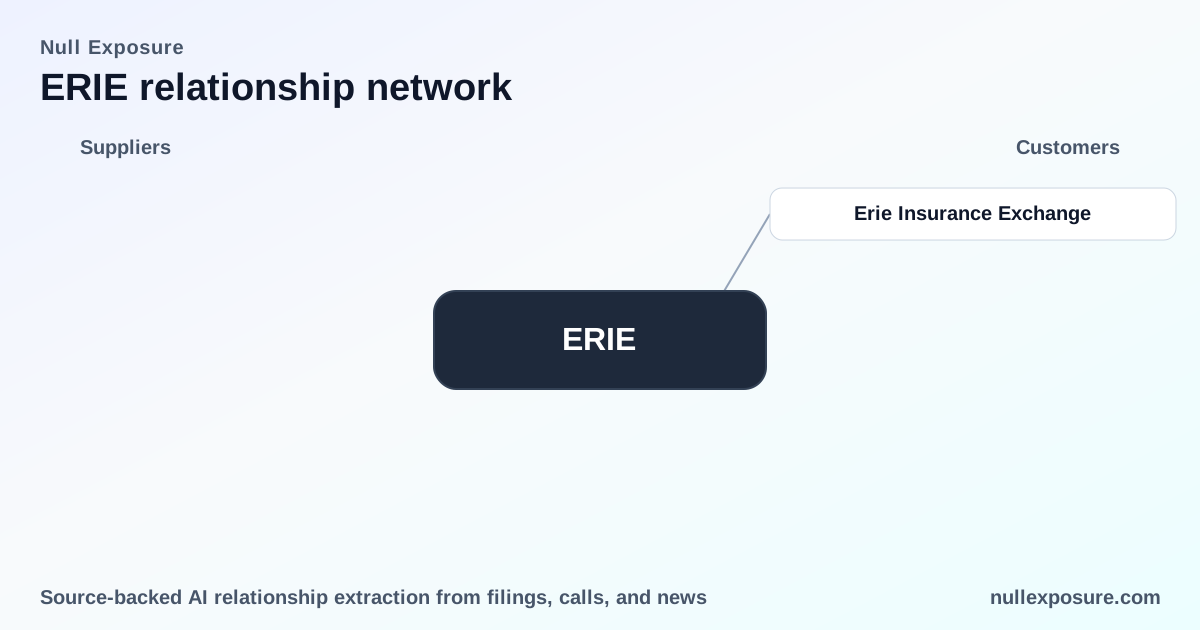
ERIE’s sole-customer model: why the Exchange determines valuation and operational risk
Erie Indemnity Company operates as the exclusive administrative manager and attorney‑in‑fact for the Erie Insurance Exchange, monetizing primarily through a usage‑based management fee equal to a percentage of premiums and related administrative reimbursements. For investors, ERIE is a services‑driven, concentrated cash‑flow vehicle whose earnings, leverage and dividend policy are directly tied to the Exchange’s premium volume and the management fee framework. Learn more about the coverage and monitoring services that inform this analysis at https://nullexposure.com/.
The business in plain English: how ERIE makes money and why concentration matters
ERIE does not underwrite the Exchange’s policies directly; it provides the people, systems and capital management the Exchange needs and charges a management fee on written premiums, plus reimbursements for administrative costs. This structure produces predictable fee revenue but also creates single‑counterparty concentration: the Exchange is the company’s sole reportable customer and the primary lever for revenue, receivables and cash generation. Public reporting and press coverage repeatedly describe ERIE as the Exchange’s attorney‑in‑fact responsible for policy issuance, claims handling and investment services (FY2026 filings and earnings commentary).
Operating constraints and what they imply for investors
- Usage‑based contracting: ERIE’s core fee is calculated as a percentage of direct and affiliated assumed premiums written under the subscriber agreement, indicating an inherently volume‑sensitive revenue stream rather than fixed, recurring subscription income. This is a company‑level signal derived from the subscriber agreement language.
- U.S. concentration: All reportable segment revenue is derived in the United States, and the bulk of that revenue comes from the subscriber agreement between ERIE and the Exchange, reinforcing geographic homogeneity in risk exposure.
- Material and critical exposure to the Exchange: Net receivables from the Exchange represented meaningful percentages of total assets (example: $707.1 million, 24.5% at Dec 31, 2024), and company statements explicitly call the Exchange the sole customer and principal source of revenue — a direct governance and counterparty risk for investors.
- Service provider and seller roles: ERIE functions both as the service provider (attorney‑in‑fact performing issuance, claims and administrative services) and as a seller of management services to the Exchange; that duality concentrates operational responsibility and revenue recognition in one counterparty.
- Mature, active relationship and single reportable segment: Disclosures frame management operations as a single reportable segment with active monthly settlements for reimbursements, supporting predictability but limiting diversification.
- Scale of fee economics: Management fee and reimbursement lines in filings show total operating revenue measured in the billions (for example, a reported management fee line and total operating revenue figures exceeding $3.7 billion), placing ERIE firmly in the $100m+ spend band for its relationship with the Exchange.
Collectively these constraints describe a contracting posture that is usage‑based, U.S.‑centric, highly concentrated and essential to ERIE’s earnings profile.
All reported mentions of the Erie Insurance Exchange (each source)
Below are every item in the reported relationship set; each contains a concise, plain‑English take and the original source.
247wallst — Board retains fee and raises dividend (Dec 19, 2025)
A 247wallst article reports the Board decided to maintain the management fee rate at 25% for 2026 and approved a 7.1% increase in the quarterly cash dividend, signaling management confidence in fee cash flow. Source: https://247wallst.com/investing/2025/12/19/income-investors-can-trust-erie-indemnitys-fortress-balance-sheet-and-low-payout/
Finviz — management fee rate maintained (Dec 2025)
Finviz coverage notes the Board agreement to keep the management fee paid by the Exchange at 25% effective Jan. 1, 2026, reinforcing the stability of ERIE’s pricing mechanism. Source: https://finviz.com/news/252265/erie-indemnity-approves-management-fee-rate-and-dividend-increase-declares-regular-dividends
SahmCapital — fee rate maintained (Dec 2025)
Sahm Capital echoes the management‑fee decision, documenting the Exchange’s vote to retain the same 25% fee, a governance action that directly anchors ERIE’s revenue base. Source: https://www.sahmcapital.com/news/content/erie-indemnity-approves-management-fee-rate-and-dividend-increase-declares-regular-dividends-2025-12-12
TradingView — SEC 10‑K excerpt on sole‑customer dependence (FY2026 filing)
TradingView summarized ERIE’s SEC disclosure that the Exchange is the company’s sole customer and principal revenue source, identifying concentration risk as a key risk factor in the 10‑K. Source: https://www.tradingview.com/news/tradingview:c01841210fb09:0-erie-indemnity-co-sec-10-k-report/
TradingView — attorney‑in‑fact responsibilities (FY2026 coverage)
A separate TradingView article highlights that ERIE serves as attorney‑in‑fact for the Exchange, handling issuance, claims and investments, clarifying the operational scope ERIE delivers to the Exchange. Source: https://www.tradingview.com/news/stockstory:54796ba6a094b:0-property-casualty-insurance-stocks-q3-results-benchmarking-assurant-nyse-aiz/
Finviz — business model and role summary (FY2026)
Finviz’s sector teardown reiterates that ERIE’s model dates to 1925 and that it manages policy issuance, claims and investments for the reciprocal Exchange, underscoring long‑standing structural arrangements. Source: https://finviz.com/news/332805/property-casualty-insurance-stocks-q4-teardown-selective-insurance-group-nasdaq-sigi-vs-the-rest
MarketScreener — management services specialization (Q4 earnings flash FY2026)
MarketScreener’s earnings coverage states that ERIE specializes in providing management services on behalf of the Exchange, linking the service model to reported revenue performance. Source: https://www.marketscreener.com/news/earnings-flash-erie-erie-indemnity-company-reports-q4-revenue-951-0m-vs-factset-est-of-975-6m-ce7e5dd3db8df220
Finviz — attorney‑in‑fact role reiterated (Q4 recap FY2026)
Finviz’s Q4 rundown repeats that ERIE serves as attorney‑in‑fact for the Exchange, reiterating operational responsibilities in market commentary. Source: https://finviz.com/news/330543/q4-rundown-radian-group-nyse-rdn-vs-other-property-casualty-insurance-stocks
The Globe and Mail — revenue generation through management fees (FY2026)
Press coverage in The Globe and Mail notes ERIE generates revenue primarily through management fees tied to policy issuance and administrative services performed for the Exchange, describing the core monetization engine. Source: https://www.theglobeandmail.com/investing/markets/stocks/ERIE/pressreleases/400029/erie-indemnity-earnings-hit-by-one-time-foundation-charge/
Finviz — historical business model reference (FY2025)
Finviz commentary from FY2025 again highlights the unique reciprocal model and ERIE’s attorney‑in‑fact role, providing continuity of public narrative around the relationship. Source: https://finviz.com/news/260317/property-casualty-insurance-stocks-q3-recap-benchmarking-mercury-general-nyse-mcy
SahmCapital — FY2025 results and Exchange dependence (FY2026 report)
Sahm Capital’s FY2025 results recap cites ERIE’s own disclosure on dependence on the Exchange and the management fee arrangement, framing it as a recurring company disclosure. Source: https://www.sahmcapital.com/news/content/erie-indemnity-reports-full-year-and-fourth-quarter-2025-results-2026-02-24
SahmCapital — growth/market share narrative (Jan 29, 2026)
Sahm Capital further discussed ERIE’s market share gains and reiterated the company’s continued role as attorney‑in‑fact for the Exchange, linking operational scope to growth narratives. Source: https://www.sahmcapital.com/news/content/how-erie-indemnitys-erie-132-revenue-growth-and-market-share-gains-could-reshape-its-investment-narrative-2026-01-29
Simply Wall St — managing attorney‑in‑fact description (FY2025 profile)
Simply Wall St’s company profile describes ERIE as managing attorney‑in‑fact for Exchange subscribers, a simple restatement of the core arrangement in investor profiles. Source: https://simplywall.st/stocks/us/insurance/nasdaq-erie/erie-indemnity
Finviz — sector commentary repeating attorney‑in‑fact role (FY2026)
A final Finviz mention repeats the same central claim: ERIE manages policy issuance, claims handling and investment services for the Exchange, confirming broad market recognition of the single‑customer model. Source: https://finviz.com/news/279393/1-safe-and-steady-stock-worth-your-attention-and-2-that-underwhelm
What investors should focus on next
- Fee stability and governance: the Board’s decision to hold the fee at 25% and increase the dividend demonstrates a willingness to preserve cash returns while maintaining the fee structure; tracking future Exchange votes and Board statements is essential.
- Premium volume sensitivity: because revenue is usage‑based, premium growth or contraction at the Exchange directly scales ERIE’s top line, making premium trends a primary leading indicator.
- Receivables and counterparty credit: large receivable balances from the Exchange mean balance sheet and liquidity monitoring must include Exchange financials and settlement practices.
- Regulatory or structural changes: any alteration to the subscriber agreement or to the reciprocal model would be material to valuation given the single‑customer model.
If you want a concise tracker that maps ERIE’s fee mechanics, receivables and dividend policy against Exchange premium trends, explore our monitoring tools at https://nullexposure.com/.
Bottom line
ERIE is a well‑capitalized, fee‑driven company whose value rests on a single operational relationship: its role as attorney‑in‑fact and manager for the Erie Insurance Exchange. Concentration amplifies both upside (through stable fee capture and dividend capacity) and downside (through premium volatility and counterparty exposure) — investors must weight fee governance, premium trajectory and receivable concentration when setting expectations.