Eterna Therapeutics (ERNA): Revenue-light biotech with transactional licensing and services to Lineage
Eterna Therapeutics operates as a clinical-stage biotechnology developer that monetizes primarily through partner-facing licenses and bespoke laboratory services rather than product sales. The company executes option-and-license deals that deliver non‑refundable upfront fees and discrete service revenues—most notably cell line customization work performed for Lineage Cell Therapeutics—while maintaining an R&D-heavy cost base and minimal ongoing product revenue. For a concise view of ERNA’s partner footprint and contract posture, visit https://nullexposure.com/.
How ERNA contracts and where cash comes from
ERNA’s commercial activity is transactional and partnership-driven: the firm negotiates exclusive option and license agreements that include up-front payments and follow-on development or customization fees. Those deals convert intellectual property into near-term cash through option fees and milestone/fee-for-service work while preserving upside if a partner exercises commercial rights. The structure creates an operating posture that is project-focused, low recurring revenue, and potentially concentrated around a small number of co-development partners.
- ERNA recognizes revenue when it performs discrete work (for example, cell line development services) and records option/license payments as non‑refundable cash inflows.
- Contracting posture is licensing-first with attached services work; this produces short-term cash events and longer-term optionality for commercialization.
Financial scale and structural signals
ERNA is a small, pre-commercial biotech in capital and revenue scale: market capitalization is approximately $4.36 million with reported TTM revenue of $1,000 and negative EBITDA. Insider ownership is elevated at roughly 42% while institutional ownership is minimal (about 1.8%), a structure that concentrates strategic control and reduces institutional liquidity support.
- Capital and revenue scale: Market cap ~$4.36M; Revenue TTM $1,000; EBITDA negative (loss-making).
- Investor base: High insider concentration (41.78%), low institutional stake (1.79%), signaling founder/insider control and limited sell-side coverage.
- Valuation profile: Price-to-sales and enterprise multiples are extreme given the near-zero revenue base, underscoring that valuation rests on pipeline potential rather than operating cash flows.
For a holistic snapshot of ERNA’s partner exposures and revenue dynamics, see https://nullexposure.com/.
Customer relationships in ERNA’s public filings
The following entries reflect every customer relationship captured in ERNA’s FY2024 disclosures.
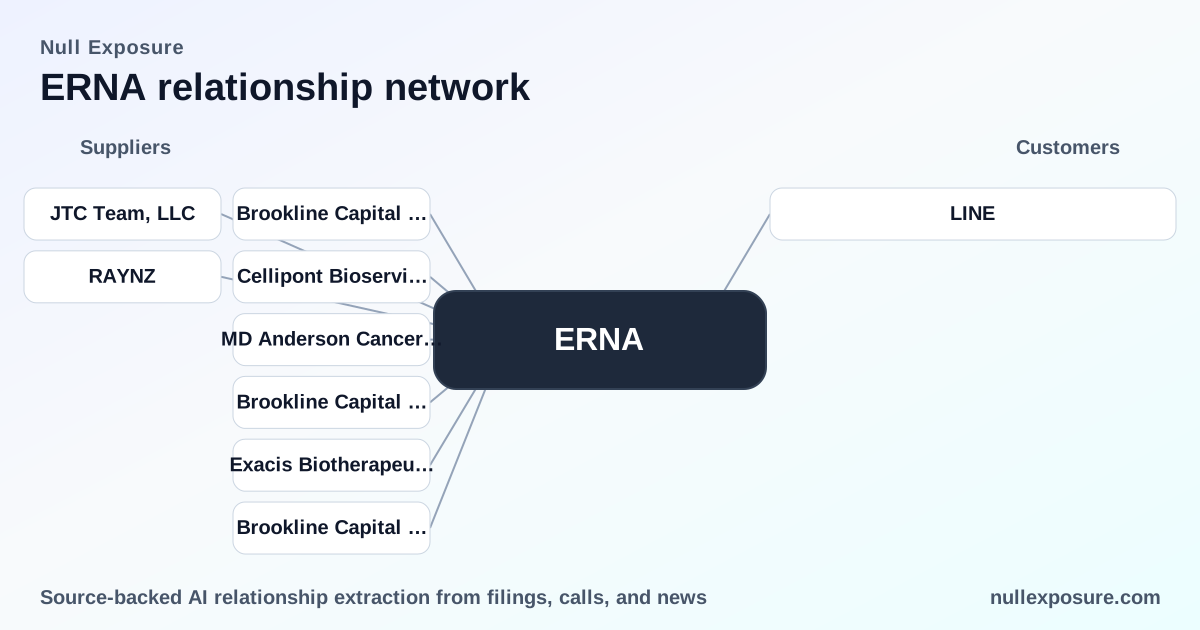
LINE (inferred symbol: LINE) — FY2024
ERNA disclosed that during FY2024 it performed customization of cell lines for Lineage and recognized revenue associated with those activities, with costs of revenue including direct labor and materials for the work. According to ERNA’s Form 10‑K for the year ended December 31, 2024, the cell line customization activities generated recorded revenue in both 2023 and 2024. (Source: ERNA 2024 Form 10‑K, erna-2024-12-31, FY2024.)
Lineage (Lineage Cell Therapeutics, Inc.) — FY2024
ERNA’s 2024 10‑K reports that Lineage entered an exclusive option and license agreement and paid ERNA a $0.3 million non‑refundable option fee and a $0.4 million initial payment to commence cell line customization, with additional project fees tied to the customization work; ERNA recognized revenue for these services during fiscal 2023 and 2024. (Source: ERNA 2024 Form 10‑K, erna-2024-12-31, FY2024.)
What the contractual excerpts reveal — constraints and implications
The public filing details give clear signals about ERNA’s customer economics and execution model:
- License + option structure: On February 21, 2023, ERNA and Lineage executed an exclusive option and license agreement that grants Lineage an option to obtain an exclusive sublicense of ERNA’s IP and to request development of customized cell lines; ERNA received a $0.3M non‑refundable option fee. This is a classic early‑stage biotech monetization strategy—convert intellectual property into immediate partner cash while retaining downstream upside if the option is exercised (Source: 2024 10‑K).
- Services revenue tied to customization: Lineage requested development of induced pluripotent stem cell lines and paid an initial $0.4M to commence the work, with ERNA recognizing revenue for cell line customization in both 2023 and 2024. This places ERNA in a fee-for-service role that supplements licensing cash flows (Source: 2024 10‑K).
- Spend-band and deal economics: The disclosed payments place the Lineage work in a $100k–$1M spend band, indicating that ERNA’s customer engagements to date are modest in size—large enough to matter to near-term liquidity but not large enough to materially change ERNA’s capital profile alone (Source: ERNA 2024 10‑K excerpts).
- Role clarity: The evidence describes Lineage as the paying counterparty and ERNA as the performing vendor for customization work—ERNA is both an IP licensor and a service provider in this relationship (Source: 2024 10‑K).
Investment takeaways and risk map
- Positive: ERNA converts IP into immediate cash via non‑refundable option fees and project payments; these arrangements reduce execution timing risk relative to pure milestone-only deals. The Lineage relationship demonstrates the company’s ability to monetize platform capabilities through services and licensing.
- Negative / Key risks: Customer concentration and revenue immaturity—current revenues are project-based and small in aggregate; a single partner like Lineage represents a material portion of recorded service revenue. Scale risk is acute: TTM revenue is negligible and ERNA remains loss-making, making new partner wins or capital raises critical. High insider ownership concentrates control and can limit liquidity.
- Operational implication: ERNA’s model requires a steady cadence of partner agreements (option/license + paid customization) to sustain operations; the current disclosure indicates the firm can extract mid‑six-figure payments but not yet deliver recurring revenue or commercial products.
Final read for investors
ERNA is operating a licensing-plus-services commercial engine that converts proprietary technology into discrete cash events. The Lineage agreement is the clearest example: $0.3M non‑refundable option fee plus $0.4M to commence cell line customization, with revenues recognized for the work in both 2023 and 2024 (Source: ERNA 2024 10‑K). Investors should weigh the tactical benefits of option fees and service payments against the broader strategic challenge of scaling recurring revenue, reducing customer concentration, and moving toward product‑level commercialization.
For a focused examination of ERNA’s partnerships and to monitor subsequent disclosures, visit https://nullexposure.com/.