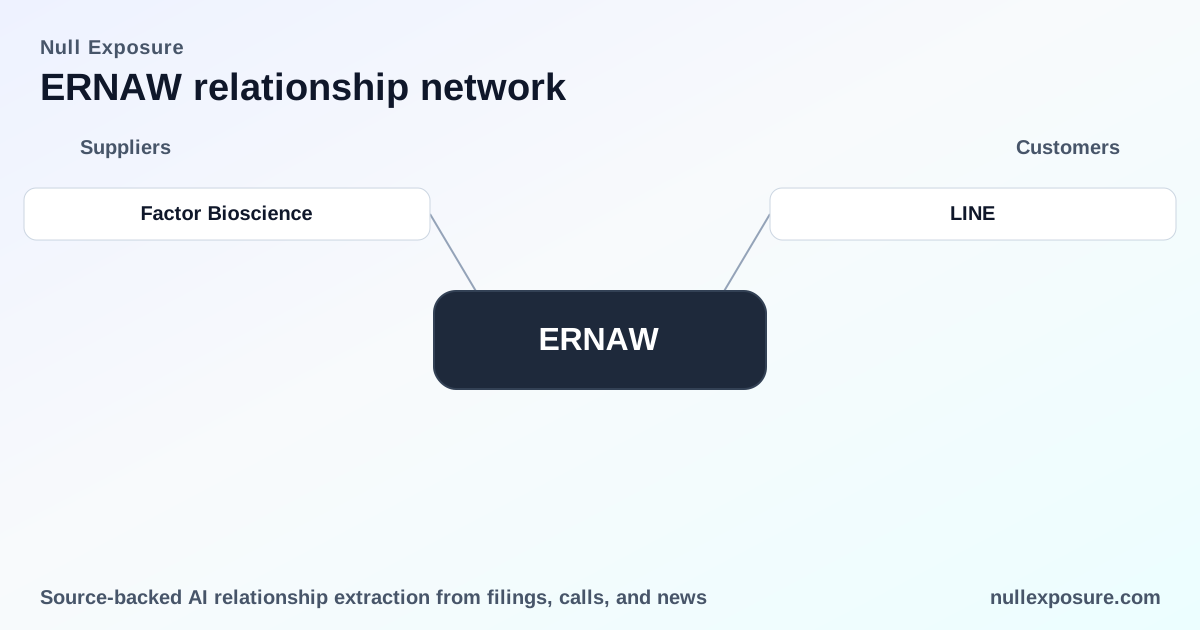
ERNAW customer relationships: what the Lineage engagement reveals about Ernexa’s commercial posture
Ernexa Therapeutics (ticker: ERNAW) is a preclinical-stage cell therapy developer that monetizes primarily through licensing and bespoke development services tied to its induced mesenchymal stem cell (iMSC) platform. Revenue to date is transactional and project-based—license option fees and cell-line customization work—rather than recurring product sales, and the company’s customer footprint visible in public filings is narrowly concentrated. For a concise dossier of relationship detail and strategic implications, visit https://nullexposure.com/.
The core commercial model in one line
Ernexa generates cash by granting options and licenses to its intellectual property and by performing customized R&D and cell-line development services for partners; the firm’s business model therefore combines up-front licensing receipts, milestone-style commercialization rights, and one-off development revenues tied directly to partner programs.
Each customer relationship disclosed in the filing
Below I summarize every customer relationship cited in the company’s FY2024 10‑K.
LINE — cell-line customization revenue recognized
Ernexa reported recognizing revenue in FY2023 and FY2024 for cell line customization services performed for Lineage. According to the FY2024 Form 10‑K, those project fees were recorded as revenue for the years ended December 31, 2023 and 2024. (Source: Ernexa Therapeutics Form 10‑K, FY2024.)
Lineage — exclusive option and license history (same commercial counterparty)
Ernexa also disclosed an exclusive option and license agreement with Lineage Cell Therapeutics, Inc., under which Ernexa granted Lineage an option to obtain an exclusive sublicense for preclinical, clinical and commercial purposes; the agreement included a non‑refundable up‑front payment of $0.3 million. This arrangement—and the related customization work—are documented in the company’s FY2024 10‑K. (Source: Ernexa Therapeutics Form 10‑K, FY2024.)
Contracting posture, lifecycle, and constraint signals
The public filing provides several clear indicators about how Ernexa negotiates and stages partner deals, and what that implies for investors.
-
Licensing-first posture. The Lineage Agreement was structured as an exclusive option and license, not a simple services purchase order—Ernexa acted as the licensor granting potential sublicensing rights in exchange for an option fee, which is consistent with a business that monetizes IP access as its primary commercial lever. (Source: FY2024 10‑K.)
-
One-off, early‑stage economics. The $0.3 million non‑refundable up‑front payment tied to the option underscores that the firm captures value up front rather than through recurring royalties at this stage; that structure is typical for preclinical IP transfers and indicates near-term cash generation is lumpy and event-driven. (Source: FY2024 10‑K, February 2023 Lineage Agreement excerpt.)
-
Assignment and termination dynamics. On September 24, 2024, Ernexa assigned the Lineage Agreement to Factor Bioscience, after which Ernexa’s contractual rights and obligations under that agreement became the responsibility of Factor Bioscience. This assignment effectively terminates Ernexa’s active role under that line of commercial engagement and converts a onetime licensor relationship into a completed transfer. (Source: FY2024 10‑K, Lineage Assignment Agreement, Note 11.)
-
Concentration and criticality risk at the company level. The only named customer/partner relationship disclosed in the FY2024 filing centers on Lineage (and its subsequent assignment to Factor Bioscience). Given Ernexa’s very small reported revenue base (RevenueTTM listed at $1,000 in the public summary) and its preclinical status, this single counterparty footprint signals high customer concentration and limited diversification of commercial channels. (Source: Company financial summary and FY2024 10‑K.)
What these relationships mean for valuation and risk
Investors should treat the Lineage relationship as illustrative of Ernexa’s broader commercial realities rather than evidence of a mature revenue stream.
-
Value capture is primarily non‑recurring. The evidence shows option fees and bespoke development work as the main monetization path; those are finite events that do not establish sustainable revenue until later-stage milestones or product commercialization occur. (Source: FY2024 10‑K.)
-
De‑risking through assignment. The September 2024 assignment to Factor Bioscience removes future performance obligations and potential upside tied to that agreement from Ernexa’s balance sheet, reducing future revenue volatility tied to Lineage but also removing a previously identified commercialization channel. (Source: FY2024 10‑K, Lineage Assignment Agreement.)
-
Operational leverage and IP dependencies. Ernexa functions as an IP licensor and development partner while also relying on third-party in‑licenses (the 10‑K notes the intellectual property for the Lineage sublicense was licensed by Ernexa from Factor Limited). That dual dependency—licensing in and licensing out—creates operational complexity and counterparty dependence that investors should factor into any scenario analysis. (Source: FY2024 10‑K.)
Financial posture and maturity implications
Ernexa remains a preclinical, development-focused company with limited commercial traction beyond one-off licensing and service fees. The FY2024 reporting shows negligible recurring revenue and negative operating metrics (EBITDA and returns), consistent with early-stage biotechs that are capital‑intensive and milestone-driven. The recent assignment of the Lineage Agreement indicates transactional monetization rather than long-term partner co-development at this point.
Key takeaways and recommended actions
- Focus on contract economics, not headline names. The Lineage agreement generated small, finite cash receipts via a licensing option and bespoke development work; that structure does not equate to a royalty-bearing commercialization partnership. (Source: FY2024 10‑K.)
- Watch for new license deals and milestone schedules. Given current concentration, any new exclusive license or recurring revenue arrangements would materially alter the company’s risk profile. Monitor subsequent filings for new counterparties or re-assigned rights.
- Stress-test downside around customer concentration and IP chain. The assignment to Factor Bioscience removes one potential path to commercialization from Ernexa’s direct control; investors should model scenarios without future payments from that agreement. (Source: FY2024 10‑K, assignment notice.)
- For deeper corporate relationship intelligence, see our coverage at https://nullexposure.com/.
Ernexa’s public disclosures present a company that monetizes through discrete IP transactions and development services, with high concentration and event-driven cash flow; that commercial posture should be the anchor assumption for any valuation or partnership due diligence. For actionable tracking of subsequent contract developments and partner activity, visit https://nullexposure.com/.