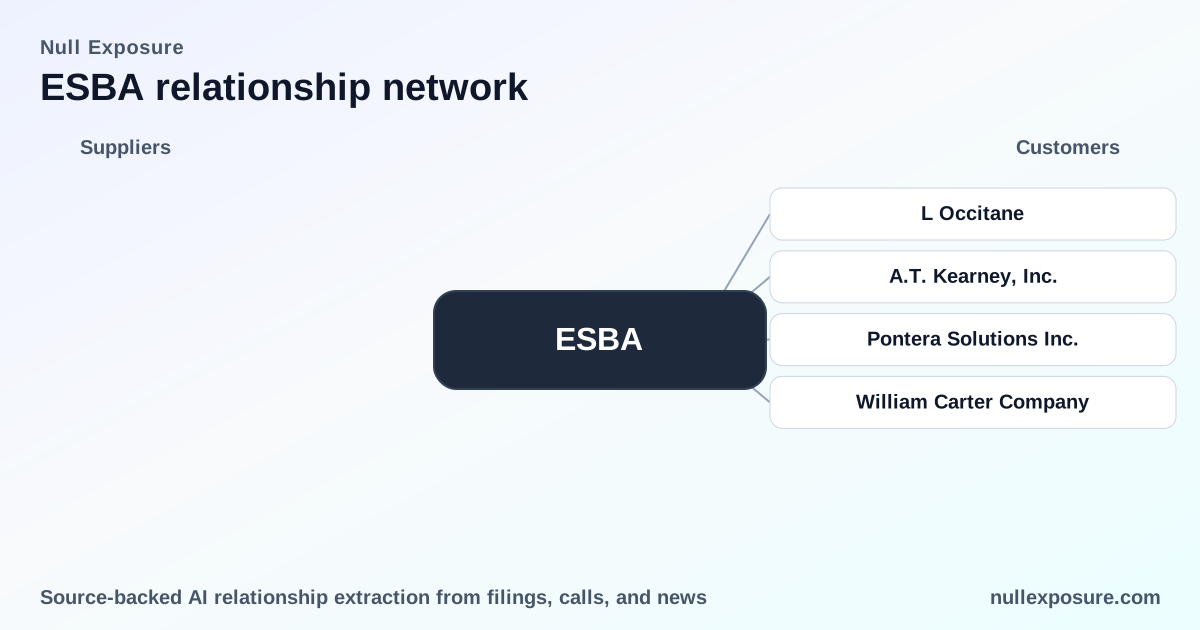
Empire State Realty OP (ESBA) — customer footprint and what it means for revenue durability
Empire State Realty OP operates as the operating partnership of Empire State Realty Trust, monetizing primarily through office and retail rents, supplemented by property management fees and the Empire State Building observatory business. The company’s cash flow profile is driven by long-term leases and ground lease interests across Manhattan and select adjacent markets, while ancillary services (management fees, observatory admissions) provide higher-margin, opportunistic revenue. For investors assessing customer relationships, the mix of long-term commercial tenants and short-term consumer traffic creates a hybrid revenue stream with a strong core of contracted rent and a service revenue layer that boosts volatility-adjusted yield. Learn more at https://nullexposure.com/.
How ESBA’s customer relationships actually behave (the operating model)
ESBA’s commercial model is anchored on long-dated leases and ground-lease interests, which produce predictable base rent and straight-line rental accounting. According to the company’s FY2024 filings, ESBA holds ground leases for 1350 Broadway, 1400 Broadway and 111 West 33rd Street with unilateral extension rights stretching into the mid-21st century, supporting long-tail cash flow visibility. The real estate portfolio is principally located in New York City, so the revenue stream is geographically concentrated and sensitive to Manhattan office fundamentals.
At the same time, ESBA runs businesses that operate on short-term, variable demand—most notably the Empire State Building observatory that sells tickets and runs by reservation. This creates a duality in contract posture: a stable base from long-term tenant leases and episodic, consumer-driven revenue in the observatory and retail footfall. The company also derives service revenue from third-party property and asset management agreements, which are modest relative to rental income but enhance margins and diversification at the margin.
Key operating signals:
- Contracting posture: predominately long-term leases and ground leases; select spot/transactional revenue from observatory admissions (FY2020–2024 disclosures).
- Concentration & geography: portfolio concentrated in Manhattan with supplemental assets in Brooklyn and Stamford, CT.
- Revenue roles: ESBA functions as both landlord (seller of space) and service provider (property/asset management).
- Maturity & scale: material, contracted rental base yielding hundreds of millions in annualized rent and high occupancy metrics reported as of FY2024.
Recorded customer relationships (what the filings and press covered)
Below are the relationships identified in company filings and press coverage; each entry is summarized in plain English with its source.
L’Occitane (Sol de Janeiro subsidiary) — tenant at 111 West 33rd Street
Sol de Janeiro, a subsidiary of L’Occitane, is identified as a tenant occupying space at 111 W. 33rd Street, indicating ESBA’s retail footprint includes branded consumer tenants at its 33rd Street property. This is disclosed in the company’s FY2024 Form 10‑K. (Source: FY2024 10‑K filing, ESBA.)
A.T. Kearney, Inc. — new long-term lease at the Empire State Building
ESBA signed an 11‑year, 27,866 sq. ft. lease with A.T. Kearney at the Empire State Building, representing a meaningful multi-year commitment from a national professional services firm and reinforcing the property’s ability to attract corporate tenants. (Source: CityBiz coverage of Empire State Realty Trust Q2 2024 results.)
Pontera Solutions Inc. — relocation and expansion into ESB tower
Pontera Solutions executed an 11‑year, 40,679 sq. ft. lease at the Empire State Building, relocating and expanding from about 10,539 sq. ft. at 111 West 33rd Street; this transaction reflects tenant upsizing and internal migration within ESBA’s portfolio. (Source: CityBiz coverage of Empire State Realty Trust Q2 2024 results.)
William Carter Company — lease at 1350 Broadway
William Carter Company signed an 11‑year, 24,592 sq. ft. lease at 1350 Broadway, a multi‑year retail/office commitment that contributes to ESBA’s leased-square-foot metrics at that asset. (Source: CityBiz coverage of Empire State Realty Trust Q2 2024 results.)
These four relationships are the complete set returned in the customer-scope search results for ESBA and are reflected in the company’s FY2024 disclosures and subsequent press reporting.
How the relationship set maps to revenue and risk
The relationships above illustrate the core revenue driver: rental income from multi-year leases with corporate tenants. ESBA reports that rental revenue is the dominant line—rental revenue was cited in filings as a primary source, and the company reported approximately $544.0 million of annualized rent as of December 31, 2024, with portfolio occupancy and lease metrics supportive (88.6% occupied; 93.5% leased). These figures confirm that tenant lease cash flows are the primary valuation lever.
At the same time, ESBA’s observatory and ticket-based operations create a variable revenue stream tied to visitor demand, which can enhance revenue in recovery cycles but increases short-term volatility versus pure office rents. Management and third‑party fees are small but consistent contributors—reported in the low‑to‑mid single millions annually—positioning services as a supplementary margin enhancer rather than a core profit center.
Constraints and operational signals that affect investor analysis:
- Long-term contract horizon: numerous ground leases and leases extend decades, improving cash flow visibility and underwriting. Ground lease expirations noted in filings include July 31, 2050; December 31, 2063; and June 10, 2077, reinforcing long-dated exposures.
- Mix of contract types: evidence of both long-term leases (one to 30 years commonly used across the portfolio) and spot consumer sales for the Observatory.
- Spend band: management and service fees from excluded properties are modest (reported in the hundreds of thousands to low millions per year), suggesting small counterparty invoices relative to rental receipts.
- Geographic concentration risk: operations are principally NYC-centric—this concentration is a structural risk to monitor.
Investment takeaways and watchlist
- Durable base, localized risk: ESBA’s cash flows are backed by long-term commercial leases and ground-lease interests, which provides a durable base for valuation, but exposure is concentrated in Manhattan, so macro and office-market trends in NYC drive downside risk.
- Quality of leasing activity: recent 11‑year leases with recognized tenants (A.T. Kearney, Pontera) and tenant expansions support occupancy and rental momentum; tenant upsizing inside the portfolio is a positive commercial signal.
- Variable revenue upside from the observatory: consumer-driven admissions revenue adds cyclically favorable upside; track visitor counts and per-visitor yield trends for near-term earnings surprise potential.
- Watch lease expirations and renewal cadence: the company’s reported lease pipeline and signed new/renewal square footage (over 1.3 million sq. ft. signed in the period referenced) are key indicators for rent roll stability and re-leasing risk.
For an integrated view of ESBA’s customer relationships and contractual profile, visit https://nullexposure.com/ to see how these tenant dynamics are mapped into cash-flow risk analytics.
In short, ESBA’s customers conspire to create a predictable rental revenue engine with measured, service-led upside; investors should balance the company’s long-term lease coverage and positive recent leasing activity against persistent geographic concentration and the secular dynamics of the Manhattan office market.