ESCO Technologies (ESE): Customer relationships that underwrite the business
Thesis — ESCO Technologies builds and sells engineered components, systems and diagnostic services primarily into aerospace & defense, industrial and power-grid customers. The company monetizes through point-of-sale product deliveries and recurring, over-time services (testing, software maintenance and consulting), supported by a sizable backlog; strategic portfolio moves such as the planned sale of VACCO reshape exposure to OEM and aftermarket end markets. For a quick company snapshot, see https://nullexposure.com/.
Why customers drive valuation here
ESCO is not a pure software or pure-service story; it is a capital-intensive, engineered-products manufacturer with a complementary services franchise. Revenue mixes across point-in-time product sales and revenue recognized over time create cash-conversion variability — long-term fixed-price contracts use performance- or progress-based payments, while short-term fixed-price and cost-type contracts are generally paid quickly. That contracting posture produces durable backlog but requires careful working-capital management.
Customer concentration is a stabilizing signal: no single customer exceeded 10% of consolidated sales in 2025, which reduces counterparty concentration risk, and domestic customers accounted for roughly 69% of firm orders as of September 30, 2025. At the same time, the company is a supplier to mission-critical aerospace and defense programs and to the U.S. government, which represented approximately 23% of revenue in 2025 — a meaningful source of stable funded work. The company also sells internationally (Asia net sales reported), reflecting a global footprint that tempers single-market cyclical exposure.
How the business model shows up in operations
ESCO operates across manufacturing, services and software disciplines. Its A&D businesses design and manufacture precision filtration, machined components and other mission-critical hardware; ETS-Lindgren supplies RF test facilities and shielding; other subsidiaries provide diagnostic instruments and software for the electric power industry. This portfolio mix translates into:
- Contracting mix: long-term fixed-price programs with progress payments for large systems versus short-term sales and cost-type contracts for diagnostic services and instruments.
- Customer roles: the company functions as a manufacturer and seller to OEMs and as a service provider for testing, software maintenance and lab work.
- Backlog-driven revenue: Total firm backlog was $1,133.6 million at September 30, 2025, with approximately 64% expected to ship in the fiscal year ending September 30, 2026, supporting near-term revenue visibility.
These characteristics mean ESCO’s commercial value derives from the predictability of backlog, the durability of government and OEM programs, and its ability to convert engineered design work into recurring aftermarket service revenue.
For more on how we track counterparties and contract signals, visit https://nullexposure.com/.
Counterparties you should monitor
The dataset of customer mentions in public filings and transcripts identifies a small set of high-relevance counterparties that influence order flow and strategic posture. Below I summarize each relationship pulled from recent filings and market reporting.
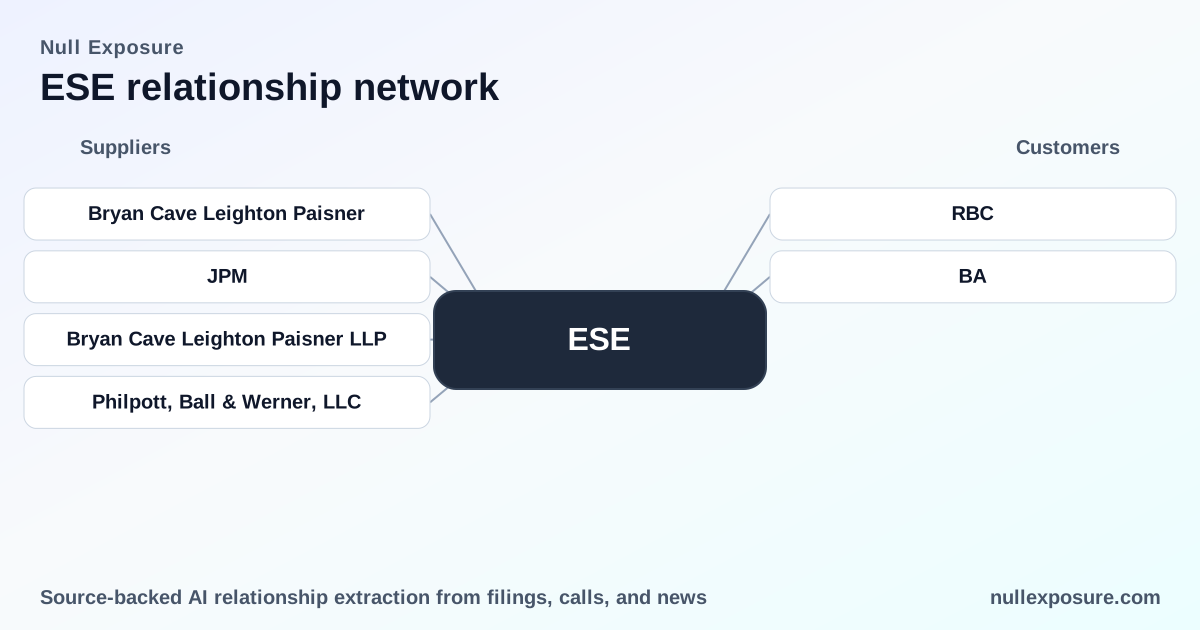
RBC / RBC Bearings Incorporated
ESCO announced a definitive agreement to divest VACCO Industries to RBC Bearings Incorporated for $310 million. The transaction reduces ESCO’s ownership of the VACCO business and transfers that customer-facing capability to RBC; the sale provides cash and alters ESCO’s future revenue mix. This was disclosed in a Quiver Quant news release on March 9, 2026.
Boeing (BA)
Management cited Boeing’s production ramp and the FAA approval to raise 737 build rates to 42 per month as a positive driver for ESCO’s order book, noting that OEM rate increases are already showing through bookings. Those comments were made on ESCO’s fiscal 2025 Q4 earnings call (March 7, 2026) and reflected again in the Q1 FY2026 call transcript (reported March 9, 2026 by InsiderMonkey), underscoring direct demand sensitivity to commercial aerospace production rates.
What the constraints tell investors (company-level signals)
The extracted constraints from filings provide actionable operational color rather than isolated statistics. Key takeaways:
- Contracting posture: ESCO runs a hybrid contract portfolio — long-term fixed-price programs paid via performance or progress payments coexist with short-term fixed-price and cost-reimbursable work that gets paid quickly. That mix supports backlog visibility but requires disciplined program execution and working-capital management.
- Counterparty mix and criticality: Government customers account for roughly a quarter of revenue, principally within A&D, creating stable funded demand and higher-contractual scrutiny; no single customer exceeds 10% of consolidated sales, lowering single-counterparty risk while still exposing the business to program timing.
- Geographic exposure: Roughly 69% of firm orders are domestic with APAC sales meaningful (Asia net sales reported), reflecting a North American-dominant footprint with international diversification.
- Segment maturity and revenue recognition: Manufacturing remains the core revenue engine, augmented by services and software that recognize approximately 19% of some segment revenues over time, supporting recurring revenue growth and higher lifetime customer value.
- Backlog and cadence: A $1.13 billion backlog with 64% expected to complete in the next fiscal year signals near-term revenue support and program maturity, reducing short-term downside but exposing the company to OEM production cycles.
Investment implications — balancing growth and cyclicality
ESCO combines the defensiveness of government-backed A&D work with cyclicality tied to commercial aerospace OEM rates and industrial spending. Strengths include diversified customer base (no single customer >10%), a sizeable backlog providing revenue visibility, and recurring services/software revenue that lifts margins and stickiness. Risks include exposure to OEM production cycles (Boeing rate swings influence orders), working-capital variability from long-term contract execution, and portfolio reshaping (the VACCO sale alters cash and revenue composition).
For operators and investors, the right focus is on execution: program margins on long-term contracts, conversion of backlog to cash, and the company’s ability to grow higher-margin services and software revenue within its installed base.
Bottom line
ESCO is a manufacturing-led, services-augmented industrial technology company whose customer relationships are diverse, government-anchored and backlog-backed, yet cyclical to OEM production rhythms. Monitor the Boeing production cadence and the post-closing integration and capital redeployment from the VACCO sale as primary drivers of order flow and valuation. For deeper counterparty mappings and ongoing updates, visit https://nullexposure.com/.