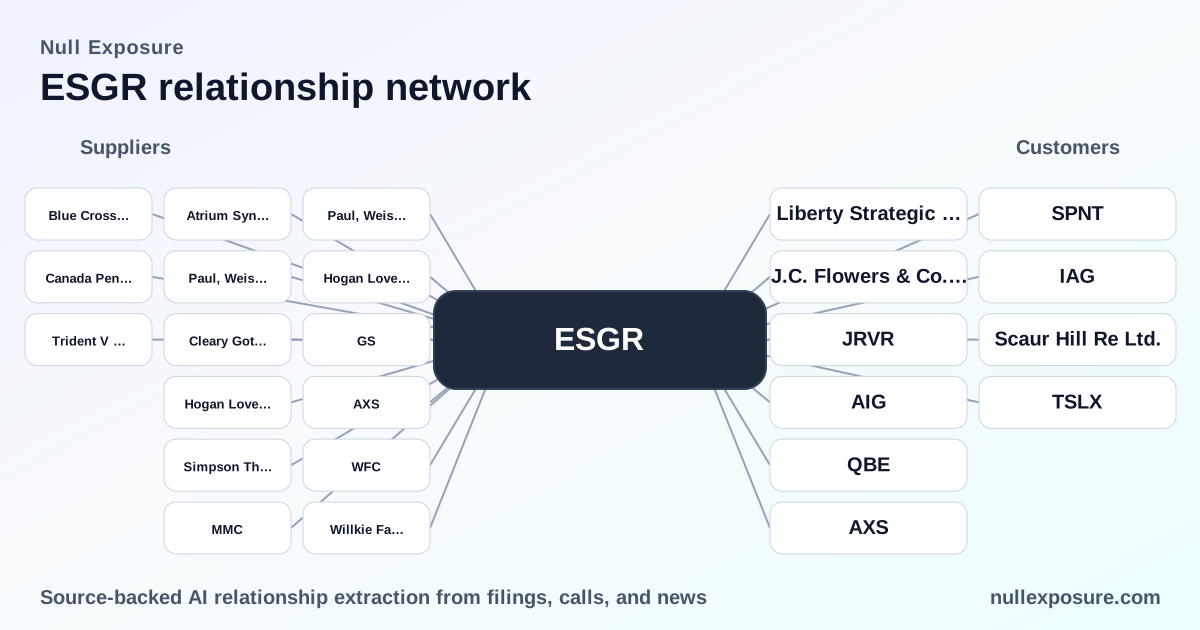
Enstar (ESGR): Legacy run‑off specialist monetizes reserve transfers and reinsurance protection
Enstar monetizes its expertise in legacy insurance and reinsurance runoff by purchasing, reinsuring, and providing adverse‑development cover on closed books, then extracting value through structured loss portfolio transfers (LPTs), ADCs, sidecars and fees for claims management. The business model generates recurring cash returns from capital deployed against large, prepared portfolios of prior‑year reserves and through bespoke protection to operating insurers, a dynamic that concentrates counterparty importance but spreads execution across many counterparties and deal structures. For a concise tracker of counterparties and material deals, see our platform: https://nullexposure.com/.
What investors should watch in a single line
Enstar is a capital and claims‑management engine: it buys and assumes prior‑year loss reserves, issues protection and sidecar capacity, and realizes profits as claims patterns run off or as assets outperform reserve pick‑ups.
How Enstar wins: strategy and commercial posture
Enstar pursues contracted, bilateral transactions with insurers and reinsurers — LPTs, ADCs and quota shares — that transfer both reserve risk and claims management. This is a business of scale and relationships: transactions are large, structured, and typically one‑off or episodic, not subscription revenue. Counterparty diversification across global insurers and reinsurance groups reduces concentration, but individual deals are financially material to both sides given the size of reserves transferred.
Visit for deal tracking and deeper counterparty analytics: https://nullexposure.com/.
Operating model and business‑model constraints (company‑level signals)
- Contracting posture: Enstar operates as a specialist counterpart to insurers seeking runoff solutions; contracts are bespoke and require regulatory and operational close‑outs (loss portfolio transfers, ADCs, retrocessions).
- Counterparty concentration: The deal book shows multiple large counterparties (global insurers, Bermuda and US groups), indicating diversification across counterparties but concentration on large, high‑value transactions.
- Criticality to clients: Enstar’s services are mission‑critical to counterparties that need finality on legacy liabilities or protection against adverse development.
- Maturity and execution: Transactions span multiple years (FY2022–FY2026 in the public record), reflecting a repeatable strategy with established market relationships and capacity to structure sidecars and investor‑facing vehicles.
Counterparty by counterparty: what the public record shows
AXIS / AXIS Capital (AXS)
Enstar completed a major loss portfolio transfer with AXIS that retroceded approximately $2.3bn of reinsurance segment reserves (75% quota share of $3.1bn reserves), a materially sized transaction that transfers prior‑year casualty risk to Enstar. Source: Reinsurance News and Bermuda Reinsurance Magazine reporting on the FY2025 LPT (December/Sept 2024 figures reported; publications March–May 2026).
QBE Insurance Group (QBE)
Enstar’s subsidiary closed a ground‑up LPT with QBE to assume net loss reserves of roughly $376m, effective July 1, 2024, focused on US commercial liability and workers’ compensation business. Source: Reinsurance News and Bernews reporting on the FY2024 QBE LPT (reported Nov 2024; coverage in March 2026).
Argo Group (ARGO)
A wholly‑owned Enstar subsidiary executed a loss portfolio transfer with Argo to reinsure US casualty portfolios (accident years 2011–2019), consistent with Enstar’s strategy of taking on discontinued program liabilities. Source: Intelligent Insurer and Bermuda Reinsurance Magazine coverage of the FY2022/FY2026 LPT announcements.
James River Group Holdings (JRVR)
Enstar provided an adverse development cover (ADC) and related E&S top‑up protections to James River, including a completed $75m ADC and an associated $12.5m equity investment and $75m E&S top‑up disclosed in proxy filings; James River also attributed reported losses to a $52.8m consideration paid in connection with an E&S adverse development reinsurance contract with Enstar’s Cavello Bay Re in FY2025. Source: Reinsurance News, Bermuda Reinsurance Magazine, StockTItan/Sec filings and Royal Gazette reporting across FY2024–FY2026.
SiriusPoint / SiriusPoint Ltd (SPNT)
Enstar’s subsidiary completed an LPT transaction with a SiriusPoint subsidiary and provided $200m in coverage beyond ceded reserves in a separate $400m LPT, highlighting Enstar’s role in both assuming reserves and providing excess coverage and claims management. Source: Insurance Business Mag and Royal Gazette coverage of FY2024/FY2025 transactions.
AIG / American International Group (AIG)
Enstar agreed to provide AIG with up to $400m of protection against adverse development relating to Validus Re carried loss reserves following Validus’s sale, illustrating Enstar’s role as a provider of targeted ADC protection for large corporate restructurings. Source: Bermuda Reinsurance Magazine and Royal Gazette reporting (FY2023 disclosures).
Artex
Enstar and Artex announced a strategic arrangement to provide exit solutions for Artex’s ILS vehicles, positioning Enstar in an aggregation/exit role for insurance‑linked‑securities exposures. Source: GlobeNewswire press releases and subsequent FY2025–FY2026 reporting.
Scaur Hill Re Ltd.
Enstar launched Scaur Hill Re, a Bermuda‑based collateralized insurer/sidecar to cede risk to investors via issued shares or notes, enabling Enstar to allocate risk across sponsored investor vehicles and scale casualty-side capacity. Source: Artemis.BM (FY2025 reporting).
StarStone Insurance Bermuda (SIBL)
Ratings commentary noted that SIBL’s balance sheet strength benefits from significant reinsurance protection including LPTs provided by Enstar group entities, underlining Enstar’s role in supporting balance sheet robustness for operating carriers. Source: Bermuda Reinsurance Magazine ratings affirmation (FY2024).
AHL‑P‑E (Aspen)
Moody’s commentary referenced an agreement with a subsidiary of Enstar for a ground‑up LPT assuming net loss reserves of $3.12bn (subject to a $3.57bn cap) for Aspen’s 2019 and prior business, showing Enstar’s capacity to underwrite very large legacy portfolios. Source: Royal Gazette Moody’s coverage (FY2022).
Maiden Holdings (MHLA)
Historical reporting documents a loss portfolio transfer and ADC framework between Maiden and Enstar under a previously announced master agreement, demonstrating the firm’s multi‑year master agreement approach with run‑off counterparties. Source: Royal Gazette reporting (FY2019).
IAG
Deal commentary around Enstar’s sale referenced the legacy reinsurer covering $1.7bn in reserves for IAG, indicating significant reserve transfer activity connected to the company’s strategic transactions. Source: Bermuda Reinsurance Magazine and related FY2024 press reporting.
J.C. Flowers & Liberty Strategic Capital / Sixth Street / TSLX / Sixth Street investors
The sale of Enstar to investment vehicles managed by Sixth Street (and participation by entities including J.C. Flowers and Liberty Strategic Capital) for $338 per share closed in mid‑2025, valuing the company at approximately $5.1bn — a transformational liquidity and ownership change that recasts Enstar’s capital base and sponsor alignment. Source: GlobeNewswire press release and Bernews coverage (July 2025 and Sep 2024 filings/announcements).
Key takeaways and risk signals
- Enstar operates as a large, active buyer and protector of legacy liabilities; counterparties include global insurers and specialty groups and transactions are financially material.
- Revenue and returns are transaction‑driven, so deal cadence and pricing on LPTs/ADCs are primary KPIs rather than premium growth.
- Counterparty concentration risk is mitigated by a broad set of counterparties, but individual transactions (AXIS $2.3bn, Aspen $3.1bn etc.) are large enough to move the economics of a reporting period.
- Post‑sale ownership (Sixth Street and other investors) changes capital dynamics and may accelerate use of sidecars and investor‑facing structures.
For a curated, continuously updated view of Enstar’s counterparties and structured transactions, visit our platform at https://nullexposure.com/ — we track public filings and press coverage to synthesize counterparty risk and deal economics for investors.