Elbit Systems (ESLT): Customer Map and What FY2026 Wins Mean for Investors
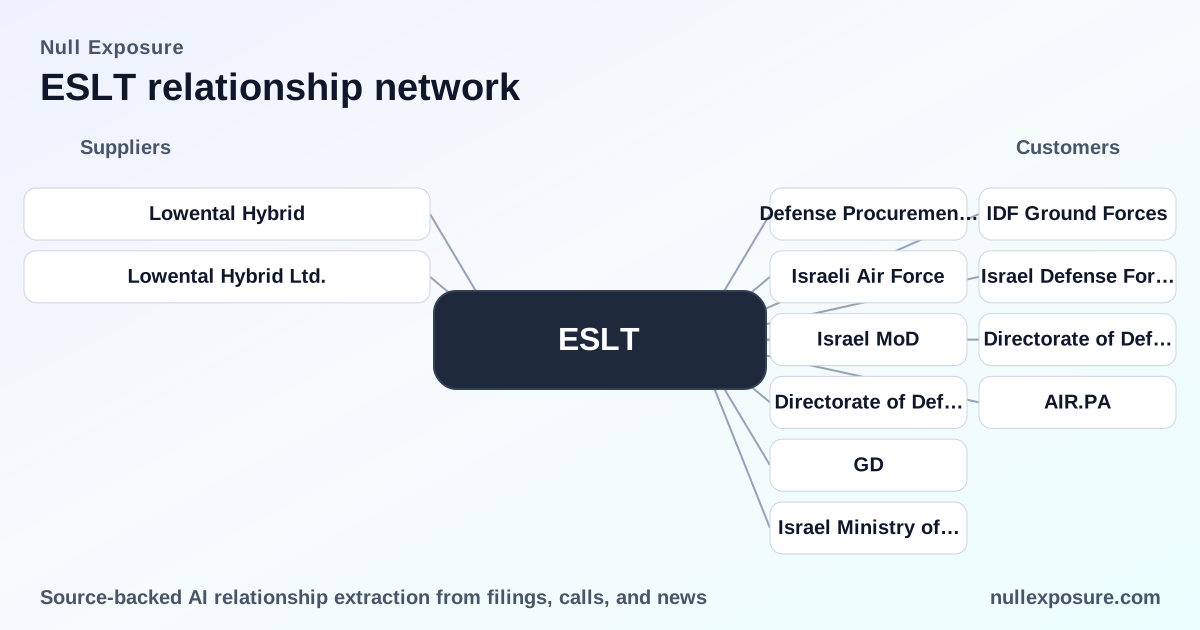
Elbit Systems monetizes advanced defense electronics and systems by winning multi-year government and prime-contractor contracts, supplying hardware (munitions, active protection, avionics) and recurring services (integration, sustainment, software upgrades). Revenue drivers are backlog-rich, contract-driven sales to national militaries and large primes, with a meaningful aftermarket and integration revenue stream. For a concise, portfolio-level view of these customer links, see Null Exposure’s database: https://nullexposure.com/.
The investment thesis in one line
Elbit is a strategically positioned defense supplier whose FY2026 contract flow reinforces a dual revenue model: direct sovereign sales to Israel’s Ministry of Defense and IDF plus strategic supply agreements with major western primes — a mix that supports high-margin systems sales, recurring support, and predictable multi-year cash flows.
What the FY2026 contracts signal to the market
FY2026 headlines show concentrated, mission-critical business: multiple awards from Israeli defense authorities for munitions, digitization, and force modernization, plus sizable prime-contractor deals (notably General Dynamics and Airbus) for active protection and DIRCM systems. This combination underscores Elbit’s role as both sovereign supplier and subcontractor to tier-one NATO/US programs — a structural revenue hedge that increases topline visibility while exposing the company to prime-contractor execution and sovereign procurement timing. More on customer exposures is available at Null Exposure: https://nullexposure.com/.
Relationship log — every mention in the FY2026 reporting
- Directorate of Defense Research & Development (DDR&D / MAFAT) within the Israel Ministry of Defense — Elbit was awarded several contracts aggregating over $100 million to develop advanced digitization capabilities for the IDF, reinforcing its role as a core partner on military digital modernization programs (EDR Magazine, March 2026).
- Israel Ministry of Defense — A PR Newswire release in May 2026 confirmed approximately $200 million in contracts for the supply of advanced airborne munitions to the Israel MoD, representing sizable sovereign demand for Elbit’s ordnance product lines (PR Newswire, May 2, 2026).
- Defense Procurement Directorate of Israel’s Ministry of Defense — DefenseMirror reported a multi-year order of more than NIS 570 million (~$184 million) for air-delivered weapons to support both near-term needs and long-term force build-up, indicating both stop-gap and sustainment demand (DefenseMirror, March 2026).
- Israel MoD (CH‑53K integration) — ASDNews reported a ~$130 million deal to integrate Israeli systems on CH-53K helicopters, highlighting Elbit’s systems-integration and avionics revenue stream tied to rotary-wing modernization (ASDNews, February 2026).
- GD (General Dynamics) — SimplyWall.St report — In January 2026 Elbit announced a US$228 million, three-year contract award to supply the Iron Fist Active Protection System for the Bradley Fighting Vehicle, marking a material subcontract with a large U.S. prime (SimplyWall.St, January 2026).
- General Dynamics Ordnance and Tactical Systems — The same SimplyWall.St item reiterates the US$228 million Iron Fist contract, showing Elbit’s role as a supplier to GD-OTS on a major U.S. Army vehicle modernization program (SimplyWall.St, January 2026).
- Israeli Air Force — ASDNews covered Elbit’s award to supply the HDTS Helmet Display and Tracking System for the Israeli Air Force’s UH‑60 Black Hawk (“Yanshuf”) fleet, underlining sales into platform upgrade programs and pilot-safety avionics (ASDNews, February 2026).
- Israel Ministry of Defense (SatelliteEvolution report) — SatelliteEvolution echoed the DDR&D awards totalling over $100 million for digital warfare and border-defense work, confirming cross-publication reporting of these sovereign digital projects (SatelliteEvolution, March 2026).
- ASLE (AerSale) — An AERSale/Avitrader item notes integration of Elbit/Universal Avionics’ SkyLens Head-Wearable Display with AerAware EFVS technology, illustrating civil/commercial aftermarket and OEM supply relationships from prior years (Avitrader, August 2023).
- GD (duplicate press mention) — SimplyWall.St also ran a related investor-facing piece reiterating the Iron Fist order, reflecting investor attention to the GD relationship and its revenue cadence (SimplyWall.St, January 2026).
- General Dynamics Ordnance and Tactical Systems (duplicate) — A second SimplyWall.St entry repeats the three-year Iron Fist award, reinforcing that this prime-contractor channel is a repeatable revenue route for Elbit (SimplyWall.St, January 2026).
- General Dynamics Ordnance and Tactical Systems (Army‑Technology) — Army‑Technology reported that Elbit’s APS will be supplied to GD‑OTS as part of the Bradley M2A4E1 upgrades for the U.S. Army, highlighting program-level integration into American armored-vehicle modernization (Army‑Technology, March 2026).
- Israel's Ministry of Defence (artillery shells) — MiddleEastEye’s May 2026 live blog reported a $48 million order for tens of thousands of 155mm artillery shells, demonstrating Elbit’s role in munitions volume supply for kinetic requirements (MiddleEastEye, May 2026).
- DDR&D / MAFAT (SatelliteEvolution duplicate) — SatelliteEvolution published a second item reiterating the DDR&D digitization awards, confirming sustained R&D and development partnerships with Israel’s defense research directorate (SatelliteEvolution, March 2026).
- IDF Ground Forces — SatelliteEvolution described joint development teams comprising Elbit, DDR&D and the IDF Ground Forces, indicating co-development and operational integration rather than simple one-off procurement (SatelliteEvolution, March 2026).
- Israel Defense Forces (IDF) — The same coverage noted that the projects are directly aimed at IDF digital warfare infrastructure, underlining the strategic, mission-critical nature of the work (SatelliteEvolution, March 2026).
- AIR.PA (Airbus) — company disclosure excerpt — Elbit disclosed a USD 260 million contract for a DIRCM (Directed Infrared Countermeasures) system to Airbus in its 2025 Q3 commentary, reflecting large-platform electronic-warfare sales to global OEMs (Elbit earnings call, 2025 Q3).
- ASLE (Globes report, FY2022) — Globes reported that Elbit’s Universal Avionics received a $33 million contract from AerSale to supply Enhanced Flight Vision Systems for Boeing 737NG aircraft, illustrating prior commercial aviation business and aftermarket integration (Globes, FY2022 reporting).
- KTOS (Kratos mention, earnings call) — Kratos’ 2025 Q4 remarks reference long-standing Israeli partnerships with firms such as Elbit, suggesting Elbit is an entrenched supplier in Israel’s defense industrial ecosystem (Kratos 2025 Q4 earnings call).
- Israeli Air Force (EDR Magazine duplicate) — EDR Magazine similarly covered the HDTS award for the UH‑60 fleet, reinforcing the IAF avionics program and Elbit’s supplier role (EDR Magazine, March 2026).
- Airbus (earnings-call duplicate) — The 2025 Q3 earnings-call excerpt mentioning the USD 260 million DIRCM award to Airbus is reflected again in company communications, confirming the Airbus program as material in recent disclosure (Elbit earnings call, 2025 Q3).
Operating model and business-model characteristics investors should note
- Contracting posture: Elbit sells through multi-year, programmatic contracts and direct sovereign procurements; many awards are structured as firm contracts with phased deliveries and system integration milestones. This produces visibility into medium-term cash flow but concentrates timing risk around procurement cycles.
- Customer concentration: The Israel MoD/IDF is a consistent, large counterparty supporting both munitions and digital modernization; simultaneously, tier‑one western primes (General Dynamics, Airbus) provide diversification into U.S. and international programs.
- Criticality and lock‑in: Several engagements (digital warfare infrastructure, DIRCM, APS for combat vehicles) are highly mission‑critical and technical, creating defensible competitive positions and aftermarket service streams.
- Maturity and execution risk: Elbit operates mature product lines (munitions, avionics, APS) alongside R&D-led digital programs. Execution depends on program management with primes and sovereign procurement schedules; supplier integration and certification timelines are meaningful operational levers.
- Balance of sovereign and prime revenue: The mix provides revenue resilience — sovereign demand underwrites baseline sales while prime contracts enable scale into larger defense ecosystems.
Bottom line for investors
FY2026 contract announcements reinforce Elbit’s dual role as a sovereign partner for Israel’s defense needs and a subcontractor to major international primes. That combination supports durable revenue visibility and higher-margin systems work, but investors must price in procurement timing and prime‑contract execution risk. For a focused view on counterparty exposures and contract cadence, visit Null Exposure’s customer intelligence center: https://nullexposure.com/.