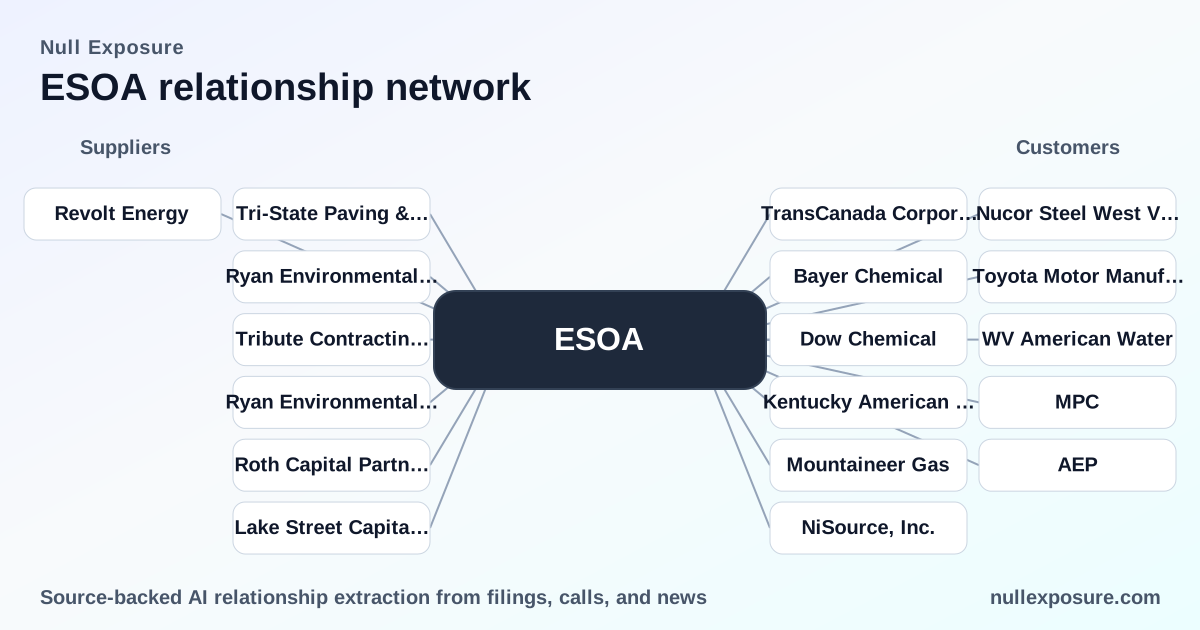
Energy Services of America: customer footprint, concentration, and contract economics
Energy Services of America (NASDAQ: ESOA) operates as a regional contractor and service provider to utilities, midstream energy firms, chemical plants, industrial manufacturers and municipal governments, monetizing through fee-based construction, rehabilitation and distribution contracts across gas, water, petroleum and power sectors. Revenue is generated from three operating buckets—underground infrastructure construction, gas & water distribution, and services—with an active backlog and near-term performance obligations that convert to cash over the next 12 months. For a concise view of the firm and its disclosures visit https://nullexposure.com/.
How Energy Services makes money and how that drives risk
Energy Services sells time, equipment and construction capability under fixed‑price and unit‑price contracts across the mid‑Atlantic and central U.S. The company reported consolidated revenues of roughly $411.0 million for FY2025, with 36.4% derived from gas & water distribution and $222.97 million allocated to underground infrastructure construction in the same period. The FY2025 10‑K discloses a backlog of $259.7 million and $205.1 million of remaining unsatisfied performance obligations, most of which the company expects to recognize within twelve months—a profile consistent with a working-capital‑intensive contracting business.
Key operating model characteristics:
- Contracting posture: Project-based contracting with a mix of fixed and unit-price arrangements; backlog and unsatisfied obligations point to predictable near-term revenue conversion.
- Concentration: The FY2025 disclosure identifies customer concentrations (notably TransCanada), which create revenue sensitivity to a small number of counterparties.
- Criticality: Many contracts are service-critical for utilities and industrial customers (gas, water, power), increasing contract stickiness but also legal and performance risk.
- Geographic maturity: Operations are concentrated in the mid‑Atlantic and central U.S., with the majority of customers in West Virginia, Virginia, Ohio, Pennsylvania and Kentucky, implying regional demand dependence. These structural points underlie both the upside of steady project flow and the downside of counterparty or regional shocks.
Customer roster disclosed in the FY2025 10‑K
Below are every customer relationship listed in the FY2025 10‑K customer section; each entry includes a concise plain‑English summary and source reference to the company filing.
-
TransCanada Corporation — Energy Services lists TransCanada among its leading customers, with TransCanada representing 10.4% of revenue for the twelve months ended September 30, 2025 and 13.9% of accounts receivable, net of retention, underscoring meaningful revenue and receivables concentration in FY2025. According to Energy Services’ FY2025 Form 10‑K, these percentages are explicitly disclosed for the period ended September 30, 2025.
-
Bayer Chemical — Bayer Chemical is listed as a customer in the FY2025 10‑K, indicating Energy Services provides construction or service work to chemical industry counterparties. The FY2025 Form 10‑K lists Bayer Chemical among the company’s leading customers.
-
Dow Chemical — Dow Chemical appears on the customer list in the FY2025 10‑K, positioning Energy Services as a contractor for large chemical manufacturers per the company’s disclosure for the fiscal year ended September 30, 2025.
-
Kentucky American Water — Kentucky American Water is named in the FY2025 10‑K customer list, reflecting municipal and regulated‑utility work in water distribution cited in the company’s fiscal 2025 filing.
-
WV American Water — WV American Water is included among disclosed customers in the FY2025 10‑K, consistent with Energy Services’ emphasis on water distribution contracts in its regional footprint.
-
Mountaineer Gas — Mountaineer Gas shows up in the FY2025 customer roster, indicating direct engagement with regional gas distribution companies as described in the FY2025 Form 10‑K.
-
NiSource, Inc. — NiSource is listed in the FY2025 10‑K customer enumeration, reflecting work for larger, multi‑state utilities within Energy Services’ service set.
-
Nucor Steel West Virginia — Nucor Steel West Virginia appears on the customer list in the FY2025 10‑K, confirming industrial and manufacturing sector exposure in the company’s project mix.
-
Toyota Motor Manufacturing — Toyota Motor Manufacturing is cited as a customer in the FY2025 10‑K, showing Energy Services’ participation in automotive sector infrastructure and utility services.
-
Marathon Petroleum — Marathon Petroleum is named among leading customers in the FY2025 10‑K, documenting Energy Services’ exposure to petroleum refining customers; the filing lists Marathon Petroleum in the customer disclosures for the period ended September 30, 2025.
-
MPC — The FY2025 10‑K contains a separate line that references MPC (the same entity as Marathon Petroleum), reflecting the filing’s multiple mentions and inferred symbol mapping in the disclosure set for FY2025.
-
American Electric Power — American Electric Power (AEP) is included in the FY2025 customer list, showing the company’s engagement with major power utilities; the FY2025 Form 10‑K lists AEP among the named customers.
(Each of the above customer entries is drawn directly from Energy Services of America Corporation’s FY2025 Form 10‑K customer disclosure for the fiscal year ended September 30, 2025.)
What the customer mix means for investors and operators
The customer roster confirms a diversified set of end markets—utility, chemical, automotive, steel and petroleum—yet concentrated revenue lines within distribution and infrastructure. The TransCanada line item constitutes a clear single‑counterparty concentration point in FY2025, and the duplication of Marathon Petroleum/MPC references highlights the presence of large corporate accounts whose procurement cycles and credit profiles matter for cash flow.
Operational implications:
- Working capital sensitivity: Project billing, retention and accounts receivable cycles drive cash; the FY2025 receivable concentration tied to TransCanada is material to near‑term liquidity profiles.
- Regional exposure: Heavy weighting to the mid‑Atlantic and central U.S. makes the company sensitive to regional construction cycles and state/regulatory funding for municipal projects.
- Government counterparties: The company lists state, county and municipal public service districts and school/state building projects among its work, indicating a mix that includes government contracts with different payment and procurement dynamics than private sector work.
If you are modeling ESOA, build scenarios around the $259.7 million backlog, the $205.1 million of near‑term unsatisfied performance obligations, and the 36.4% revenue share from gas & water distribution, because those items drive both revenue visibility and short‑term cash conversion (all cited from the FY2025 10‑K).
For a structured view of the company disclosures and relationship mapping, see https://nullexposure.com/ — the homepage consolidates filings and relationship signals for deeper diligence.
Quick takeaways for decision‑makers
- Revenue predictability is moderate: Significant backlog and near‑term performance obligations provide short‑term revenue visibility, but single‑counterparty concentration (TransCanada) and regional exposure increase idiosyncratic risk.
- Sector diversification cushions cyclicality: Exposure across utilities, chemicals, automotive and petroleum reduces complete dependency on any one industry cycle.
- Execution and cash management are key: Contract performance, retention collection and accounts receivable management will be the primary levers for operating stability given the project‑based business model.
This customer map and the FY2025 disclosures give a clear framework for evaluating ESOA’s operating risk and upside from contract execution; for more detailed document-level extraction and relationship charts, visit the firm’s dossier at https://nullexposure.com/.