Espey Mfg & Electronics (ESP): Customer Relationships Drive Valuation and Risk
Espey Mfg & Electronics monetizes through engineered hardware and adjacent services sold predominantly into defense and large-enterprise industrial channels; the company wins multi-year contracts, manufactures power and RF components, and captures recurring backlog that underpins near-term revenue visibility. Investors should value ESP as a specialized supplier to government and prime defense contractors where contract timing, backlog conversion, and customer concentration are the primary drivers of upside and downside. For a consolidated view of Espey customer signals, see more at https://nullexposure.com/.
How Espey actually operates and where the money comes from
Espey manufactures power supplies, converters, transformers, UPS systems and antennas while also offering design, build-to-print, testing, and fabrication services. Revenue is contract-driven: the company wins long-term awards and converts backlog into production revenue; at June 30, 2025 Espey reported a total backlog of approximately $139.7 million, including about $95.2 million tied to three significant customers, which evidences substantial near-term revenue visibility. Espey sells primarily to government customers and large industrial and defense primes, using a combination of direct sales and outside representatives, and generates more than 90% of revenue domestically, concentrating its counterparty exposure in North America.
What the public record shows about the customer roster
Below I cover every customer relationship captured in the available results and provide a concise plain-English take for each.
U.S. Navy
Espey won a government-funded expansion award worth $7.4 million that supported facility expansion and equipment purchases, demonstrating direct program-level engagement with naval customers and investments to scale capacity. According to a February 2023 Albany Business Journal report, Espey received this Navy funding to support expansion and equipment purchases (BizJ, Feb 2023: https://www.bizjournals.com/albany/news/2023/02/13/espey-navy-funding-expansion.html).
Defense Logistics Agency Aviation (DLA Aviation)
Espey was named as a participant in a multi-vendor indefinite-delivery/indefinite-quantity (IDIQ) vehicle for low- to high-voltage power supplies, positioning the company to win task orders under a large DLA Aviation procurement that aggregates hundreds of millions in program value. ClearanceJobs reported Espey’s inclusion on an IDIQ referenced in a 2020 notice tied to design and production of power supplies (ClearanceJobs, Sep 2020: https://news.clearancejobs.com/2020/09/15/l3harris-technologies-awarded-53-million-idiq-contract-for-b-1b-aircraft/).
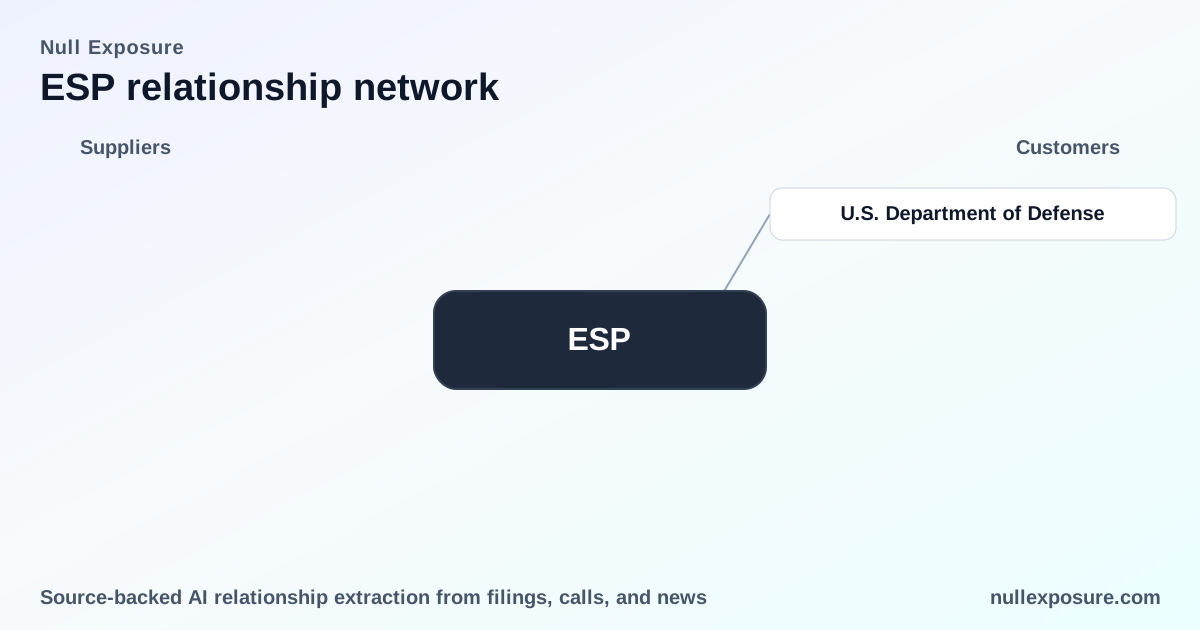
U.S. Department of Defense (DoD)
Espey has repeatedly invested in product development and capacity to serve DoD programs, signaling a strategic orientation toward defense system suppliers and direct U.S. government engagements. Local coverage in 2017 documented Espey’s product and capital investments to better serve Department of Defense contracts (Saratoga Business Journal, Jun 2017: https://www.saratoga.com/saratogabusinessjournal/2017/06/espey-manufacturing-electronics-making-upgrades-better-serve-military-contracts/).
Company-level operating and business-model signals investors must weigh
The relationship-level evidence above sits inside a distinct company-level operating posture that shapes both opportunity and risk:
- Long-term contracting posture. Espey reports that in FY2025 it received $86.4 million in new orders, including two multi-year awards aggregating $49.4 million; the business converts these multi-year wins into a substantial backlog. This underwrites near-term revenue but also ties growth to award cadence.
- Government and large-enterprise counterparties dominate. Public filings state that the majority of orders derive from prime defense contractors, the U.S. Department of Defense and other government agencies; that supplier/customer mix translates into high program criticality and dependence on defense spending cycles.
- Material customer concentration. In fiscal 2025 six customers accounted for 16%, 13%, 12%, 12%, 11% and 10% of sales respectively, a concentration profile that is material and creates single-customer risk versus diversified peers.
- Geographic concentration in North America. Domestic revenue represented more than 90% of total revenue in the last two fiscal years, focusing exposure to U.S. defense budgets and procurement policy.
- Active backlog and meaningful spend band. With a backlog of roughly $139.7 million, and $95.2 million from three customers, Espey sits in a $100M+ spend band of committed future work—important for revenue visibility and capital allocation plans.
- Hybrid product-services model. The company’s mix of hardware (power supplies, transformers, antennas) and services (design, testing, build-to-print) increases customer stickiness but also requires capital investment in production and testing capabilities.
- Direct seller posture. Espey markets through its direct sales organization and outside representatives, which supports tailored program wins but limits scale relative to suppliers that distribute through larger OEM channels.
Investment implications: upside, concentration risk, and what to watch
Espey’s valuation and operational outlook are driven by contract wins converting into backlog and by its ability to defend and expand program revenues with existing government and prime customers.
- Upside engine: the combination of long-term contracts and a large backlog provides solid revenue visibility, supporting free-cash-flow conversion if margins hold; Espey’s FY2025 gross and operating margins indicate attractive unit economics for a specialty manufacturer.
- Concentration risk is the principal downside. Losing a single top customer or a program cancellation would have a measurable impact: sales to six customers already represent the bulk of revenue, and the firm itself flags this as a significant risk.
- Budget and procurement sensitivity. Domestic revenue concentration ties Espey’s trajectory to U.S. defense spending and procurement timing; program award schedules will materially alter quarterly and annual results.
- Operational commitment required. Market wins have required facility and equipment investment (illustrated by Navy-supported expansion funding), and the company must continue to invest to retain technical qualification and capacity for defense programs.
How investors should monitor performance and catalysts
- Track quarterly changes to the backlog and any movement in the $95.2M tri-customer bucket; shrinking backlog signals execution or award risks, while expansion confirms momentum.
- Monitor DoD and DLA task-order announcements for incremental wins under the IDIQ vehicle cited in public notices.
- Watch margin trends as production scales: hardware/service mix shifts and capacity investments will show up in operating margin movements and cash flow.
- Review periodic disclosures for customer concentration changes and any material single-customer dependencies.
For a concise, actionable view that consolidates customer-level signals with company filings and news coverage, visit https://nullexposure.com/ to subscribe to ongoing relationship intelligence.
Bold takeaways: Espey’s business is contract-backed with a large backlog and clear upside from conversion, but its concentrated customer base and U.S.-centric revenue expose the company to outsized program and budget cadence risk. Investors should price in both the revenue visibility from a $139.7M backlog and the execution risk that comes from dependence on a small set of large customers.