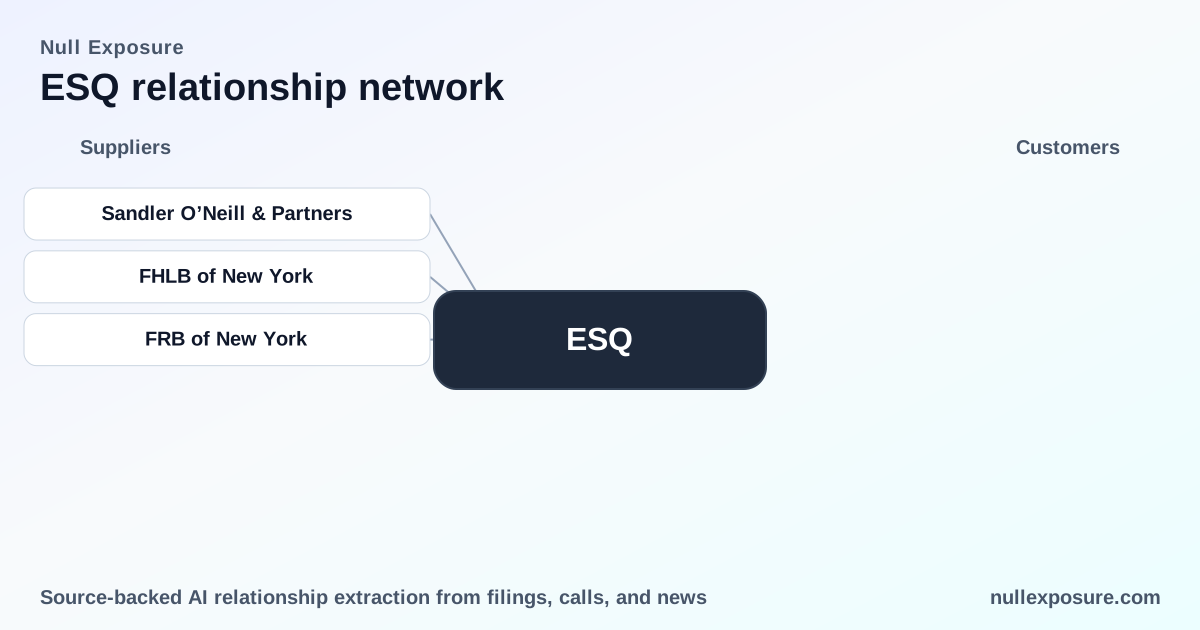
Esquire Financial (ESQ): Customer Relationships, Concentration, and Commercial Durability
Esquire Financial operates as a specialized bank and payments platform that monetizes through deposit spreads, payment-processing fees, ACH/merchant services, and short-term commercial lending to legal firms and small-to-mid-sized businesses. The firm pairs a high-margin banking franchise focused on the litigation community with an acquiring business that services 88,000 merchant customers and processed $36.3 billion of card volume in 2024, creating a mixed revenue base of recurring deposit yields and variable, usage-based payments income. Explore our coverage at https://nullexposure.com/ for deeper relationship analytics.
What Esquire sells and who writes the checks
Esquire Bank is a full-service commercial bank dedicated to the legal industry and small businesses nationwide, and its holding company captures value across several commercial touchpoints. Core revenue drivers are:
- Deposit-led net interest income backed by a highly concentrated litigation deposit base (escrow and claimant trust accounts).
- Payment processing and merchant acquiring fees, recognized on transaction volume and driven by ACH and card volumes.
- Short-term commercial loans and consumer/post-settlement advances targeted at law firms, plaintiffs, and small businesses.
Company financials show $142.4 million in revenue (TTM) with healthy profitability (profit margin ~36%), a strong return on equity (~18.7%), and a market capitalization near $912 million (latest quarter March 31, 2026). These fundamentals reflect a compact, high-margin franchise with both stable and variable revenue streams derived from its customer base.
Publicly reported customer relationships (complete list)
Esquire’s public relationship mentions in the supplied results database are sparse but specific. Below is every relationship returned in the search results.
- Liberty Global (LBTYA): A March 2026 news item referenced Liberty Global’s “Top Choice” video tier, which listed Esquire among channels included in the package; this is a media carriage mention rather than a banking or payments commercial customer relationship. The reference is in a NewsIsMyBusiness article dated March 10, 2026. (NewsIsMyBusiness, Mar 10, 2026)
How the company-level constraints shape operating realities
The extracted constraints from Esquire’s disclosures create a coherent operating profile. Treat these as company-level signals that explain how Esquire wins and retains customers and where operational risks concentrate.
Contracting posture: a hybrid of long-term stability and usage volatility
Esquire combines long-duration deposit relationships with usage-based payment fees. According to company disclosures as of December 31, 2024, the litigation community represented approximately 75% of the deposit base, with $979.0 million (60% of total deposits) held in longer-duration escrow or claimant trust accounts where law firms act as trustees. That deposit stickiness supplies low-cost funding and stability. Conversely, the ACH and merchant processing lines are usage-based revenue streams: ACH fees are variable and recognized based on monthly transaction volumes. This mix produces both steady interest income and cyclical fee revenue tied to merchant activity.
Customer concentration and criticality
Concentration is a defining characteristic. The litigation community’s dominance of deposits constitutes a single-point exposure: escrow and claimant trust balances are simultaneously a funding asset and a business concentration risk. The company explicitly flags that litigation-related deposits are material and critical to funding operations. That concentration elevates sensitivity to legal-market cycles, settlement timing, and any regulatory change to trust-escrow handling.
Counterparty mix and credit posture
Esquire serves a diverse counterparty base by type: small businesses (88,000 merchants), individuals (consumer and post-settlement loans), and small-to-mid-market commercial borrowers (term loans to law firms and local businesses). The firm underwrites short-term unsecured term loans to law firms for working capital, while merchant acquiring supports both ISO partners and end merchants. This layered counterparty profile supports revenue diversification but concentrates credit exposure in the legal and merchant sectors.
Service role and relationship lifecycle
Esquire operates primarily as a service provider—an acquirer and clearing bank for merchant transactions and a trustee/financial depository for the litigation community. The platform is active and scaled: the merchant platform generated 17% of 2024 revenue, demonstrating that payment services are a material, operating business rather than a peripheral offering. The company maintains active relationships with 27 ISOs and processes hundreds of millions of transactions annually.
Where operational constraints translate into investor-level risk and optionality
- Concentration risk is the clearest single risk: with three-quarters of deposits tied to litigation-related trusts, settlement cadence and law-firm behavior materially affect funding stability and net interest income. Investors should track escrow balances and law-firm deposit trends closely.
- Revenue cyclicality is embedded: usage-based ACH and card fees scale with merchant activity; merchant growth and retention are direct drivers of fee revenue growth. The merchant platform’s scale (88k merchants, $36.3B volume) provides runway for fee expansion, but fees will follow economic activity and card volume trends.
- Funding resilience is strong but specialized: long-duration escrow balances create a low-cost funding pool, but their specialized nature increases operational and regulatory governance requirements.
- Credit exposure is concentrated in short-term commercial lending to law firms and post-settlement borrowers; performance will track litigation cycles and local small-business conditions.
If you want a granular read on how those relationship dynamics alter credit and fee profiles, see extended coverage at https://nullexposure.com/.
Tactical investor checklist: what to watch next quarter
- Escrow and claimant trust balances (absolute level and share of total deposits).
- Monthly ACH and card volumes, merchant count, and revenue contribution from payments (growth or attrition among the 88k merchants).
- Composition and seasoning of term loans to law firms (delinquencies and roll rates).
- Any regulatory notices affecting trustee deposits or payment clearing rules.
- Changes in card-network fees and the company’s pass-through policy (affects merchant margins and pricing flexibility).
The bottom line
Esquire is a niche financial and payments operator that combines deposit-driven banking stability with a substantial, usage-dependent merchant-acquiring business. That hybrid creates attractive margins and growth optionality but concentrates funding and credit risk in the litigation ecosystem. For investors and operators, monitoring escrow concentration, merchant volume trends, and law-firm lending performance will provide the most direct forward signals on profitability and risk.